- Saturday, 2 May 2026

Infrastructure tops poll agenda in Karnali
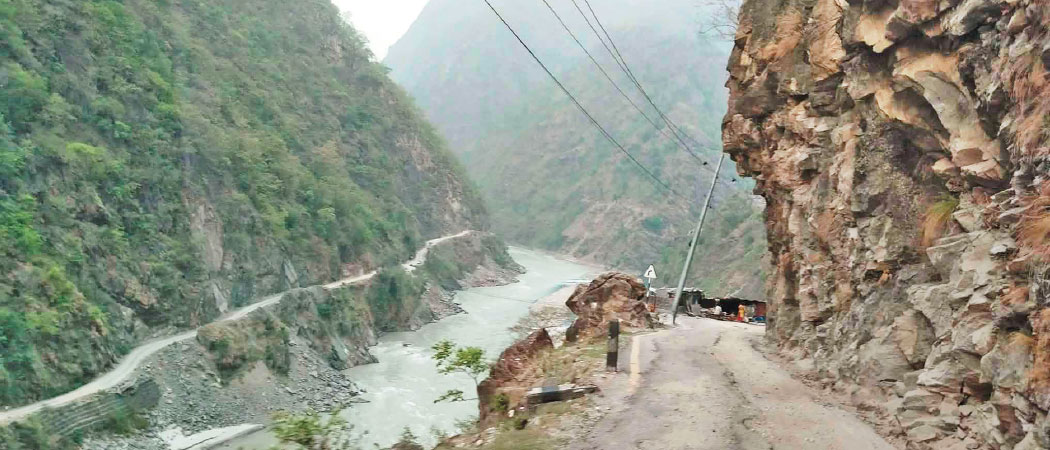
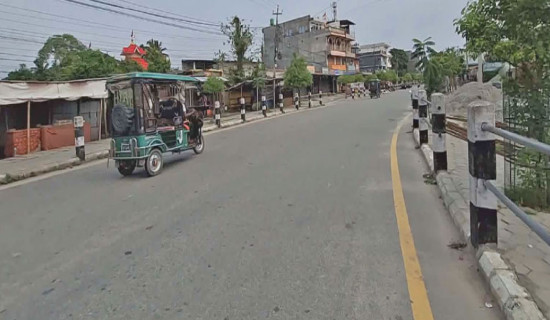
Photo: Lalit BASEL Worsening condition of Karnali road.

BY LALIT BASEL,Surkhet, Feb. 27: In the election manifestos released by political parties for the upcoming House of Representatives election scheduled for March 5, road infrastructure development in Karnali has been identified as the top priority.
Major parties, including the Nepali Congress, CPN-UML, Nepali Communist Party, Rastriya Swatantra Party, Rastriya Prajatantra Party, and Ujyalo Nepal Party, have emphasised the need to improve Karnali’s road network.
In addition to road infrastructure, the manifestos also address the preservation of Khas civilisation, the development of hydropower through the utilisation of water resources, the production and processing of herbs and fruits, and the promotion of tourism in Karnali.
The Nepali Congress, in its commitment document, has pledged to prioritise the construction of the Jamunaha-Kohalpur-Surkhet-Hilsa fast track connecting India and China. It has also promised to improve access to several key roads, including the Rajapur-Bardiya-Surkhet-Ranighat-Dailekh route, Mahabu-Kalikot, Gamgadhi-Nakchelagna, and the Chhinchu-Jajarkot-Dolpa-Morimla border route. The party has proposed building a Surkhet-Kohalpur tunnel road to reduce travel time and facilitate economic activity and service delivery.
Other plans include developing an inter-provincial tourism circuit road linking Lumbini to Dang, Salyan, Jajarkot, Jumla, Mugu, and Rara, and connecting Rukum and Salyan to Kohalpur through an inter-provincial road network.
Under the Lumbini-Karnali-Sudurpashchim inter-provincial pride project, the Nepali Congress has said it would contribute to economic integration among the three provinces by constructing and upgrading the Dang-Salyan-Surkhet-Dipayal road.
The party has also pledged to establish an international study centre in Karnali, develop small and large hydropower projects utilising local water resources, and implement a special cultural plan to preserve Khas civilisation.
Similarly, the CPN-UML manifesto proposes developing the Karnali Corridor as the backbone of economic prosperity and building a Corridor City. It also aims to complete the Bheri-Babai Diversion Project to provide irrigation and electricity, and to finish the highways along the Karnali Corridor within five years.
The Nepali Communist Party has committed to launching a Himal Prosperity Programme to promote sheep, mountain goat, and yak farming, as well as the cultivation of apples, walnuts, and medicinal herbs in the Himalayan region.
It also plans to establish a Dairy Development Board in all seven provinces to facilitate milk sales and provide subsidies within one month.
Additional commitments include setting up agro-industrial parks for production, processing, research, and skills development, completing the Bheri-Babai project on time, implementing an Integrated Karnali Irrigation Special Programme, developing Karnali as a hub for herbs, fruit, and eco-tourism, expanding the Karnali Highway into a four-lane road, and preserving and promoting Sinja civilisation.
The Rastriya Swatantra Party’s manifesto highlights the promotion of overlooked tourist destinations in Karnali, branding and promoting the region’s underrecognized heritage sites, linking cities, including Surkhet, to Chinese and Indian railway networks, and completing national pride projects such as the Bheri-Babai within two years.
The Rastriya Prajatantra Party has pledged to provide special subsidies and tax exemptions for herbal and fruit processing industries in Karnali’s Himalayan areas. It also proposes forming an autonomous development authority for Karnali’s overall development, expanding services similar to Kathmandu’s Budhanilkantha School and Bir Hospital to all seven provinces, and developing large and medium-sized multipurpose reservoir-based hydropower projects.
Likewise, the Ujyalo Nepal Party has promised to complete the Bheri-Babai project within five years to provide electricity and irrigation services, build one smart city in each province, upgrade and expand the Karnali Corridor, and conduct feasibility studies for water transport in the Karnali River basin, launching public transportation services where viable.
Party leaders claim that the commitments made in their election manifestos will be easier to implement if they win the election. Devkumar Subedi, Secretary of Nepali Congress Surkhet, stated that the party would fulfil its manifesto commitments if it forms the government. He stated that Karnali still required significant road infrastructure development, which is why the party had prioritised projects such as the Karnali Corridor and the Bardiya-Surkhet road connecting provinces.
Krishna Bahadur GC, a leader of the Nepali Communist Party, said that the manifestos still fail to fully address Karnali’s integration into national development. He emphasised the need for greater focus on projects such as the Karnali Corridor, Bheri Corridor, and airport construction.
Hari Prasad Adhikari, Joint General Secretary and spokesperson of the Rastriya Swatantra Party Karnali Province, said that the party chose to unveil its manifesto from Karnali Province to demonstrate its priority for the region. He claimed that the party’s plans focus not only on provincial and district development but also on national progress.
Pitambar Dhakal, a leader and former dean of Mid-West University, described the manifestos as ambitious. He said that past promises had often gone unfulfilled, suggesting that current pledges might be aimed primarily at attracting votes. However, he recommended that if parties genuinely focus on improving Karnali’s road infrastructure, education, and health sectors, it would significantly enhance both provincial and national development indicators.
-square-thumb.jpg)