- Saturday, 2 May 2026

Illegal opium cultivation destroyed in Jajarkot
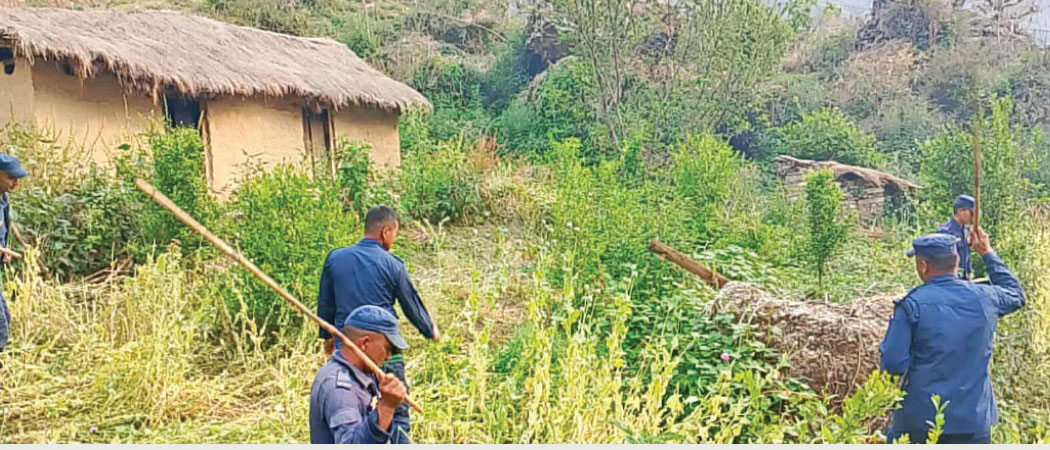

By Our Correspondent, Jajarkot, May 2: Police in Jajarkot have destroyed illegal opium cultivation spread across approximately 1,640 ropani of land.
A police team deployed from the District Police Office and its subordinate units carried out the operation between April 4 and mid-April, destroying opium crops grown unlawfully across large areas.
The illegal cultivation was destroyed in six local levels, excluding Shivalaya Rural Municipality. The operation covered areas in Bheri Municipality, Chedagad Municipality, Nalgad Municipality, Barekot Rural Municipality, Kushe Rural Municipality and Junichande Rural Municipality. Police uprooted and destroyed opium plants grown across various settlements in these areas as part of an ongoing campaign.
According to Deputy Superintendent of Police Basant Kumar Sharma, opium cultivation, which was previously concentrated in Nalgad Municipality, has now spread to six local levels this year. He said the crops were found in several wards and settlements, including Maide, Maidechaur, Ghuilneta and Syal in Bheri Municipality, and Bharkattiya, Gairikhark and Thapla in Nalgad Municipality.
Police teams from the District Police Office, Area Police Office Dalli, Area Police Office Rimna, Area Police Office Badawan, Police Post Paik and Area Police Office Barekot were mobilised for the eradication drive.
DSP Sharma said police have been raising awareness among the public about the legal consequences and disadvantages of producing and trafficking narcotics. With locals increasingly encouraging opium cultivation, authorities have intensified efforts to identify production areas and destroy the crops.
Public awareness programmes related to drug abuse are also being conducted in villages across the district, police said.
Last year, opium was cultivated in ward Nos. 2, 5, 6, 8, 9, 10, 11 and 13 of Nalgad Municipality. Although cultivation has declined in Ward 13 following awareness campaigns, it has increased in other wards and expanded into new areas where it was not previously grown, raising concern among authorities.
DSP Sharma noted that, as opium cultivation has turned into a livelihood in six out of seven local levels, local governments must strengthen awareness efforts to eliminate the practice, as it involves substances banned by the government.
He added that eradication was carried out during the flowering season of the crop. Although individuals involved in drug trafficking are being arrested and prosecuted, cultivation has not ceased. Opium is often grown in remote highland areas beyond the reach of authorities, requiring police to walk for more than four hours to reach and destroy the crops.