- Sunday, 24 May 2026

Importance Of Mindful Communication
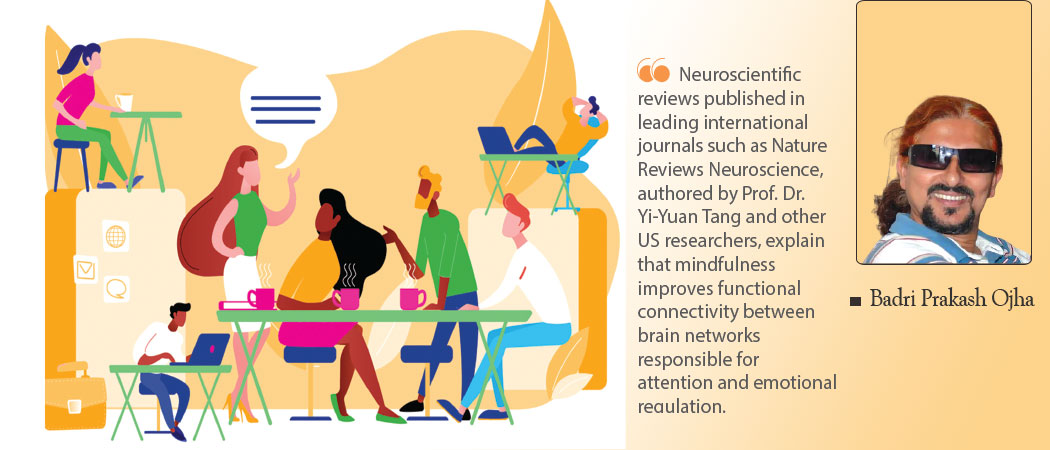

The digital era has fundamentally transformed the nature, scale and speed of human communication. The emergence of internet-based platforms and mobile communication technology has enabled real-time interaction amongst the people around the globe. They have reshaped various modes of communication such as interpersonal, organisational and mass communication.
Platforms including Facebook, YouTube, Instagram, TikTok, and X have become the central spaces for information exchange, opinion building and social interaction. As per the data published by the US fact tank, the Pew Center, in 2025, about 54 per cent of the global population reports that they receive news from social media platforms. Of them, 68 to 70 per cent of users are engaged on Facebook, making it the largest human interaction network. Similarly, data released by another US think tank, DataReportal, in 2026 shows more than 5.4 billion, almost 66 per cent of the global population, use social media for information acquisition. Users spend an average of 143 minutes per day on social media interacting, sharing and consuming information. Short videos are basically dominated by TikTok accounts, 58 per cent of the social media use time span.
This rapid digitisation has introduced serious challenges like information overload, reduced attention span, online hostility and the spread of misinformation.
Cognitive scenario
In the digital environment, individuals frequently switch among multiple social media platforms within a very short time span. This behaviour creates a cognitive condition known as 'media multistaking', where attention is continuously divided across competing information streams. Research reveals that such constant switching increases cognitive load on working memory, reducing the ability of the brain to sustain focus on a single task at a time and weakening information processing efficiency.
An experimental study conducted by a group of researchers at Hebei Normal University in China in 2024 reveals that media multitasking can alter anticipatory brain activity and the attention preparation system. It shows that individuals who engaged in high levels of media multitasking perform worse on attention regulation tasks and working memory assessments compared to low multitaskers, suggesting a weakened top-down cognitive control mechanism.
A landmark neuroscience study from Stanford University, USA, in 2024 found that individuals who frequently engage in media multitasking face increased attention lapses, weaker working memory performance and reduced ability to filter irrelevant information.
On audio-based social platforms like Clubhouse, anonymity creates a distinctive communication scenario where users often participate under minimal identity disclosure or partial profile information. In such a setting, a user may enter a public discussion room about politics or mental health without revealing their real name, location, or professional background. Reduced visibility can lower social pressure and encourage more open sharing of opinions and personal experiences.
The Sage studies of 2022 reveal that anonymity can also alter behaviour patterns. Some users may feel less accountable for their speech, leading to more extreme opinions, interruptions or emotionally charged statements that they might avoid in face-to-face communication. In contrast, others may remain silent or less engaged due to uncertainty about the credibility of unknown speakers.
The digital communication environments differ significantly from traditional face-to-face contexts. The absence of non-verbal cues, anonymity of users and algorithm-driven content distribution often encourage impulsive responses rather than reflective dialogues.
In such a context, the constant connectivity facilitated by digital tools contributes to cognitive and emotional fatigue, highlighting the need for more conscious communication practices.
Mindfulness
Within this context, the concept of mindfulness, rooted in Buddhism and developed by modern psychology through scholars such as Prof. Dr. Jon Katat-Zinn has gained increasing relevance.
Mindfulness is commonly understood as present-moment awareness characterized by non-judgemental attention, commonly known as 'Sakshi Bhava' in oriental meditation pedagogy. While applied to communication, it emphasises conscious engagement, emotional regulation and internal expression. The integration of mindfulness into communication studies provides a framework for addressing the reactive and often fragmented nature of digital interaction.
Mindfulness communication emerges as a response to the challenges by promoting awareness in both message production and perception. It aligns with key communication principles such as active listening and emotional intelligence, which stress empathy, attentiveness and self-regulation.
These competencies become even more critical, as individuals are expected to interpret and convey meaning primarily through text, images, videos and short forms of media.
Furthermore, the increasing role of digital platforms in shaping public discourses in political and social scenarios has intensified the demand for ethical and responsible communication practices.
Mindfulness offers a normative framework that encourages individuals and institutions to think thoughtfully, verify information and consider the broader social impact of their communication.
Neuroscientific research provides strong evidence that mindfulness practices produce measurable changes in the human brain that directly support mindful communication behaviour.
One of the most widely cited studies comes from Harvard-affiliated researchers at Massachusetts General Hospital, where neuroimaging evidence showed that an eight-week mindfulness programme led to increased gray matter density in the hippocampus, a part of the brain associated with learning and memory, and decreased activity in the amygdala, a part of the brain associated with stress and emotional reactivity.
This evidence suggests that mindfulness communication may reduce emotional impulsivity and improve reflective responses during interaction.
Further research summarised by Harvard Medical School explains that mindfulness training strengthens the prefrontal cortex of the brain responsible for executive control, decision-making and attention regulation.
This neural enhancement supports better and sustained attention during conversations, improved listening ability and reduced reactive speech that are the core components of mindfulness communication.
In addition to this, neuroscientific reviews published in leading international journals such as Nature Reviews Neuroscience, authored by Prof. Dr. Yi-Yuan Tang and other US researchers, explain that mindfulness improves functional connectivity between brain networks responsible for attention and emotional regulation. This means that individuals become more capable of observing thoughts and emotions without immediate reactions, which is considered an essential element for conscious and respectful communication.
Similarly, clinical research on Mindfulness-Based Stress Reduction (MBSR), developed at the University of Massachusetts Medical School by Dr. Kabat-Zinn, further shows increased activation in brain regions such as the anterior cingulate cortex and insula. These areas are linked to self-awareness, emotional monitoring and attention regulation.
This neurological improvement supports more empathetic, calm, and socially appropriate communication behaviour in real-life interaction.
These empirical research sources consistently show that mindfulness communication is supported by measurable brain changes that enhance attention regulation, emotional stability and self-awareness. These changes collectively enable individuals to communicate more consciously and effectively, especially in high-stimulus environments. Thus, the background of mindfulness communication in the digital era is rooted in the intersection of technological advancement and the need for conscious human interaction. As digital communication continues to evolve, the application of mindfulness principles provides a valuable approach to enhancing clarity, reducing conflict and fostering meaningful engagement.
(Ojha, a PhD in communication, is a meditation teacher.)




-square-thumb.jpg)