- Tuesday, 26 May 2026

Women Makers Of Indian Constitution
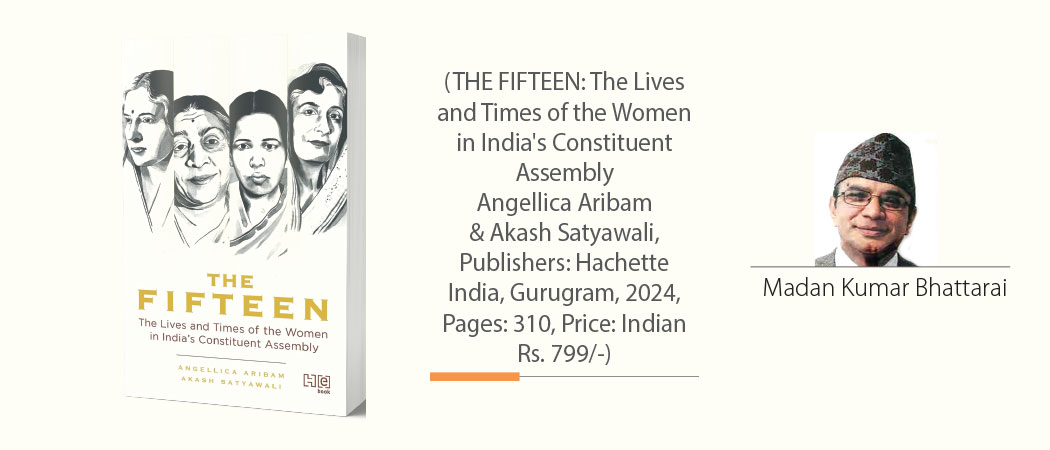

A new book with sketches of four women members on the front cover has recently been published, highlighting the lives, legacies, roles and times of 15 women members of the Constituent Assembly (CA) of India, making the world's longest constitution that came into full effect on January 26, 1950. There have been several publications on different aspects of the Indian constitution and constitution-making but few devoted to female architects of the document.
Seemingly focused on the valuable role of 15 women of the CA that later also served as the provisional parliament prior to the first general elections, the latest work portrays their role in the freedom struggle and post-independence administration, including politics, education and other aspects.
The book lists the roles and responsibilities of women legislators in framing the constitution, including the incorporation of gender rights, human rights and other basic postulates. These women, who made up a bare 5 per cent of total members of the CA, were not only renowned in their respective fields, they were generally trained in the high school of independence struggle under the leadership of Mahatma Gandhi.
The quite fascinating work with the most comprehensive title, THE FIFTEEN: The Lives and Times of the Women in India's Constituent Assembly, is jointly authored by two young writers, Angellica Aribam and Akash Satyawali. When the British government decided to grant independence to India, the first effort towards making the constitution was made in the form of the formation of CA.
The CA was a mixed assembly initially consisting of 389 members drawn mostly from newly elected provincial assemblies, quite a number of persons as nominees from the princely states and a few representatives of chief commissioner states. Out of them, a total of 17 high-profile female members were included in the house.
S. Nijalingappa, two-time Chief Minister and Congress President, writes in his autobiography that out of three CA members from his region that later became Karnataka, one was a woman that would have made the number 18. But since her Socialist Party preferred to opt out, Kamaladevi Chattopadhya, an important name in culture, handloom, film and freedom struggle, could not join the CA.
The assembly faced the first challenge when Britain decided to partition the new country into India and Pakistan, leading to the formation of a separate CA for Pakistan on June 3, 1947. The CA of India was thus pruned to 299 members, including 15 women, as two celebrities, Begum Jahanara Shahanawaz and Begum Shaista Suhrawardy Ikramullah, representing Punjab and Bengal respectively, withdrew in favour of Pakistan.
Ikramullah, the first Muslim woman to get a doctorate from the University of London, was a writer and diplomat married to Mohammed Ikramullah, Pakistan's top diplomat originally belonging to the princely family of Bhopal and the elder brother of Mohammed Hidayatullah, who became India's Chief Justice and Vice-President. Ikramullah, who belonged to the 1927 batch of the Indian Civil Service, was Pakistan's foreign secretary twice (first and sixth) and served as ambassador to a number of countries.
The book may conveniently be taken as an important supplement to an earlier work, The Founding Mothers of the Indian Republic: Gender Politics of the Framing of the Constitution, brought out by Achyut Chetan in 2022. Besides a short introduction, the new work deals comprehensively with all 15 members in separate chapters.
Sarojini Naidu, Vijaya Lakshmi Pandit, Rajkumari Amrit Kaur, Sucheta Kripalani, Hansa Mehta, and Durgabai Deshmukh assumed political positions and later occupied top posts as governor, chief minister, central minister, ambassador and representative to high-profile missions, university vice-chancellor and even members of the Planning Commission. Pandit and Mehta caught international headlines for their exploits in the aspects of women's empowerment and diplomacy.
Drawn from diverse ethnic, religious, territorial and language communities, the rest included Ammu Swaminathan, Annie Mascarene, Begum Qudsia Aizaz Rasul, Dakshayani Velayudhan, Kamla Chaudhri, Leela Roy, Malati Chaudhury, Purnima Banerji and Renuka Ray.
Sarojini Naidu was the oldest, having been born in 1879, and also the first to die, in 1949. The youngest was Purnima Banerji, born in 2011, but she sadly passed away as early as 1951. Belonging to a prominent Ganguly family of Bengal, she was the younger sister of Aruna Asaf Ali, a freedom fighter and educationist, who married Asaf Ali, also a CA member.
While the exercise of forming India's CA and framing a constitution has already crossed a period of more than 76 years, it may be pertinent to compare the work with our own side, as we drafted a constitution through CA only a decade back and have recently witnessed one of the most momentous election results marking generational change in our polity.
We had quite a disproportionately large CA with as many as 601 members, with one-third of them female. Besides, we spent a colossal amount of time and resources in the form of two constituent assemblies, a rarity among countries forming such bodies to frame constitutions.
Our constitution came into force after several twists and turns on September 20, 2015, following several years of work spread over two constituent assemblies. Despite huge representations and benefits of technology and information, not to speak of sizeable external support in various fields, there are few examples of any extraordinarily notable contribution on the part of our CA members, male or female, as was the case in India.
We had so many relatives in the CA, mostly being represented out of their familial and political access. In the case of Indian CA, those who may be termed 'relatives' consisted of Jawaharlal Nehru, Vijaya Lakshmi Pandit (sister) and Feroze Gandhi (son-in-law), who rose on the basis of their own contributions, not otherwise.
Besides, some more examples in this field were the prominently versatile couple Acharya J.B. Kripalani and Sucheta Kripalani; Jivraj Narayan Mehta and Hansa Mehta; and relatives Asaf Ali and Purnima Banerji, who had their own contributions to the country rather than being just inspired by family connections.
While the seminal work entails extensive research with comprehensive bibliographical and other useful references, inclusion of some relevant photos pertaining to the work of CA could have added to the value of the otherwise most praiseworthy endeavour. I congratulate the authors for their ground-breaking exercise in terms of portraying the role of women members.
(Dr Bhattarai is a former Foreign Secretary, ambassador and author. kutniti@gmail.com.)