- Tuesday, 26 May 2026

Minister Shrestha stresses priority to reservoir-based hydropower projects

By A Staff Reporter,Kathmandu, May 26: Minister for Energy, Water Resources and Irrigation Biraj Bhakta Shrestha has said that reservoir-based hydropower projects should now be advanced as a national priority to ensure Nepal’s long-term energy security, industrial development, agricultural modernisation, tourism promotion, and overall socio-economic transformation.
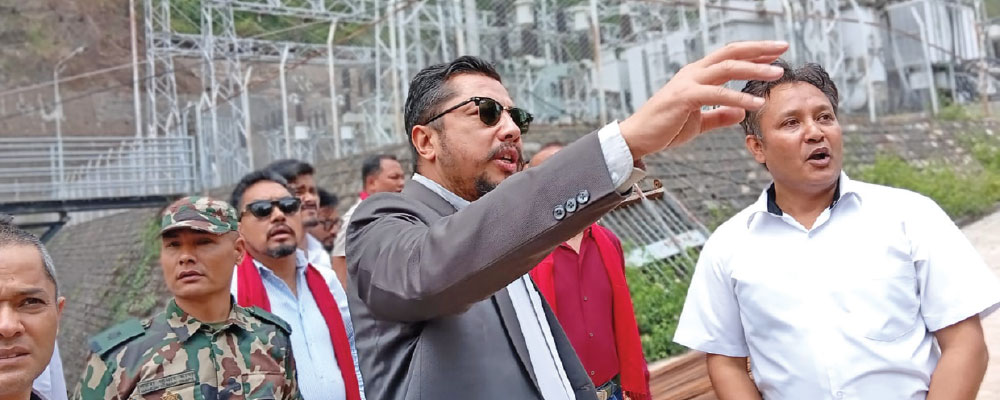
During a visit to the Kulekhani Hydropower Centre, Minister Shrestha said that the government’s primary focus in the coming days would be on the development of reservoir-based projects.
He said that such projects are not merely a means of electricity generation but can also serve as a foundation for national development through water management, flood control, irrigation expansion, tourism promotion, and balanced energy supply.
During discussions with employees of all three Kulekhani hydropower plants, Minister Shrestha said that climate change has led to irregular rainfall, glacier melting, and increased natural risks, making water storage infrastructure even more important for the future.
He said the visit to Kulekhani was also aimed at understanding key issues to consider while developing new reservoir-based projects.
He said that reservoir-based projects can generate more electricity during peak demand hours, ensuring sustainable energy supply for industries, businesses, data centres, information technology industries, and urban areas, thereby accelerating economic growth.
Minister Shrestha also stressed the need for the Nepal Electricity Authority to develop an integrated model for reservoir-based projects to promote multipurpose benefits and energy trade. During the discussion, he emphasised that domestic manpower has become capable of constructing and operating such projects and stressed the importance of attracting both domestic and foreign investment.
Stating that the government has maintained a 50-year license period for reservoir-based projects to increase private sector interest in such initiatives, he emphasised the need to maximise their multidimensional benefits.
Referring to Kulekhani as Nepal’s 'role model' project, Minister Shrestha said that its contribution to economic and social transformation should be made even more effective.
He also instructed officials of the Nepal Electricity Authority and the Kulekhani Hydropower Centre to immediately address social concerns raised by local communities.
He drew the attention of concerned authorities to address local grievances, clearly demarcate the watershed area, and take waste management around the reservoir more seriously.
He said that clear land demarcation is necessary to protect project property and noted that increasing tourism activities in the Indrasarowar area have made waste management increasingly challenging, urging local governments, business operators, and the public to work in coordination.
Likewise, Minister Shrestha expressed concern over the impact of annual flood- and landslide-borne sediment on the project, the effects of past earthquakes on the dam, the condition of equipment in the dam area and powerhouses, the need for repair and replacement, and staff management.
Completed in 1982, the Kulekhani Hydropower Project is Nepal’s first reservoir-based hydropower project, with a total installed capacity of 106 MW in Indrasarowar Rural Municipality.
Kulekhani-I, II and III generate 60 MW, 32 MW and 14 MW respectively.
The man-made Indrasarowar Lake has also become a major tourist destination, while the project plays a key role in balancing Nepal’s power supply during dry seasons and peak demand periods.