- Tuesday, 26 May 2026

Unprecedented Account Of Sacred Sites

Veteran writer and cultural expert Dr. Ram Dayal Rakesh has proved himself to be a man of letters. Although he is in his 84th year, his active life as a columnist and writer continues to surprise many. Over nearly six decades of his writing career, Dr. Rakesh has penned almost fifty books in four languages – Nepali, Maithili, English, and Hindi.
Recently, on his 83rd birthday on 25th July, Dr. Rakesh published his latest book, Desh-Bidesh Ko Samjhana, in the Nepali language. It is his sixth travelogue. Earlier, in January 2024, his book Temple Tourism in Nepal hit bookshops across the country. The book begins with an introductory preface written by Dipendra Purush Dhakal, a former secretary at the Ministry of Culture, Tourism and Civil Aviation. According to Dhakal, the book is a repository of the country’s most prestigious treasures, which demand better utilisation for the benefit of humankind.
Very few books on religious tourism, such as Pilgrimage Tourism in Nepal by Yagya Raj Satyal, have been published in Nepal. Realising the importance of documenting religious sites and heritage, Dr. Rakesh has worked diligently to produce Temple Tourism in Nepal. The book comprises ten valuable chapters.
The first chapter, titled Temple Tourism in Nepal, begins with the famous quote by Kirkpatrick: “The valley (Kathmandu Valley) consists of as many temples as there are houses and as many idols as there are men.” This chapter serves as an introductory overview of the book, enabling readers to visualise its overall contents. It provides details of Hindu religious sites and also Buddhist and Islamic places of worship. The extensive information on religious sites in the Kathmandu Valley is one of the main attractions of this chapter.
The second chapter beautifully discusses the religious sites of Koshi Province. Around twenty sites—including Baraha Kshetra, Dantakali Pindeshwori Baba Dham, Haleshwar Mahadev, and Pathibhara —are described. The author also mentions religious ponds such as Maipokhari and Sabhapokhari, which are popular among both domestic and international tourists. The inclusion of myths and legends associated with these sites adds further value for readers. The chapter also features descriptions of some Buddhist religious sites.
Following the initial chapters, the book unfolds with province-wise details of temples. The author appears to have a special affinity for Madhes Province, possibly because he originally belongs to that region.
As a result, the province is given extensive coverage in three consecutive chapters. The chapter titled Province No. 2 (Madhes Pradesh) provides a detailed account of temples and religious sites across all eight districts. Janakpur, along with prominent religious sites such as Janaki and Ram Temple, receives special attention.
The chapter on Province 3 begins with a brief geographical, cultural, and religious introduction. It then elaborates on world-famous religious sites such as Pashupatinath, Swayambhunath, Boudhanath Stupa, Budhanilkantha, and Krishna Temple. The inclusion of legends related to these sacred places enhances the appeal of the chapter.
The temples and religious shrines of Provinces 1, 2, 3, and 4 have been given greater importance and broader coverage, while those of Provinces 5, 6, and 7 receive comparatively less attention.
A genuine question arises as to why, despite the official renaming of provinces, the author continues to refer to them by their former numerical designations.
The images of temples attract readers as they turn the pages; however, they are printed in black and white. The book would have been more visually appealing if the photographs were in colour.
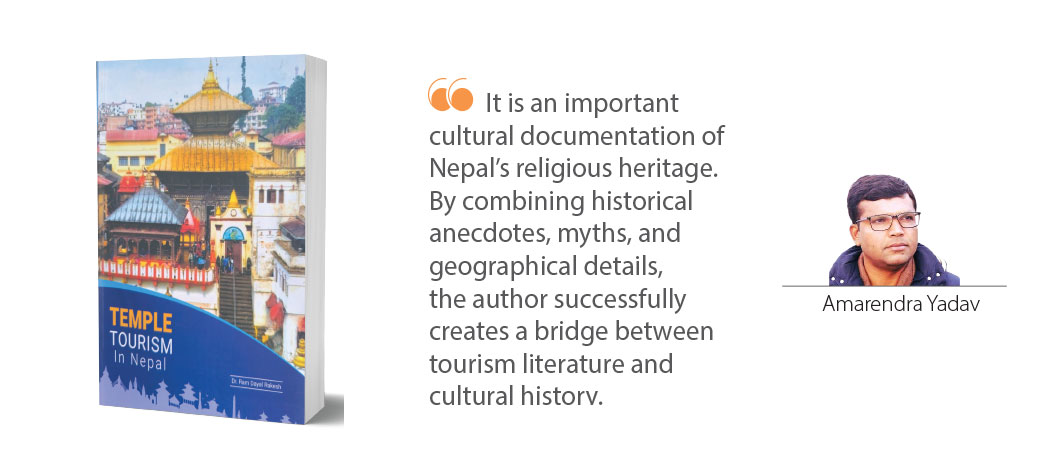
The cover design, however, is vibrant and engaging. The front cover features a popular image of Pashupatinath, while the back cover is adorned with iconic images of Janaki Temple and Vivah Mandap in Janakpur. The book consists of a total of 140 pages, including the cover pages, and is self-published by the author at a price of Nepali Rs. 500.
The author had clear motivations for writing this book. Firstly, he observed that, compared to general tourism literature, very few books focusing on Nepal’s religious and spiritual heritage are available. Secondly, he aimed to fill this gap by documenting these significant sites in a comprehensive manner.
The book presents a vivid collage of religious and spiritual sites across the country. As readers go through it, they gain additional knowledge about hundreds of sacred places and are also inspired to visit them. The book is inclusive in terms of region, religion, and community.
It is an important cultural documentation of Nepal’s religious heritage. By combining historical anecdotes, myths, and geographical details, the author successfully creates a bridge between tourism literature and cultural history. The book also indirectly highlights the immense potential of religious tourism for Nepal’s socio-economic development.
For researchers, students of culture, and travel enthusiasts alike, this work serves as a valuable introductory guide to Nepal’s diverse spiritual landscape. Despite some limitations in presentation, the book stands as a significant contribution to the growing body of literature on Nepal’s cultural and pilgrimage tourism.
(The writer is a journalist at The Rising Nepal daily.)