- Monday, 25 May 2026

Haliya Lives Bound Beyond Legal Freedom

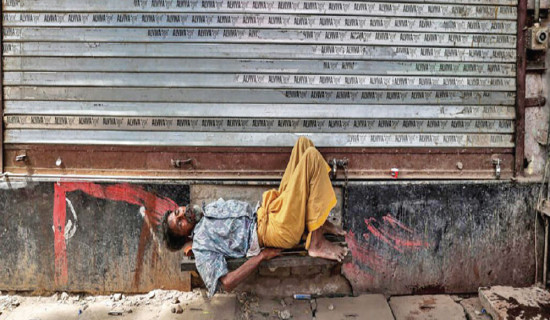
Despite the abolition of the Haliya system 18 years ago, Tara Aauji of Sanphebagar Municipality-4 in Achham still works as an agricultural bonded labourer. An ancestral loan taken by her forefathers from a landlord has never been fully repaid, tying her to the same landlord even after emancipation. She carries no official identity card as a freed Haliya, having been left out when the government collected data for rehabilitation.
In the same locality, Dinesh Luhar labours at the house of Jhapta Kunwar in Mastamandau without any formal recognition or protection, and he too has no identity card. Another Haliya, Surendra Bhul, has served for generations at Dhruba Kunwar’s home, receiving only 7–8 sacks of paddy and 3–4 sacks of wheat a year, yet lacks any legal documentation of his status.
Local enumerations have systematically failed many. In Ward No. 4 of Sanphebagar, around 20 to 25 Haliya households were excluded from the official count, revealing how discretion and indifference can distort identification. In Bajhang’s Thalara Rural Municipality‑3, Jogi Nepali worked as a Haliya for two decades after taking a loan of Rs. 12,000 from Hari Singh Rawal simply to survive poverty. Madhura Kami, a so‑called freed Haliya, says she owns neither house nor land and has no support to live independently.
Systemic exclusion
Across seven districts of Karnali—Rukum (West), Salyan, Dolpa, Jumla, Mugu, Kalikot, and Dailekh—and all nine districts of Sudurpaschim—Bajura, Bajhang, Doti, Achham, Darchula, Baitadi, Dadeldhura, Kanchanpur, and Kailali—about 19,000 Haliyas were left out of the government’s official data. This exclusion has left many either still working as bonded labourers or forced to return to the same conditions after being declared “freed” on paper.
Haliyas have tilled landlords’ fields to repay debts their ancestors took, often with no clear record of when the obligation should end. They remain of denied basic human rights and social justice, fully dependent on landlords for food, land access, and even permission to seek work elsewhere. Debt and landlessness continue to operate as the main cause binding them.
Even now, landlords call on Haliyas for agricultural work and domestic chores, often without wages. Some are made to plough fields free of charge; others stay bound in the hope of being relieved from loan interest, land rent, or the cost of food provided by the landlord. As landless labourers, they have no alternative to sustain themselves and must seek the landlord’s consent before looking for other work.
While Nepal has become a democratic republic, large sections of Haliya communities still live in practical bondage. The persistence of the Haliya system signals a failure to translate legal emancipation into real freedom and equal rights. Linked closely to caste hierarchy, the system allows relatively wealthy and upper‑caste landlords to rely on Dalit bonded labour for farming and domestic work, reinforcing structural discrimination that disproportionately presses down on Dalit households.
Feudal bondage systems akin to the Haliya practice were abolished in Europe by the mid‑19th century, in Russia in 1861 under Tsar Alexander II, and in China through land reforms after the 1949 revolution. In Nepal, however, a similar arrangement continues to shape rural livelihoods, prompting rights groups to question the quality and reach of post‑abolition policies.
Political gaps
After sustained pressure from Haliya organisations, the government declared emancipation in 2008 and officially verified 16,322 Haliya families. Rehabilitation and livelihood programmes started from the fiscal year 2010–11, but it took five more years—until 2013—for a structured framework and action plan to be approved, delaying implementation.
According to government figures, even after this period, 2,367 of the 16,322 verified families have not received any identity card as freed Haliyas. Among those who have received cards, 1,135 have not been given any rehabilitation package. This means only about 85 per cent (13,955 families) hold identity cards and only about 78 per cent have received some form of support, exposing critical gaps in delivery.
Data from the Ministry of Land Management, Cooperatives and Poverty Alleviation show that 12 per cent of freed Haliyas received category ‘A’ identity cards, 27 per cent category ‘B’, 5 per cent category ‘C’, and 56 per cent category ‘D’. These categories indicate varying levels of vulnerability, but critics argue they do not always reflect real household conditions. Between 2013 and 2019, the government purchased land for 1,601 families, constructed 2,203 houses, and repaired 8,427 others. However, experts and community groups say these measures fall short of ensuring long‑term livelihood security and social inclusion.
The National Freed Haliya Society Federation of Nepal views implementation as inadequate. Parbat Sunar, vice-chair of the federation, says that although some land has been distributed, there are almost no coherent programmes for employment, education, health, or income generation—elements crucial for sustainable rehabilitation. The federation also points out that the five‑point agreement signed between the government and Haliya organisations in 2008 has not been fully implemented.
Federation chair Ishwor Sunar adds that basic rehabilitation remains incomplete in the geographically remote and economically poor districts of Sudurpaschim and Karnali. The terrain and limited infrastructure make follow‑up, monitoring, and service delivery difficult, compounding the marginalisation of Haliya communities.
A 2021 government‑mandated study committee found that the classification of Haliyas was “highly unscientific and flawed". The committee reported that the categorisation seemed to have been copied from the Kamaiya system without properly assessing whether families actually had enough land to sustain themselves, thus weakening targeted policy interventions. The study repeatedly emphasised that data on excluded Haliyas must be collected urgently as a first step toward effective rehabilitation.
Despite repeated political commitments, the situation on the ground has changed little. Major parties promise land and housing rights in their election manifestos, but such promises rarely translate into consistent action. The CPN‑UML pledged in its 2022 manifesto that no citizen would remain homeless, and the government led by KP Sharma Oli reiterated land reform and housing‑right commitments in 2024, yet measurable progress for Haliyas has been minimal.
The Nepali Congress has similarly pledged to end homelessness within five years, but Haliya‑specific policies remain weak. The CPN (Maoist Centre) promised to address bonded‑labour issues while in power but delivered few concrete outcomes. The current government’s 100‑point reform agenda includes a pledge to complete digital data collection of landless squatters within 60 days and resolve the issue within 1,000 days, plus phased land or integrated housing schemes. Several weeks after this announcement, however, the process has scarcely moved forward, raising doubts about both implementation capacity and political will.
Constitutionally, Nepal prohibits all forms of forced labour. Article 16 guarantees the right to live with dignity, Article 24 protects against untouchability, and Article 29 safeguards against exploitation, explicitly forbidding slavery and bondage and making it a punishable offence while entitling victims to compensation. Yet many Haliyas still face caste‑based discrimination, underscoring the gap between constitutional guarantees and lived reality.
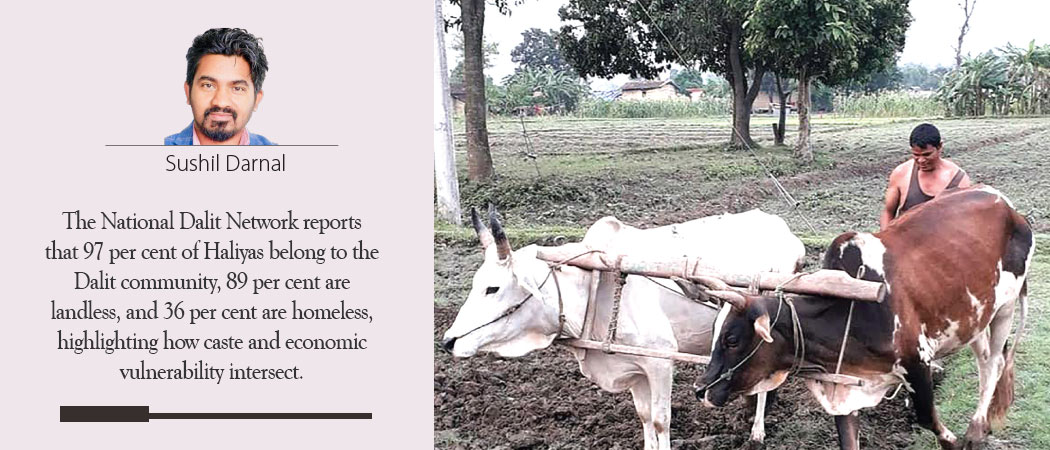
Article 40 requires the state to provide land to landless Dalits and housing for the homeless. The National Dalit Network reports that 97 per cent of Haliyas belong to the Dalit community, 89 per cent are landless, and 36 per cent are homeless, highlighting how caste and economic vulnerability intersect. Article 51 further directs the identification and rehabilitation of freed bonded labourers, including Haliyas, through land, housing, and employment support, aligning with Nepal’s broader commitments to social justice and inclusion.
Sunar and other activists argue that meaningful rehabilitation must go beyond land distribution. It should include education, health care, employment opportunities, sustainable livelihoods, and social empowerment. Lawmaker and Haliya rights activist Ganesh BK stresses that the federal government has neglected its obligation. “More than 15,000 Haliyas have not even been counted, and the government has not allocated any budget for them since 2019,” he says, calling for ward offices to collect data on excluded families and coordinate with the Land Commission and the federal government.
According to Dandi Kumar BK, an activist for Haliya rights, the assertion that the problem of Haliyas has been solved is a baseless and unethical statement made against those still being deprived of their rights. The Constitution of Nepal is premised on the concept of building an inclusive and just society, which cannot happen as long as the practice of bonded labour exists in agriculture.
There is a need to reconcile law and practice in order to attain sustainable development goals by ensuring that the following four components are considered: systematic identification of non-Haliya, cancellation of debt burden, availability of land and accommodation, and educational and medical services. In other words, without a comprehensive package of rehabilitation, most released Haliyas continue living under the same bondage due to a lack of economic opportunity.
(Darnal is a journalist at the National News Agency, Nepal.)