- Friday, 22 May 2026

Moon, Meteors And Planets Align

The warm night skies of this month could enable sky-gazers to observe the planets and stars dwelling in charming constellations and dive deep into the complex but comely conundrums of celestial entities that can be noticed all over the heavens. Fleet-footed planet Mercury would be scooting through puny constellations Aries (ram) and Taurus (bull) during daylight. Discerning it would be difficult. Planet Venus would be shining in the western sky after sundown among the shimmering stars of the constellation Taurus (bull). It would then dip down into the horizon. The ruddy planet Mars is unseen this month. It is marching across the sky during the daytime through the commodious constellations Pisces (fishes) and Aries.
Attempting to glimpse it low in the eastern sky before daybreak would not be easy. It is strictly cautioned not to peer at any object near the Sun through an optical aid. Permanent damage to eyesight could be incurred otherwise. Giant planet Jupiter can be spotted in the western sky after sunset in a conspicuous constellation. Gemini (twins). It would be slipping towards the horizon after a few hours. Castor with six stars (Kasturi) and orange-hued Pollux (Punerbasu) scintillate spellbindingly in gloriously glistening Gemini. Ringed planet Saturn can be perceived tersely in the eastern sky before sunrise. It can be identified in the non-zodiacal confounding constellation Cetus (whale). Saturn has waywardly wandered into Cetus.
The magnificent binary star Mira decorates Cetus. Its striking system consists of a variable red giant (Mira A) along with a white dwarf companion (Mira B) staying scarcely 300 light-years away. Cetus is depicted as a sea monster in Greek mythology which both Perseus and Heracles needed to slay. Cetus is sprawling in the region of the sky that contains other water-relat ed constellations: Aquarius, Pisces and Eridanus (river). The sun rests in Cetus for a petite 14 hours each year on 27 to 28 March.
Planet Uranus is lost in solar glare. It is lumbering through the constellation Taurus. Planet Neptune will be gliding through constellation Pisces during the day. Glancing will not be gratifying. On 01 May the first full moon of this month would heartily greet with veneration and respect the Buddha Jayanti festivities. It is popularly known as the 'Flower Full Moon' because during this time of the year spring flowers appear in abundance. Its other exotic, startling sobriquets are the corn planting moon or even the milk moon. The tenebrous new moon is manifested on 16 May. The second full moon bizarrely betides on 31 May as the blue moon. Since this is the second full moon in the same month, it is often referred to as the quirky blue moon. This rare calendar event befalls bafflingly once in every few years, thus introducing the term 'once in a blue moon'.
An above-average Eta Aquarids meteor shower capable of conjuring copious amounts, up to 60 meteors per hour at its utmost, could be relished this month. Most of the activity is admired in the Southern Hemisphere. In the Northern Hemisphere, the rambling rate can count merely 30 meteors per hour. The shower generally runs annually from 19 April to 28 May. It peaks this year on the night of 06 May and during the mellow morning of the 07 May. The wonderfully waning gibbous moon post-midnight setting after sun-up will block out and wash away numerous fainter meteors this year. But if ardent meteor fans are patient and peaceful, they can still savour succinctly some splendid and shiny shooting stars.
Best viewing could be conducted from murky lightless locations after midnight. Meteors will exude from the radiant station in the alluring constellation Aquarius (water bearer). Tracing the paths of the Eta Aquariid meteors backward, they all seemingly spring out from a serene spot in the congenial constellation Aquarius (water bearer). This point on the sky’s dome is called the radiant of the meteor shower.
It aligns with hazy star Eta Aquarii. The meteor shower takes its stirring moniker from this star. Eta Aquarii is one of the four stars drawing up the Y-shaped Water Jar asterism in the northern part of Aquarius. The alignment of the radiant and the star is cunningly coincidental.
Eta Aquarii is a sheer 170 light-years away, while Eta Aquariid meteors disintegrate drastically a scant 100 kilometres above earth’s surface at speeds of a whopping 70 kilometres per second. The radiant rises during the wee hours after midnight and is still climbing toward its apex position in the southern sky at dawn. Thus, hours before fading twilight are excellent during the morning on 05 May to enjoy the maximum shower, which in fact stretches out over several days. The progenitor for the Eta Aquariids is the famous Halley’s Comet. Earth slips near its trajectory twice. One time along the outbound portion of the comet’s trail during early May, causing the Eta Aquariids, and another time along the inbound portion of the comet's way, triggering the Orionid meteor shower in late October. Halley’s Comet orbits the Sun on an average of every 76 years.
It visited us last, in 1985/86. It has been heeded since 240 BCE. In December 2023, the comet arrived at its farthest place from the sun. Now it is pulled inexorably by the Sun's gravity and heading back toward our inner solar system. It will be back happily to us again in 2061.
NASA’s Artemis II astronauts returned safely to Earth from the journey to the moon with a dramatic splashdown in the Pacific Ocean on 10 May after successfully completing the first lunar mission in more than one half-century. It marked a teary, triumphant homecoming for the crew of four whose record-breaking lunar flyby revealed and divulged not only the moon's mystique, the far side (never inspected before by humans), but also a terrific total solar eclipse.
The Orion capsule, dubbed 'Integrity', had whizzed at Mach-33 (circa 33 times the sound speed) during its re-entry into our atmosphere before plunging into the water. It was engulfed in blistering red-hot plasma as it entered a critical six-minute communication blackout that preceded the opening of the parachutes. Its life-protecting heat shield withstood immense heating bravely. The recovery ship USS John P. Murtha welcomed the crew off the San Diego coast with military planes and helicopters. NASA and the defence department had teamed up for the lunar crew's re-entry for the Apollo-17 venture in 1972. Artemis II whooshed, screaming at an abominable speed of 11025 metres per second before slowing to a paltry 30 kilometres per hour at splashdown.
Artemis II's record flyby escapade was launched from Cape Canaveral, Florida, on last 01 April. All deftly and responsibly navigated NASA's long-awaited lunar comeback and heralded the first major step in establishing a sustainable moon base. Artemis II did not land on the moon or even orbit it. It broke Apollo-13's distance record and marked the farthest that humans have ever journeyed from earth. The crew reached an awesome 406,771 kilometres.
The mission's most heart-wrenching moment was when astronauts requested permission to name a pair of craters after their moonship and the astronaut's late spouse. Vibrant, breathtaking pictures of the moon and earth with Apollo 8's first lunar explorers showing earth as a blue marble setting beautifully behind the grey moon and the unforgettable earthrise shot from 1968 were channelled. Artemis II was a tense test flight for future moon missions. It harvested rich scientific yield during almost 10 days.
However, it was also beset with technical issues, which were shrugged off wisely and intelligently. Under the revamped Artemis programme, next year's Artemis III will allow astronauts to practise docking their capsule with lunar lander(s) in space. Artemis IV will strive to disembark a special crew of two near the lunar South Pole in 2028.
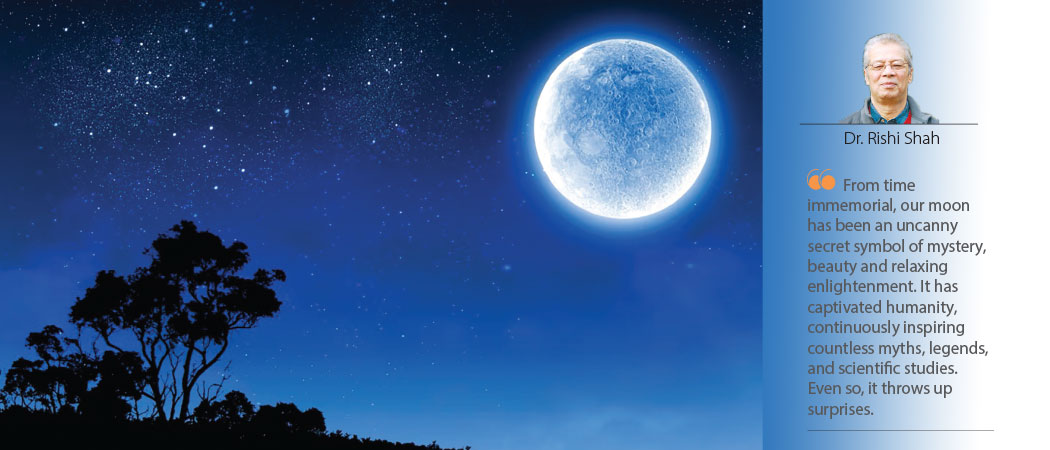
From time immemorial, our moon has been an uncanny secret symbol of mystery, beauty and relaxing enlightenment. It has captivated humanity, continuously inspiring countless myths, legends, and scientific studies. Even so, it throws up surprises.
The moon is moving approximately 3.8 cm away from us every year. Its radius is just 1740 kilometres, and it's roughly 384400 kilometres away from Earth. It is rotating at the same value that it revolves around the earth (synchronous rotation) and faces the earth all the time. It goes through phases. During a full moon it is fully illuminated by the sun. The moon races, allegedly, around the earth in every 29 days.
(Dr. Shah is an academician at NAST and patron of NASO.)





-square-thumb.jpg)