- Friday, 1 May 2026

Divine Protector Of Kathmandu

From a storied past of the Kathmandu Valley marked by a perennial war between the forces of different hues and shades, let this scribbler draw one more leaf.
The kingdom of Kantipur (Kathmandu) has been grappling with a series of attacks from the neighbouring kingdom of Lalitpur. Such are the atrocities that excesses by Lalitpur’s soldiers have become routine. Neither a hapless people nor their king knows how to deal with the crisis.
With no solution in sight, the king seeks the wise counsel of his Gubhaju, a Tantric practitioner.
The practitioner of occult practices, unique to the valley in particular and Nepal in general, responds thus: In the distant land of Kamrup Kamakshya, there’s a goddess—Bhadrakali—who can protect us. All we have to do is propitiate her, bring her here and install her by following certain rituals.
Upon getting assurances from the Tantric that he can bring the superpowerful goddess to his kingdom and install her properly, the king becomes happy and orders the Tantric to launch the mission by mobilising men and means. On an auspicious day, the entourage under Gubhaju leaves for the faraway land and manages to bring the goddess up to what is now the National Theatre in Jamal.
At this point, a thought flashes in the tantric’s mind: Now that we have brought the goddess who will protect the people of Kantipur from the evil forces, it will be quite fitting to take her to the city proper by organising a colourful, musical procession with the participation of a large number of people. He hangs the basket containing the goddess in a Kalash (a sacred jar) on the branch of a tree and rushes to the royal court, where he asks the king to organise a grand ceremony marking the arrival of the goddess.
Then he rushes back to Jamal, only to find the basket and the jar fallen with no trace of the resident goddess and the plan to protect the city with divine help in jeopardy. Crestfallen and with a heavy load of worry, Gubhaju starts a frantic search for the lost goddess in a sparsely populated city. By the way, where did the deity go? Do you have any idea, readers?
Let’s follow in the footsteps of Gubhaju and one more character to find her whereabouts in a city that was not so densely populated as it is today.
After Gubhaju leaves for the royal court, a farmer heading to his fields in what is now Chappal Karkhana (Dhumbarahi) sees a sweet little girl lying on the ground and crying profusely.
He asks who she is, but elicits no response. Thinking that the child may be hungry, he offers bread (marhi in Nepal Bhasa) from his midday meal. He then asks the girl whether she wants to accompany him to his field, and the child appears willing.
Together, they march to the fields in Dhumbarahi, where the farmer finds a safe corner for the child, leaves her there and busies himself with farm chores.
When he returns to pick up the girl and head home, shock and surprise greet him at once: the mysterious girl is gone, while the slice of bread (Marhi) offered to her and other slices meant for him have become Lun Marhi, or gold loaves (Lun means 'gold' and Marhi means 'bread' in Nepal Bhasa). Thus, divinity reveals itself first not to authority, but to simplicity.
Call it sheer luck or the divine endorsement for the plan to shore up the defences of Kantipur: During his search, Gubhaju comes across a girl, and instincts tell him that she is none other than the goddess brought from afar with great effort.
Gubhaju then asks whether she would want to visit the city proper with him. When she says no, Gubhaju offers her Marhi that she has never eaten before and a Jatra (religious festival) that she has never seen before.
Subsequently, Gubhaju offers the little girl a Marhi with a sprinkling of turmeric powder to give an impression of Sunko Roti (bread made of gold) and takes her to what is now Tundikhel to witness the Jatra she has never seen before—Ghode Jatra—amid a colourful, musical procession attended by the royalty, the laity and others. To this day, Ghode Jatra is performed in Tundikhel, the Nepali Army parade ground, to trample a demon believed to be residing there with the hooves of galloping horses.
Even after the installation of the mighty goddess, soldiers from the kingdom of Lalitpur try one more time to attack Kantipur and torment her subjects. But the mere sight of Bhadrakali forces them to flee for their dear lives, ending a reign of terror in Kathmandu.
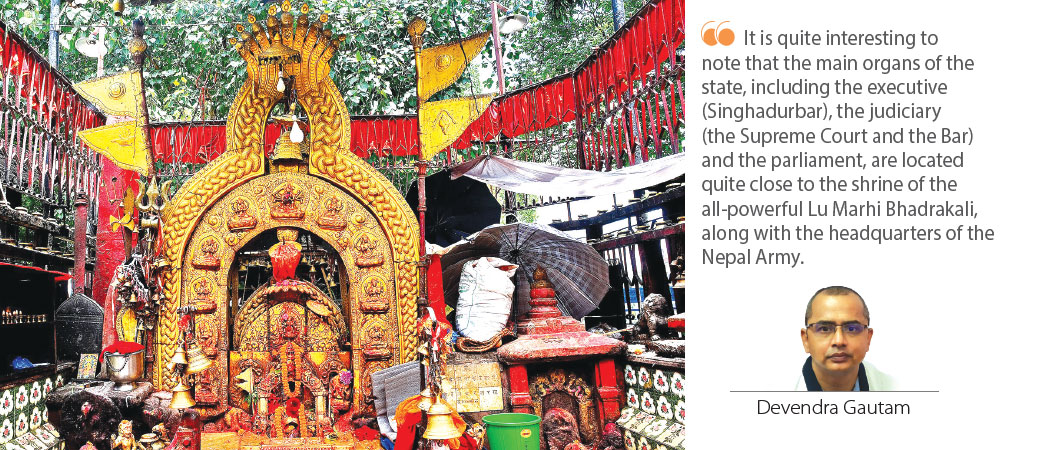
The shrine located east of Singhadurbar, the federal government secretariat, is a principal Shaktipeeth (a centre of divine powers) and central to some of the valley’s most sacred and visually striking traditions, with its rituals often blending Hindu and Buddhist Tantric practices. People visit it in large numbers, especially on Saturdays, Tuesdays and Thursdays, to pray for good health, protection and fulfillment of wishes. It is not uncommon to see brand new vehicles—two-wheelers and four-wheelers—by a crowded road stretch outside the temple as buyers choose to offer Puja to Bhadrakali with the help of priests, seeking divine blessings for a safe ride for years to come. The shrine is also a chosen destination for rituals like Vivaha (weddings).
On any given day, sweet-sounding bells ring out in celebration on the temple premises. Oil-fed traditional lamps glow while traditional Nepali incenses give the atmosphere a sweet fragrance on a piece of earth in meditation amidst urban cacophony.
Priests solemnising the nuptial Knot ritual amid hurried chants of sacred mantras, beaming faces of newlyweds and equally delighted onlookers leave a lasting impression on visitors as they bring them closer to Nepal’s sociocultural and religio-spiritual realms.
Apart from major festivals like Vijaya Dashami and Ghode Jatra, the goddess is worshipped during Barha Barse Jatra—celebrations held every 12 years for the regeneration of spiritual strength for the entire city—by invoking and worshipping Ashtamatrika, the eight mother goddesses of the Kathmandu Valley. Ashtamatrika and Bhadrakali dances are performed on the occasion.
During the three-day Pahan Charhe festival in March/April, the palanquins of Lun Marhi Bhadrakali and her sister goddesses (Kanga Ajima and Tebaha Ajima) are brought together at Asan Bazaar for a spectacular torch-passing ceremony.
It is quite interesting to note that the main organs of the state, including the executive (Singhadurbar), the judiciary (the Supreme Court and the Bar) and the parliament, are located quite close to the shrine of the all-powerful Lu Marhi Bhadrakali, along with the headquarters of the Nepal Army.
Let’s hope—and pray—that Kali, considered the most formidable during Kaliyug, when the powers of several other deities are believed to plummet, will continue to shield Nepal and the Nepalis from evil forces as the war between the good and the evil intensifies in front of her very eyes.
Gautam is a desk editor and columnist.