- Saturday, 23 May 2026

Apology To Dalits
 Ranjit Prakash Wad
Ranjit Prakash Wad
Ranjit Prakash Wad
The government's decision to "apologise to the Dalit community" was hailed by some as historic. However, a fundamental question arises: Can an apology erase structural injustice? Is a mere apology from the state sufficient? Will a simple "sorry" solve the deep-rooted problems faced by the Dalit community?
When a small Dalit child in Rolpa is brutally beaten on the pretext of "entering a Khatri’s house," or when 22-year-old Krishna BK in Sindhuli dies a suspicious death in custody after being slapped with a rape charge due to an inter-caste relationship, and when people are still publicly humiliated with slurs like "Dum" in Jumla, yet no major outcry follows nor strict action is taken, it reflects the grim reality of our society. These are just a few cases that gained traction on social media. Countless other incidents occur where no video is filmed, no voices are raised, victims find no justice, and perpetrators walk free.
Though these incidents occur in different places, they reveal a single truth: Nepal's democracy remains weak on the fundamental question of social justice. Article 24 of the Constitution of Nepal guarantees the "Right against Untouchability and Discrimination" as a fundamental right. It explicitly states that no person shall be subjected to any form of untouchability or discrimination in any private or public place based on their origin, caste, community, profession, or physical condition. Yet, in practice, caste still determines the value of a life. The gap between constitutional promises and the cruelty of reality proves the moral failure of both the state and society.
According to the 2028 BS (2021) census, Dalits constitute about 13–14 per cent of population. Article 40 of the constitution provides specific rights for Dalits, including proportional inclusion in all state bodies, free education, and land for landless Dalits. Despite this, their access to representation, education, land ownership, and employment remains abysmally low. This inequality is not just economic; it is a result of social exclusion. While some claim, "we do not discriminate," the "Brahmanical" mindset that excludes Dalits persists across every level of state and society.
The murder of Nabaraj BK and his friends in Rukum West over an inter-caste marriage, the denial of access to public taps and temples, the abuse of teachers based on caste, and the struggle to find rental rooms in Kathmandu are clear indicators that the end of caste discrimination exists only on paper. Therefore, treating the incidents in Rolpa, Sindhuli, and Jumla as isolated events is a flawed analysis. They represent the peak of the state's failure to implement constitutional rights.
The role of the state is decisive here. An apology is an admission of guilt, but when the error is structural, the solution must also be structural. Article 24(5) recognises untouchability and discrimination as serious social crimes, entitling victims to compensation. However, when the state tries to downplay such incidents as "personal disputes" or "accidental events," law enforcement weakens, and criminals gain impunity.
Most importantly, we must change the mindset that Dalit issues concern "only Dalits." This is not just a Dalit problem; it is a "social disease" akin to cancer affecting our entire society. Its cure is everyone's responsibility. If any citizen feels unsafe due to their identity, it is a failure of the entire nation. The strength of a democracy is measured not by elections, but by the security of its most vulnerable and marginalised citizens.
The solution is clear, but it requires political willpower and a change in individual consciousness.
A specialised judicial mechanism is needed for caste discrimination cases. Delayed justice only discourages victims. Investigation must be independent and impartial. Every custodial death must trigger an automatic judicial inquiry. Laws like the 'Caste-based Discrimination and Untouchability (Offense and Punishment) Act, 2011' must be strictly implemented. The mere existence of law is not enough; the realisation of justice is what matters.
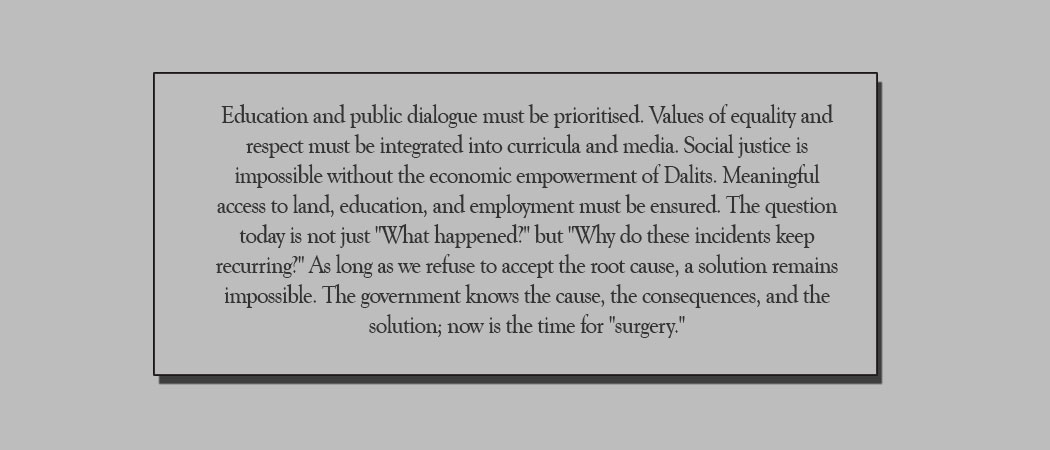
Education and public dialogue must be prioritised. Values of equality and respect must be integrated into curricula and media. Social justice is impossible without the economic empowerment of Dalits. Meaningful access to land, education, and employment must be ensured. The question today is not just "What happened?" but "Why do these incidents keep recurring?" As long as we refuse to accept the root cause, a solution remains impossible. The government knows the cause, the consequences, and the solution; now is the time for "surgery."
The government must understand that an apology is not enough. It must deliver justice, change the system, and transform society. Otherwise, the cycle of social media outrage followed by forced settlements and eventual forgetting will continue indefinitely. Ultimately, this is not just a fight for the Dalit community; it is a fight for the constitution, democracy, and humanity. In such a fight, remaining neutral is equivalent to standing with the oppressor.