- Saturday, 23 May 2026

Does The Constitutional Vision Drive Politics?

National goals, not just the blind passion, greed, jealousy or reason, motivate wise leaders for political actions. Goals are not entirely based on scientific reason, but on historicism, national feelings and care for the life of people and their posterity. In democracy, their motive of political rationality flows from the impulse to animate unrealised needs, rights and aspirations of Nepalis. People are, however, often driven more by feeling, desire and emotion, than exclusively reason. Social practices, traditions, laws and institutions shape incentive structures and regulate the behaviour of both sides and orient them to normative and constitutional order. They internally link different aspects of Nepalis' life to each other. Their success rests on how they cooperate to overcome each other’s deficits and craft leverage for positive action.
Universal ideologies, once idealised as a cognitive frame and conduct of leaders and people, have become trivial now. The velocity of critical information has offered them an ability to grasp the complexity of current problems. Regular discourse and deliberation with the people and cultivation of workmanship can overcome the emptiness of the contextual grasp of reality of the Nepali life-world. The upshot of mere heaping praise without performance becomes heartless: One can see the denouement of sudden spurt of heroic action of Nepali youths against the political regime. Reflection on the living conditions of people, the nature of human constitution and the constitution of the nation thronged them into political action demanding good governance. They have captured the imagination of Nepal’s potentials — land and natural resources, labour, capital and information technology vital to drive development and change.
Silent works
Precisely for this reason the government led by Prime Minister Balendra Shah is thinking differently to utilise these potentials, control inter-generational theft, claim national sovereignty in matters of politics, policy, development and foreign policy and aim to uplift the living conditions of the masses. It is vital to build their stake and ownership in national governance. Prime Minister Shah’s silent works are eloquent, briskly blustery and louder. Digital platforms incarnate his vision and viewpoints everyday arousing feelings of people and mustering support. The flair and fire of cultural patriotism is evocative of sovereign Nepalis’ historical spirit, not lured by empty babbling of old political classes without gist and without sensitivity to public life.
In this sense, the reaction of the court against his initiatives springs from the fear of creative destruction of old structures and laws and liberating them from the grip of partisan setting and syndicate. The government sees no fresh hope of rebuilding this nation through abstract legalism devoid of justice. Nepalis know the perennial ego-centric drama needs a change and thus gave stunning electoral mandate to his rule to rend veils of evils, change political culture and make politics a matter of public duty. But without veering from vision Prime Minister Shah needs the legitimacy of its translation. Constitutional route matters in democracy. The idiom of will of people requires altering antinomies.
Reforming patrimonial political structure through social inclusion: When the political structures of Nepali parties are patriarchal, it is hard for them to truly promote ecological ethics, social inclusion and set gender and intergenerational justice. Only inner-party democracy can help the realisation of the constitutional vision of an egalitarian society through a constant communication and feedback loop between leaders and people, the government and opposition and public authorities and the public and initiate change. Political awareness of Nepalis has increased. So do their demands for the realisation of rights and justice that transcend the policy of shock-therapy and the will of patriarchs to keep the status quo.
If Nepali leaders unreflectively follow old habits of power, profits, status and privileges without responsiveness to people’s concern and without changing the behaviour as per shifting values, they are bound to plunge in chaos. Nepali political parties and civil society are connecting tissues of civic culture. Democratisation of their structures and functions can widen political space and allow for a vibrant public sphere to flourish where even ordinary Nepalis can participate in policy issues, raise their concerns and enforce political elites for their transparency and accountability. It is a genuine condition for participatory democracy. Nepal’s linkage to the global sphere should not become a vehicle for marginalisation.
Social learning and standardization of political life: To become adaptable, Nepali leaders must keep abreast with the changing condition of people towards the stimuli of the internal and external milieu and formulate updated policies. Ways of life give meaning to them as social or interest-maximising individuals. In Nepal, however, the chasm between the living condition of Nepalis and what they feel is deeper and their desire for better future often prompts them to mobilise political energy for collective action. Modern desire for the liberty and dignity of life cannot be met by traditional politics. The underlying motive behind the desire of Nepali youth for change is to connect with the like-minded and attain good governance that delivers justice to people.
Middle class as a vehicle of progress: The government’s policy to focus on the middle class as a vehicle of progress and change is aimed to reduce its cost, create mediating forces and push for welfare state reforms. Its style of sociability reflects vaunted cultivation of politics in the middle path against what it calls both totalitarianism and crony capitalism or the discarded theory of neoliberalism. It helps to revive the conscience of society, its civic virtue and values of civilisation. This social shift can change the future of politics as specialised experts and intellectuals will have greater say than those gripped by careerism without any sense of public purpose and performance.
It, however, requires measured leadership able to conjoin both ends and means of politics not impulsively transactional indulged in vote buying and rent-seeking that rob the future of youth. It has only postponed Nepali aspiration for inclusive social transformation and failed to make the nation livable. Nepalis are not merely labour or data to be manipulated like mindless consumers but are strongly linked to the national sovereignty, culture and context and capable to make decision and judgment about what and how their leaders perform against the political culture of unhealthy conformity
Shift from soft state to virtuous state: A soft state is deeply permeated by corruption and impunity and unable to stand above the dominant interest groups of society to provide justice and welfare benefits to the ordinary Nepalis. Gunnar Myrdal long ago described the characteristics of South Asian soft states as a source of their modernisation torpor. Anti-corruption and anti-criminal attitude of the government is likely to create a social surplus to invest in the real economy and drain the swamp of vices so that Nepalis can enjoy the benefits of democratic rule of law. Cleaning the root causes of evils requires comprehensive reforms in the style of governance and abolishing the political culture of epicaricacy — deriving pleasure from the misfortune of rivals, not becoming tolerant to opposition which is a vital aspect of a modern democracy and entering into mutual cooperation for shared benefits.
Change in organisational politics: Digital media has altered the organisational base of political parties built on hierarchy, patriarchy and top-down leader-orientation. Digitalisation is pushing for a post-hierarchic milieu and putting the top-down leadership evolution into permanent tension with the grassroots and aspiring cadres drifting to de-alignment in elections. It does not mark a departure from the normalisation of violence as a legitimacy of muscular politics, not a savior of peasants and workers. Nepal’s recent parliamentary election has marked a cataclysmic change in the political landscape and the mode of governance. As a mandate for change sprouted from the election, the government is reforming in many areas. The power of this landscape change reveals behavioural change in the entire social, economic and political realms tossing aside, amending, slicing and replacing the old establishment’s excessive splurge —spending scarce money extravagantly on unproductive activities rather than on national priorities and becoming accountable to their own architect of initiatives.
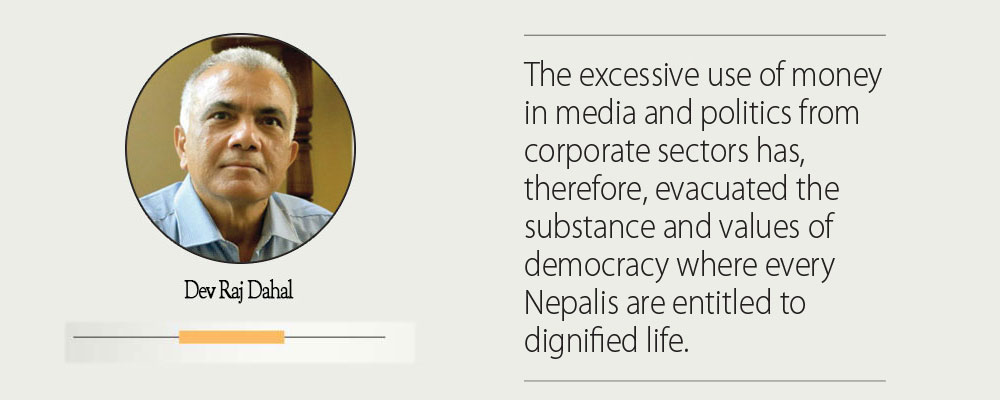
Now the neo-liberal belief that a deregulated market and democracy can go together proved deceiving. Liberation of the soulless market from democratic control has sharply cut ordinary Nepalis’ freedom and social opportunities. The excessive use of money in media and politics from corporate sectors has, therefore, evacuated the substance and values of democracy where every Nepalis are entitled to dignified life. Wellbeing requires abundance of public goods, not their illicit appropriation by the web of powerful elites which only subdues the weak. Increased interest of the government now in ecological, social, economic and political development can change the organizational politics.
Constructive roles
Government as a solution, not problem: The current government is proactive and, therefore, expanding its constructive roles in society especially in the areas of agriculture, industry, technology, health, education, justice and infrastructure for the solution of problems without bureaucratising them. It marks a paradigm shift from the earlier “farewell to the state,” and “reinventing government” to “boosting public confidence in state institutions” through administrative and management discipline, efficiency and performance. It marks a fundamental change in the economic model, a strategy to pull it from consumerist passion to native production and utilisation of its strategic commodities and a struggle against the power of comprador classes, deep state and entrenched system of syndicate but without undermining the ethical business practices of the private sector.
It is also an exit from neoliberal mode of the past which treated the government and the state as a problem, not the solution and clientalised the state, economy and people to globalisation, not nation building. This is precisely the issue the government is seeking to control the flow of unearned money in politics and business that distort national priorities. Revaluation of tax and import policies will definitely show solidarity with the local production, consumption and entrepreneurship and bring them to visibility and viability. This is the way to promote both social solidarity and social cohesion and national unity from the bottom up and project independent national identity in world politics.
(Former Reader at the Department of Political Science, TU, Dahal writes on political and social issues.)