- Monday, 25 May 2026

Nepal Moving Beyond Survival Imperative

Foreign policy beyond the survival imperative requires the existential viability of the state and its ability to promote national interests shared by all people. It also requires fulfilling people’s critical needs and defending the state’s raison d'être. Survival is the supreme law of the state. Nepali constitution offers a cognitive template for this. But survival alone is not enough to fulfill the rights of people for a dignified living and projection of national identity in international politics. Certain tangible factors of its pivotal strategic geography and resources remain stable but the nation can improve the indicators of progress to boost its power potential through intangible factors of statecraft, art of diplomacy, connectivity and rearing the comparative advantage of the nation to escape from location determinism and force- field of great power politics.
Nepal’s continued survival as sovereign state reflects the struggle of its people to defend security and self-transformation in the changing geopolitical context of imperial, hegemonic, nation-state and anarchic global systems nested in a hierarchy of power and adopted varied policies of isolation, dodging, balance and mildly tiling to bandwagon. It has sacrificed its territory, population and wealth as a price of peace and avoided a sphere of influence, buffer, tributary and client status that coordinates foreign policies with big powers. Nepali leaders since the unification times have esteemed the sovereign values of state and its heroes and builders have defied reducing the state either to regime, leaders, class, market, business or any institutions.
Ethics of its own integrity
It survived the desire of neo-liberal, post-modernist and comprador classes to sap national narrative and evaded the state being dragged into a scramble for influence. The Nepali state has carried the ethics of its own integrity, defending the people, core values and institutions. It has fused will with credibility. Nepal’s adaptive response to a range of geopolitical shifts is eased by its native knowledge, culture, sovereignty, identity and geo-strategy without entirely conforming to global power politics of coercion devoid of diplomatic contents.
Neat statecraft entails wisdom of statespersons able to think in generational terms, break the ties of deep state with outer predators and take prudent decisions benefiting people. In no way statespersons are governed by the standards of private passion. They enter into mutually beneficial cooperation with various actors without losing national psyche and conscience. Since the stakes of Nepalis are too high in the state, they must give priority to public and national interests over ideology and mini-identities and avoid being subject to other’s policy.
The ultimate goal is not only to climb to the peak of power but to brace the state’s interests without cultivating acrimony to enlightened ideals. Unlike his predecessor Prime Minister Balendra Shah will not reduce the state, polity and public institutions to partisan prejudice. Such act upends the internal cohesion of Nepal ditching decades of its non-alignment thus allowing macro-management and turning the state into an impotent buffer or bridge without choice. His government promises to follow diplomatic code while meeting foreign bigwigs and keep due diligence on those sowing discord among Nepalis through centrifugal forces.
Diplomatic acrobatics: The post-1991 regimes had shifted state-centric realism to state minimalism and tax-bearing to undue borrowing, thus spiking the size of debt and dependence. They had relentlessly pursued de-agrarianisation, de-industrialisation and globalisation and favoured the ideology of Anglosphere befitting regime compatibility, decoupled from Russia and put China’s Belt and Road Initiatives into sterility waiting for a right gear. Even continental Europe and East Asia remained outside its apt focus and broke air connectivity which the nation once boasted. These regimes have opened the state, economy and society to every kind of soft power influence and accelerators of social change, even some disruptive, which it could not close to keep international sub-culture within limits of national sovereignty.
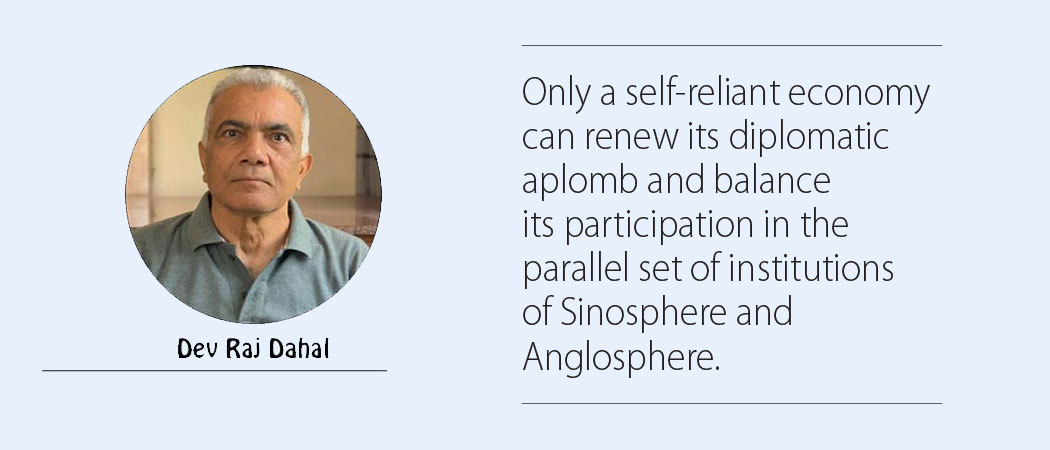
It has left the Chinese policy to transform landlocked to land-linked nation through connectivity, access to transit and commerce almost moribund. India and the West feel unease over Nepal’s strategic cooperation with China and find convergence in Tibetan issue, despite Nepal’s reassertion of one-China policy and tightrope walk. Reaping the internal production of energy sources including hydropower, IT, tourism and import-substituting industries for trade and commerce and modernisation of agriculture can boost its leverage in foreign policy and utilise youth bulge for nation building. But the huge imports, remittance, aid and debt dependence need to be reversed to add stamina to Nepal’s economic diplomacy. Only a self-reliant economy can renew its diplomatic aplomb and balance its participation in the parallel set of institutions of Sinosphere and Anglosphere.
A shift from reckless globalisation to territoriality is afoot. It is vital to control space and circulation to brace the organic view of the state, mother Nepal. National self-assertion is the leitmotif of Prime Minister Shah. It is luring a flurry of high level dignitaries’ visits to Nepal and their offer of cooperation. Although he has dispelled the fear of the nation joining any security alliance, the apprehension of exploitation of its strategic commodities lingers. In the past, the trivialisation of the centrality of the state, power sharing with the business, civil society and international financial institutions in matters of economy and refusal to abide by diplomatic code has cut the prerogative of Nepali parliament and ministries in national self-determination of policies.
Now the return of geopolitics has subsumed other actors within the state’s orbit. The key strategic challenges for Nepal are to rear institutional capacity, achieve political stability, reduce economic dependence and harness global creditworthiness. Prime Minister Shah has set high value to Nepal’s relations with all nations and vowed to strengthen partnership based on mutual benefit. A policy of shared prosperity can lift the nation from dependence to interdependence. The creation of an “investment-friendly milieu, entrepreneurship and sustainable progress” through a predictable policy situation can spur the range of free maneuver. Economic self-reliance can lift the flow of public goods and set positive neutralism in the vicinity and global non-alignment.
Foreign policy innovation: Prime Minister Shah has sparked both new resonances to decide the fate of the nation without outside powers’ involvement like former Prime Minister B. P. Koirala and new strategy to mobilise centripetal forces of the nation akin to King Mahendra. It can strengthen the linkage of the heartland, Kathmandu with the periphery, desh (state) with pradesh (local structures) and provide superhuman glue of Hindus-Buddhist philosophy to link hills with Tarai and Himalayan cultures, thus defining its own way of life. His interest to re-introduce ethical education can balance the rights of people with the fidelity to loyalties to Nepali state and augment its capacity to execute policies aligned with nonalignment. The pivot of Kathmandu is high for regional and global powers.
It is an idyllic listening post for them and a strategic site to watch each other’s behaviour and activities. In this sense, it is important for Nepal to avoid diplomatic roller-coasters and adopt quiet diplomacy to settle differing territorial claims. The government’s effort to synthesise the manifestoes of national political parties will help to optimise their interests, forge national consensus on vital matters and restore the bungled foreign policy to genuine non-alignment that rejects to bend to the will of other powers.
Multi-platform approach: For a relatively small nation like Nepal multi-platform approach enables to articulate its concern for survival, sovereignty and justice. Rival conception of security and security dilemma of neighbours limit the scope of trilateralism. India has adopted multi-alignment with many powers of the world, reaping leverage in international affairs while China is asserting its power with great strategic heft and considered by the USA as security, frontier technologies (solar, wind, batteries, AI, electric cars), trade, finance and strategic competitors. It is the biggest producer and exporters of rare earth minerals and largest trading nation. Its ascent and outreach can help Nepal revise many of its earlier policy options and escape from the buffer or bridge metaphor which puts the context above the cloud.
Its non-alignment has to keep balance among major powers - India, China, the USA, Russia, continental Europe and East Asia without alienating any one. The nation can adopt diplomacy of hedging not just as an event but a careful process of achieving national goals without countering them. King Mahendra’s political realism utilised the help of the Soviet Union as a part of balancing strategy and global diversification while King Birendra introduced a zone of peace to project the nation’s peaceful identity. The rise of Russia and its offer of cooperation may merit Nepal re-linking as India and China are in a common cause with it for another world order. It should equally utilise the goodwill of the US for its progress and leverage.
Integration
Freedom of maneuver: Cooperation does not flourish if Nepal pursues its absolute national interests without taking other’s concerns. Prime Minister Shah speaks of creating a regional and global frame of integration in matters of development, trade, investment, climate action and people to people cooperation. Upgrading shared interests can overcome the flipside of geopolitics, proving that a small nation does not mean its judgments are wrong. While regional cooperation in South Asia is losing steam, a stable rule-based global order remains undefined. The decay of multilateralism in the phase of multipolar world order presents a paradox as the UN and WTO seem to fade the scope of their activities owing to the US retreat from many of its specialised agencies. Peace requires effectively working together in shared interests and resolution of differences by diplomacy.
The wars in West Asia and Ukraine are deadlocked. They have entered a phase of attrition causing global energy, food, job and livelihood crisis. The great wall of distrust between the US and China is triggering mutual containment while the crisis in West Asia might affect Nepal’s remittance flow and soar up the prices of essential commodities. The nation’s freedom of maneuver entails putting security, defense, foreign policy and economy in the right track and adopting reflexive development where outsiders do not subordinate its foreign policy through painful compromises on aid, trade, investment, debt, knowledge and connectivity but provides space to pursue its own priorities. The smartness of PM Shah is expected to shift from the distinctly shabby style of diplomacy of mere regime endurance to choose a fate of its own to navigate in the neighboUrs and the wider world beyond survival imperative.
(Former Reader at the Department of Political Science, TU, Dahal writes on political and social issues.)