- Saturday, 2 May 2026

Infrastructure, connectivity top election agenda in Sudurpaschim
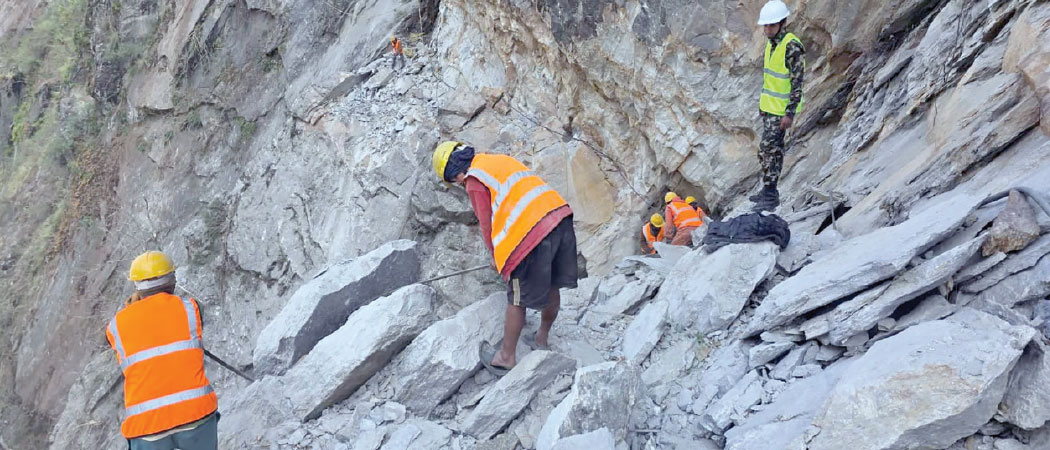
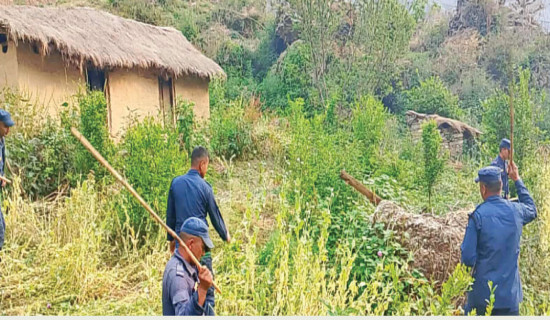
Photo: Prakash Bikram Shah/TRN Nepali Army personnel working on a rocky cliff to open a track along the Mahakali Highway.

By Prakash Bikram Shah,Dhangadhi, Feb. 28: As the election fervour has gripped the entire nation, the political discourse in Sudurpaschim Province has shifted decisively towards grand-scale infrastructure and regional connectivity.
Candidates from major political parties are anchoring their campaigns on the promise of transforming the province into a strategic gateway between India and China, specifically through the completion of the long-awaited Seti and Mahakali corridors.
For nearly 17 years, the Seti and Mahakali highways have remained in various stages of completion. These projects aim to link Tikunia on the Indian border with Taklakot in Tibet, China, via the Urai Bhanjyang pass in Bajhang. Despite the slow pace of construction, the economic potential of these routes, spanning 359km and 417km respectively, remains the central pillar of local manifestos.
Candidates, including Lekhraj Bhatta of the CPN (UML) and Bharat Bahadur Khadka of the Nepali Congress, have pledged to expedite the construction of these lifeline roads to unlock the province’s frozen economic potential.
The infrastructure debate is further bolstered by the proposed 92 km fast-track road connecting Dhangadhi, Khutiya, and Dipayal, which includes ambitious tunnel sections. While construction is technically ongoing, local leaders admit that chronic budget shortfalls have stalled the progress.
Beyond roads, Sudurpashchim is being positioned as the future energy hub of Nepal. Experts and politicians alike point to the massive hydroelectric potential of the Mahakali, Seti, and Karnali river systems, estimated at between 10,000 and 12,000 megawatts. Central to this vision is the Pancheshwar Multipurpose Project, projected to generate 6,480 MW. However, after decades of bilateral talks with India, the project has not materialised.
Dr. Deepak Prakash Bhatta, a CPN (UML) candidate, has stressed that renewed diplomatic engagement with New Delhi is essential to finally break ground on both Pancheshwar and the 750 MW West Seti project.
The province’s economic roadmap also highlights a shift towards industrialisation and high-value exports. Candidates are advocating for the completion of the Dodhara Chandani dry port, described as a game-changer for national trade and the elevation of the Shahid Dashrath Chand Health Science University to international standards. There is also a concerted push to upgrade Dhangadhi Airport to international status to facilitate direct tourism and trade.
Tourism remains a significant, yet under-exploited, sector. Local entrepreneurs and candidates argue that by integrating destinations such as Khaptad, Badimalika, and the Api-Saipal peaks with the wildlife sanctuaries of Shuklaphanta and Ghodaghodi Lake, Sudurpashchim could host over two million tourists annually. Tourism specialist Tharka Bahadur Shah suggests that tapping into the 220 million inhabitants of the neighbouring Indian state of Uttar Pradesh alone could generate upwards of $ 90 million (15 billion NPR) in annual revenue.
Agriculture and herbal medicine offer further avenues for growth. The high-altitude forests of the province are rich in valuable herbs like Yarsagumba and Jatamansi. Experts believe that a shift from raw exports to local processing could create a market worth Rs. 10 billion per year. In the plains of Kailali and Kanchanpur, candidates like Birman Chaudhary and Dr. Tara Prasad Joshi are campaigning on green gold initiatives, modernising the granary of Nepal through cold storage, organic farming, and processing industries.
However, a gap remains between provincial aspirations and national party manifestos. While the Nepali Congress, CPN (UML), and Nepali Communist Party, all mention these projects, critics argue they are often buried deep within national priorities rather than being treated as immediate regional necessities.
The Nepali Congress has focused on viability gap funding for projects like the West Seti, while the CPN (UML) emphasises Mega-City developments for sub-metropolitan areas like Dhangadhi. The Nepali Communist Party has proposed the establishment of a provincial Institute of Technology and agricultural industrial parks. Meanwhile, the Rastriya Swatantra Party (RSP) has introduced a policy-heavy commitment paper, focusing on administrative reform, road safety, and the creation of bypasses for congested hubs like Attariya.
As voters head to the polls, the recurring theme is clear that Sudurpashchim is no longer content with being a remote periphery. The demand is for the swift transition of these decades-old national pride projects from political rhetoric into concrete reality.
-square-thumb.jpg)