- Tuesday, 9 June 2026

Women Still Struggle For Political Parity

"Woman is the builder and moulder of the nation's destiny. Though delicate and soft as a lily, she has a heart far stronger and bolder than that of a man. She is the supreme inspiration for man's onwards march; no doubt, it is her commanding personality that is, nevertheless, grimly solemn,” wrote the great Indian poet Rabindranath Tagore.
Of the 8.06 billion people living on the Earth in 2024, 4.09 billion are men and 4.05 billion are women, constituting nearly half of the world’s population. Yet, the world of politics remains overwhelmingly male-dominated; hence, women at national, regional, and international levels have experienced social discrimination and persistent scepticism regarding their leadership capabilities.
Data compiled by UN Women reveal that only 27.2 per cent of parliamentarians in single or lower houses worldwide are women. It has been a global tendency that in various forms of political systems, women’s representation is substantially low. As of September 2025, across 29 countries, there were only 32 women who have served as heads of state and/or government. This tenacious gap is largely rooted in structural barriers, gender stereotypes, and limited access to the political institutions.
In a democratic society, political representation is intrinsic to determining women’s political engagement. Increased female participation in politics is a prerequisite for gender equality and is made effective through the reservation of women's seats in parliament by many countries. Countries with higher female representation in parliament (50 per cent or more) include Rwanda, New Zealand, Mexico, Cuba, Nicaragua, and the United Arab Emirates, the UN reveals. As of 2023, Rwanda has the highest share of women in any parliament around the world, at 61.3 per cent.
A greater number and participation of women in the political domain garners political accountability, making it more responsive and inclusive towards gender equality. Georgetown Institute for Women, Peace and Security’s 2023 study documented that women’s representation is strongly correlated with the health of democracy and is determined by measures of free elections, free association, and checks on governmental power. Hence, the authors of the study advocated that investments in women should be taken as investments in robust democratic systems.
Nepal, a newly established federal democratic republic, is seeking ways to integrate women into politics. Interestingly, the country got its first female prime minister, Sushila Karki, to lead an interim government after the Gen Z-led protest in September 2025. Historically, Nepali women in politics date back to the late 19th and early 20th centuries, notably under the leadership of Yogmaya Neupane (1860-1941), who stood up against the autocratic Rana regime. The Constitution of Nepal (2015) made it mandatory for women’s participation in the parliament, provincial assemblies, and local municipalities, ensuring a total of 33 per cent of seats. However, women in Nepal continue to face barriers to political representation and leadership. Despite implementing legislative gender quotas, the nation’s overall pace of progress on women in politics is concerning.
According to the election commission, there are altogether 9,240,131 registered female voters for the upcoming 2026 parliamentary election. The UNDP 2079 report on GESI (Gender Equality and Social Inclusion in Nepal) documented that political parties are only interested in fielding women's candidacy in positions where women's candidacy is mandatory, such as executive roles.
We still lag behind in gender equality and are thwarted by the continued under-representation of women in political leadership. “Most of the men still have the mindset that all women, except men, are weak, cannot work, and lack leadership qualities. Therefore, women are suitable only to assist men. There is also a strong belief that the political field is an exclusive domain of men. Therefore, women's participation in the political field is very low in the world. Nepal is no exception to this. The Central Department of Statistics (2021) national census revealed that there were 609,858 more women than men in Nepal, yet only 6 per cent of the female candidates ran in the local elections, highlighting the country’s pervasive patriarchal worldview.
In moments for the upcoming parliamentary election in 2026, from party conventions, critical debates, candidacy, and presidency, women were less prioritised. According to the election commission report, out of 3,406 candidates, the number of women candidates is only 388. This rooted gender imbalance in politics at times appears unworthy of study, as it seems to be a permanent feature of the Nepali political system. Of the 275 members of the House of Representatives elected in 2022, only 92 were female, and 22 of the 59 members of the National Assembly were female in 2023. Out of 334 federal lawmakers, women accounted for merely one-third. Amidst the structural barriers, social expectations about women's stated roles and skills make the political parties, institutions, and even the voters biased towards women or refuse to support them. It is undeniable that social roles, values, and stereotypes have been the primary subject of contestation in politics, and the realm of politics has remained unwelcoming to women in political leadership.
The 2025 IPU-UN Women in Politics Map confirms that men outnumber women by more than three times in executive and legislative positions. As IPU Secretary General Martin Chungong aptly said, "The lack of progress in achieving gender equality in political leadership serves as a sobering call to action.”
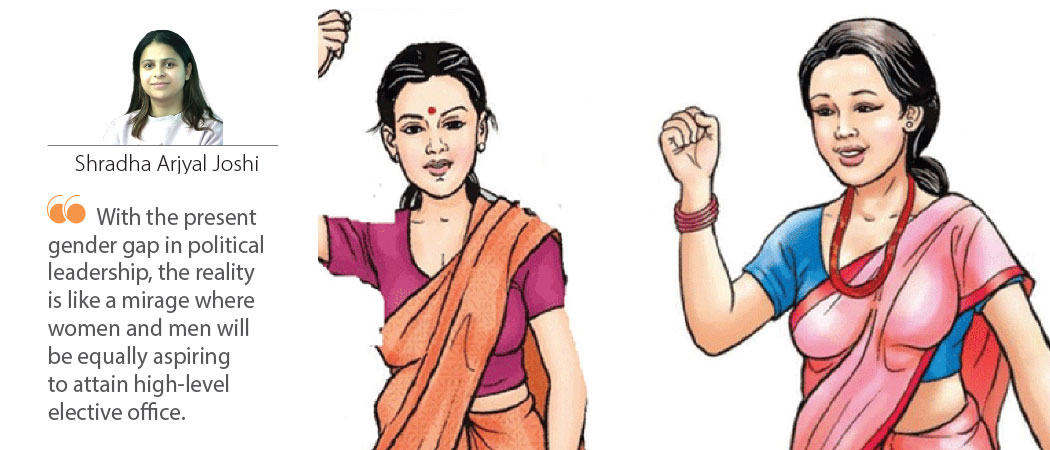
Increasing women’s representation and leadership in politics holds multifaceted challenges, including structural barriers, gender imbalances and psychological prejudices, among others. This has led to the continuation of the exclusion of women from politics. With the present gender gap in political leadership, the reality is like a mirage where women and men would be equally aspiring to attain high-level elective office.
(Joshi is a development professional focusing in political and resource economics, diplomacy.)