- Thursday, 21 May 2026

Health Inequalities Among Nepal’s Elderly
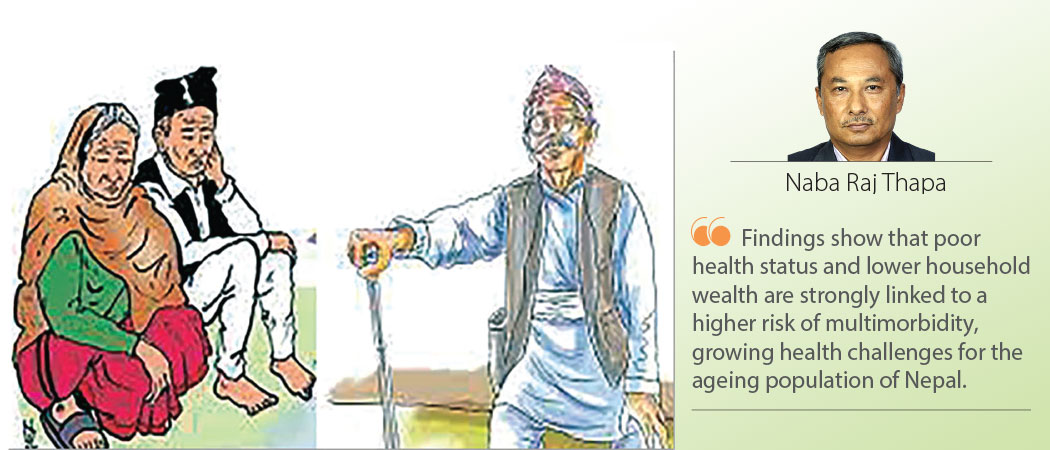

Nepal is undergoing a profound demographic transformation characterised by the rapid growth of its older population. The segment of the older population aged 60 years and above has expanded at an unprecedented pace over the past seven decades, reflecting broader shifts such as a decline in fertility, a decline in mortality, and an increase in life expectancy.
Census data show that the number of people aged 60 years and above has grown from 0.41 million in 1952/54 to 0.65 million in 1971, 1.07 million in 1991, and 2.98 million in 2021. The decade between 2011 and 2021 alone saw an increase of 0.82 million older individuals—the largest numeric growth recorded so far.
During this period, the older population increased by 38.2 per cent, compared to a 10.1 per cent rise in the total population, underscoring the faster pace of ageing relative to overall growth. This demographic transformation, caused by a historic shift from high to low fertility and mortality, with increased life expectancy, is associated with both challenges and opportunities. The ageing population demands more healthcare services, particularly in chronic illness management, geriatric care, and social and mental health support, which consequently places an additional burden on healthcare costs.
The United Nations sets the cutoff at 60 years and above to refer to the older population. Nepal is entering an ageing society, bringing with it a complex set of challenges such as increasing demand for healthcare services, management of multimorbidity, geriatric care, and mental health support. The growing older population is closely linked to a higher risk of chronic illness, a gradual decline in physical activity, and a rise in disability.
Multimorbidity, the coexistence of two or more chronic conditions in an individual, is emerging as a pressing concern in the context of population ageing. It is often linked with higher demand for health services and a decline in overall quality of life. Older people in Nepal are facing escalating health challenges such as malnutrition, chronic diseases, and inadequate health services, with disparities shaped by residence, demographic, and socioeconomic status. The prevalence of multimorbidity is more common among older people in Nepal, leading to fragmented care. Multimorbidity disproportionately affects socio-economically disadvantaged older people, exacerbating health inequalities.
A population-based study was conducted in Kamalamai Municipality of Sindhuli District among 692 older people aged 60 years and above to understand the patterns and prevalence of multimorbidity, as well as its associations with socio demographic, economic, and health-related factors.
The framework of the study was developed through an extensive review of theoretical approaches and empirical studies related to multimorbidity. A multi-stage sampling design was employed to ensure a representative sample of older people in Kamalamai Municipality. The sample size for each ward of the 14 wards was determined using probability proportional to the number of older people aged 60 years and above.
Health status of older people
The study surveyed 692 older people, of whom 54 per cent were male and 46 per cent female. The majority (43 per cent) belonged to the 60-69 years age group. The study shows that only one in three older people in Nepal rated their general health as good, whereas over half rated it as moderate. Around 15 per cent reported poor health. The survey also found that 15 per cent had experienced some form of injury in the year preceding the survey.
High blood pressure, gastritis and other gastrointestinal issues, arthritis, diabetes, osteoporosis, asthma, eye conditions like cataracts and glaucoma, heart disease, high cholesterol, and kidney disease were the most common chronic conditions among older people. More than three-quarters were taking medications or receiving treatment at the time of the survey.
The study found that half of older people experienced difficulty with at least one activity of daily living, and 12 per cent faced difficulty with two or more activities of daily living. Forty per cent reported trouble controlling bladder and bowel functions. More than two-thirds faced difficulty with at least one task of instrumental activities of daily living, and more than half experienced two or more difficulties. Despite these hurdles, nearly 85 per cent remained engaged in moderate or vigorous physical activity.
This study asked older people to rate their difficulty with seeing, hearing, walking, remembering, self-care, and communicating. The result highlighted that seven in ten older people experienced at least one functional difficulty across six domains.
Among issues related to seeing, walking or climbing steps, remembering or concentrating, hearing, and self-care, communication difficulties were the least common, whereas walking or climbing steps emerged as the most severe disability, defined as experiencing a lot of difficulty or not being able to do it at all. Overall, approximately one-fifth of older adults were classified as having a disability.
Prevalence of multimorbidity
About 34 per cent of older people reported a single morbidity, while half experienced multimorbidity. Sociodemographic and economic factors were found to significantly contribute to variations in the prevalence of multimorbidity. The prevalence of multimorbidity was found to be higher among older people aged 80 years and above, women, those who belonged to Hill castes, those with no formal education, those not currently engaged in work, older people relying primarily on old-age and recipients of social security allowance, and those from the richest household wealth status.
The study pointed out that the burden of multimorbidity was higher among older people reporting poor health status, those dependent on activities of daily living, and individuals with low functioning in instrumental activities of daily living.
Older people experiencing a lot of difficulty in performing functions necessary for independent living, and those classified as disabled, demonstrated the highest prevalence. Multimorbidity was also more prevalent among older people who did not currently smoke, did not consume alcohol, were unable to engage in vigorous or moderate-intensity physical activities, and had no reported experience of elder abuse. These findings highlight the multifaceted associations between health status, functional capacity, lifestyle behaviours, and the prevalence of multimorbidity among older people.
The study revealed that females and older people who relied on old-age allowance as their primary source of income were more likely to experience single morbidity. Additionally, older people who rated their health status as fair or poor were more likely to have single morbidity compared to those reporting good health.
Correlates of multimorbidity
The study has identified several key factors shaping the risk of multimorbidity among older people in Nepal. The findings show that the relative risk of multimorbidity was 1.9 times higher for females than for males. The relative risk of multimorbidity was lower among older people who belonged to Hill Janajati compared to those from Hill Caste. Similarly, the relative risk for multimorbidity was lower among older people without disability compared to those with disability.
Economic conditions emerged as important determinants. Older people relying on old-age allowance as their primary source of living had a higher relative risk of multimorbidity compared to those who reported their own income as their main source of living. The relative risk of multimorbidity was higher among older people from the richest wealth quintile compared to those from the poorest wealth quintile.
Perception of health and functional activity further influences multimorbidity. Older people who rated their health status as fair or poor were considerably more likely to live with multimorbidity than those with good self-rated health status.
Likewise, the relative risk of multimorbidity was higher among older people who were dependent on activities of daily living compared to their corresponding reference categories. These findings reveal the complex interplay of sex, caste, ethnicity, disability status, economic source of living, wealth status, self-rated health status, and functional activities in shaping the burden of multimorbidity among older people in the study area.
This study has expanded the understanding of multimorbidity among older people in Nepal with reference to Kamalamai Municipality of Sindhuli District.
This study examined the patterns of multimorbidity in relation to sociodemographic, economic, and health-related factors. Findings show that poor health status and lower household wealth are strongly linked to a higher risk of multimorbidity, growing health challenges for the ageing population of Nepal.
(Thapa, PhD, is Associate Professor of Population Studies at Tribhuvan University.)
-square-thumb.jpg)