- Saturday, 2 May 2026

Change Yourself To Change The World

So you too want to change the world without changing a thing about yourself?
If that’s so, you and this pensmith happen to be on the same page. It feels so great to know that this living thing is not alone in this vast universe.
By the way, what portion of the world population wants to change the world without changing themselves?
This question cropped up in this eternal freelancer’s mind after his thought-provoking meeting with one of the key figures of an industry that is extremely sensitive to geopolitical and geostrategic shocks. This piece will present the gist of that meeting after trying to deal with the above-mentioned question with a little bit of help from the worldwide web.
According to a cursory online search, though there’s no exact data on the population segment that wants to change the world without changing themselves, it is a widely recognised human tendency described often as a near-universal sentiment. The observation, famously attributed to Leo Tolstoy, is that "Everyone thinks of changing the world, but no one thinks of changing himself."
The desire for external change is high, while personal change is a no-no for most of us, as we see so commonly in everyday lives.
Reflecting a high desire for systemic change, a 2020 Ipsos survey for the World Economic Forum found that 86 percent of adults across 27 countries would prefer the world to change significantly and become more sustainable and equitable rather than returning to the pre-COVID status quo.
Worryingly, though, studies also point towards a low desire for personal change, with only about 19 per cent of surveyed people able to maintain significant personal, long-term behaviour changes and the motivation for such change declining with age.
This difference between the 85 per cent desiring global change without changing a thing about themselves and the much smaller percentage actively changing their own behaviour (or sustaining that change) highlights a large but not precisely quantified portion of the population that focuses on external change.
Looking around us, if not within us, we see that people often prioritise changing systems, governments or other people rather than initiating introspection or personal transformation. People want the benefits of change, but they often fear the discomfort and risk associated with personal growth and behavioural adaptation, according to psychologists.
Barring a very few successful people, most of us have blamed all other factors, such as luck—save ourselves—for our failures, our underperformance, haven’t we?
This all-too-common tendency to focus on the "cruel behaviour" of the world while neglecting to look at one’s own behaviour makes it easier to demand change from others.
Now, let this sapien, perennially in search of career growth opportunities, touch upon an enlightening conversation he had one sunny and beautiful January afternoon with the above-mentioned figure at a great educational institution that happens to be his alma mater.
This key figure, after probing into the nitty-gritty, such as job experience and academic experience, wanted to know whether the sapien in question had political connections or not. The reply came with a straight bat: I have no political connections whatsoever. My job experience and academic qualifications—or lack thereof—are all that I have.
After my reply, he spoke, highlighting his inability to make room for a new face, for that would mean harming the interest of some other member of the team (this sapien read it as some well-heeled figure).
A touch of Nepali hospitality, including a cup of steaming tea and the sweet-sounding
‘we should stay in touch' and ‘I will call you if and when a suitable opportunity comes my way', and an exhortation on policy lapses amid
two other guys in a passionate discussion on policy issues in the same chamber was the icing on the cake.
Towards the end of this piece, a flash of thought comes from Albert Einstein: The definition of insanity is doing the same thing over and over again and expecting different results.
You too want to prove Einstein wrong? You too want to change the world in our very own time-tested ways?
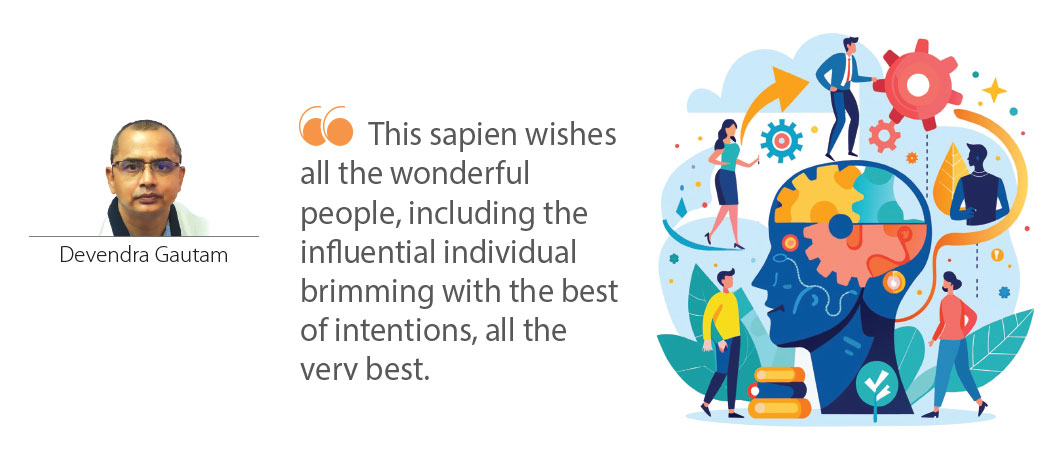
This sapien wishes all the wonderful people, including the influential individual brimming with the best of intentions, all the very best.
(The author is a freelancer.)