- Friday, 22 May 2026

Healing Through Colours: Sangee's Inner Vision
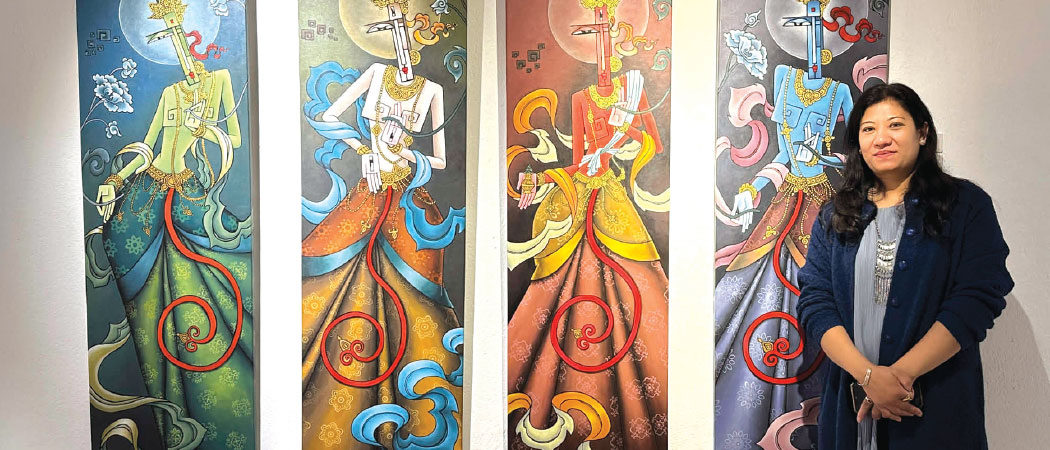

From chaos to contentment and from emotional shattering to inner peace are themes artworks often reflect. An Inner Vision (Antardrishti), an art exhibition by Sangee Shrestha at Kala Salon, has been no exception.
Artist Shrestha, who has spent over three decades in the art world, has transformed one of the darkest periods of her life into a journey of self-discovery and purpose. More than 115 artworks she created over the past two years have been on display. Each of her works reflects her resilience, healing and renewed sense of direction. They powerfully explore how creativity can transform adversity into beauty.
Through deeply expressive works, the exhibition reveals how art becomes a healing force, turning pain and suffering into meaning in life.
Every painting on display reflects transformation and the profound meaning of life. Shrestha expresses life’s deeper truths through geometric forms such as rectangles, squares and polygons.
In her latest exhibition, rectangular forms have appeared in almost all of her paintings and have become her signature style. She sometimes shapes rectangles into faces or bodies, symbolising how people often hide their emotions. The black colour or dot she places inside the rectangles represents boundaries and the hidden feelings individuals keep within. Another recurring motif in her work is a half-open eye, suggesting that people should see and think not only about themselves but also about others.
Three years ago, the death of her mother deeply affected her and changed her understanding of life. Witnessing her mother’s pain brought her closer to realising life’s true meaning. She was shattered by the loss, when she first tried to paint afterwards, her hands trembled. Having grown up in a religious environment, she remembered God whenever she felt pain. Gradually, she began to see art itself as God. “Art for me is God,” she says.
Through this belief, she created artworks representing the form of the mother. She created various forms of Tara, symbolising the mother figure and expressing her devotion to both her mother and God. Creating these motherly forms brought her healing.
In addition to paintings, she has created various sculptures and ceramic works. She works with common and gorged clay using hand-building techniques that honour slowness and touch. She leaves surfaces raw or lightly burnished, allowing the material to speak honestly.
Each sculpture expresses the unusual patterns of life. There was a time when Shrestha struggled to find meaning in life, but working with clay helped revive her spirit. She believes clay carries the energy of the earth, and through sculpting she regained strength and purpose.
She uses soft colour palettes and gentle techniques to spread positivity through her art. In particular, she loves to build layers slowly using thin washes, stains and textured grounds that absorb light rather than reflect it. She believes that the colours she chooses aim to heal suffering and cultivate compassion.
She also incorporates various mudras, symbolic healing gestures. Through her work, she reminds people, often absorbed in daily routines, of the true essence of life and encourages them to seek meaning through their passions.
Her artworks are mostly semi-abstract because she wants people to discover their own interpretations and meanings.
Likewise, her pen sketches carry deep significance. She believes that lines allow her to express freedom from boredom and suffering. In her etching paintings, she beautifully portrays the connection between God and human beings. She feels that modern life has weakened this spiritual connection, and through her etching works, she seeks to reconnect humanity with the divine. The theme of her latest artworks is overcoming pain, suffering and confusion.
She has created ceramics and sculptures in different forms and movements; some pots and sculptures symbolise the ongoing flow of life. Soft colours continue to unify her artistic expression in her clay work too.
Her paintings have not only healed her but have also touched others. She shared that last year two art lovers broke down in tears while viewing her work. They confessed that they had been hiding their pain, and her paintings allowed them to release it and feel healed. Shrestha believes that art should possess a gentle power, not only pleasing to the eye but also capable of transforming lives from inside.
So far, Sangee has organised four solo exhibitions. Her first solo exhibition, Abyakta Abhibyaktiharu, was held at Siddhartha Art Gallery in 2009, followed by exhibitions at Gallery M3 in 2022, GG Machan, Patan in 2022, and currently at Kala Salon.
Born in Patan, she began painting in childhood and formally started her artistic journey in 1993. She holds a Bachelor of Fine Arts from Lalitkala Campus and a master’s degree in Nepalese History, Culture and Archaeology from Tribhuvan University. Alongside her artistic practice, she has taught art, worked as an illustrator, engaged in handicrafts and written articles.
She has participated in more than 300 national and international exhibitions and workshops, including the 7th Beijing International Art Biennale in China in 2017, the 16th Asian Art Biennale in Bangladesh in 2024, and the 10th Silk Road International Arts Festival at the Museum of Fine Arts in Shaanxi, China, in 2024.
She is an academician at the Nepal Academy of Fine Arts. She has received the National Award in Contemporary Art, the Araniko National Art Award, and the Best Painting Award from the Camlin Art Foundation, India, among others.
Although she describes herself as a slow worker, this January, she set herself a personal challenge: to create one painting every day for an entire year. Beginning on January 1, she plans to complete a painting each day until the end of December. She is also preparing to organise another art exhibition in 2027.
(Dhakal is a journalist at The Rising Nepal)