- Monday, 25 May 2026

Over 13 thousand forest fire incidents recorded in thirteen years
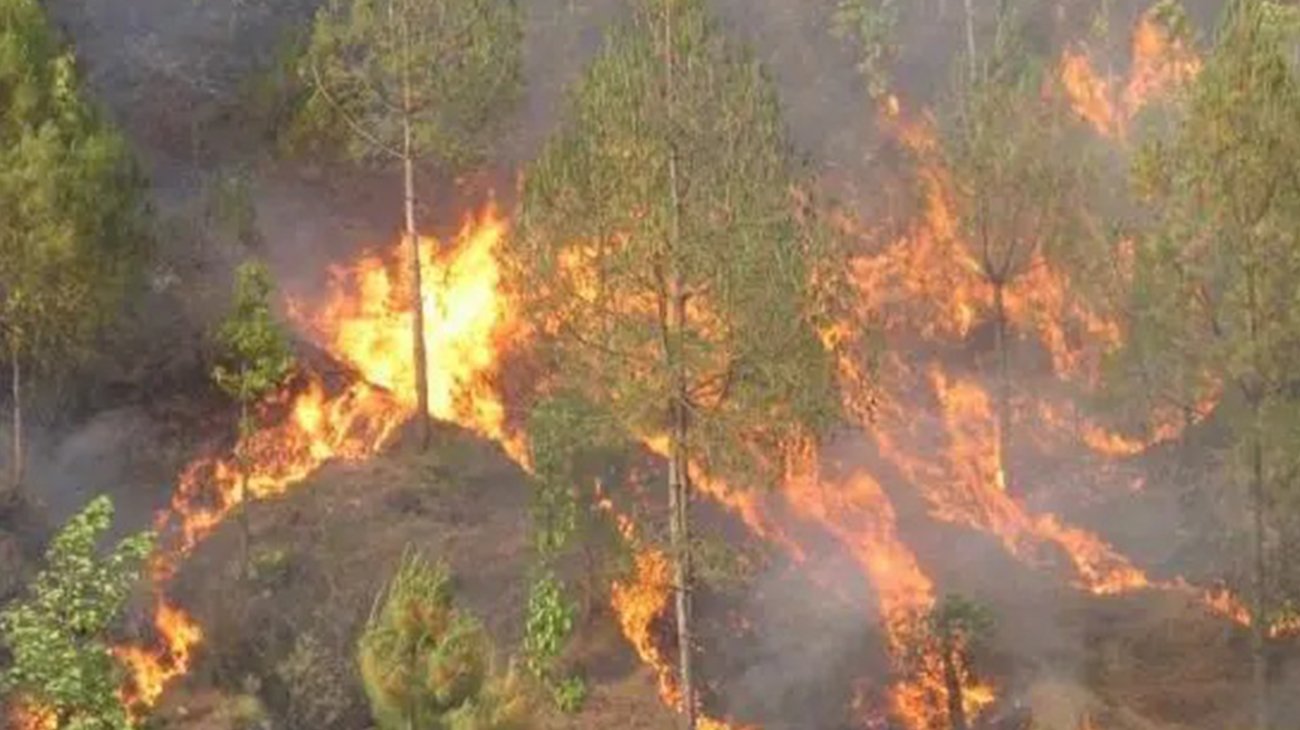
By Pragati Dhakal, Kathmandu, March 19: The country is currently observing the 'forest fire awareness week (March 15-21)' by organising various programmes focussed on prevention of forest fire and raising public awareness on disaster mitigation.
During this period, the Department of Forests and Soil Conservation has released a report on forest fires.
The report mentions that according to satellite data over the past 13 years, the risk of forest fires in the country is increasing. According to the Department's data, 13 thousand 622 forest fire incidents have been recorded nationwide in the last 12 years from 2070 to 2082 BS.
Forest fires have been seen as a serious environmental challenge. According to the report, forest fires in Nepal are of a seasonal nature. About 89 percent of the total incidents of forest fires occurred from mid-February to mid-April.
The report stated that the risk of forest fires is higher due to prolonged dry spells, low humidity, high temperatures, strong winds, the practice of burning agricultural residues, and increased human activity in forest areas during that period.
It has been reported that approximately 57.7 percent of total incidents in the month of Baisakh were forest fires.
The year 2016 has been recorded as the most severe year for forest fires. A significant number of wildfire incidents were recorded in 2021 and 2024.
According to the Department's analytical report, at least 282 fire incidents were recorded across the country from 1st Baisakh to 29th Falgun 2082 BS.
The report stated that although forest fires spread across all seven provinces of the country from 1st Baisakh to 29th Falgun, the Sudurpaschim Province was seen to be the most affected. About one third of the total forest fire incidents recorded in the country during this period, or 33.3 per cent, of forest fires occurred in that province.
Province-wise, Bagmati has recorded 19.1, Karnali 16.7, Gandaki 9.6, Lumbini 8.9, Koshi 8.2, and Madhesh 4.3 percent of wildfire incidents.
During the same period, Kanchanpur became the most affected district. There have been 41 recorded fire incidents there. Chitwan recorded 27, Kailali 19, and Surkhet 18 incidents.
Director General of the Department of Forests and Soil Conservation, Dhirendra Kumar Pradhan, said that to effectively control the increasing risk of wildfires, coordination among federal, provincial and local bodies, community forest user groups, security agencies, the private sector, media and local communities is essential.
Tarai-Chure and Mid-Hills regions at risk of wildfires
In terms of spatial analysis, the Tarai-Chure and Mid-Hills regions have been identified as highly sensitive to the risk of wildfires. In particular, the Tarai-Chure region in Sudurpaschim, the Chitwan–Makwanpur forest area, forests around Surkhet, and the Bardiya–Banke Tarai region are major hotspots for forest fires.
According to Kamala Oli Siwakoti, a member of the President Chure Tarai-Madhesh Conservation Committee, the accumulated biomass in the Chure region, prolonged drought, low humidity, and human activities are the main reasons for the increasing incidence of forest fires.
Preparedness and community roles necessary
Most forest areas in Nepal are managed under the community forestry model. Therefore, the roles of local communities and forest user groups are equally significant in controlling and mitigating forest fires.
According to Thakur Prasad Bhandari, Chair of the Federation of Community Forestry Users' Nepal (FECOFUN), preparedness and broader public awareness are vital for controlling and preventing wildfires. Without proper fuel management, the development of early warning systems, and active community participation, effective control of forest fires is not possible.
Such systems should be activated at the beginning of the dry season.
Rakesh Karna, Chair of the Nepal Foresters' Association, emphasized the need for effective forest management to control and prevent wildfires. “Where forests are well managed, the incidence of fires is relatively low,” he said.
"Forest management is also a means of job creation and income generation at the local level; however, it has not yet been prioritized by the state," he said.(RSS)