- Sunday, 31 May 2026

A Life Shaped By Storms
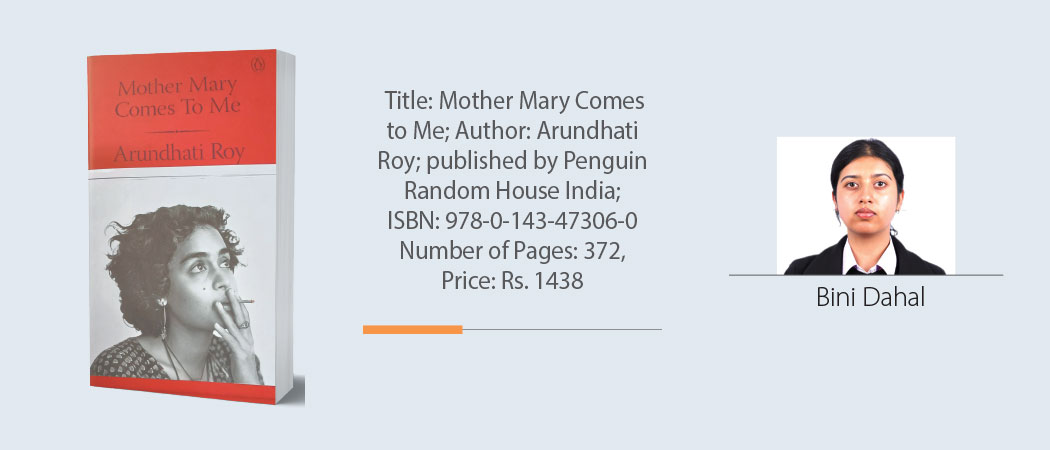

Indian writer-activist Arundhati Roy’s memoir Mother Mary Comes to Me is a deep, intimate and emotional piece of writing, laced with humour. Inspired by her mother’s death, the memoir, her first, pivots around her mother, Mary Roy, and her remarkable life.
Within a few pages, readers gain insight into the dynamics shared by the mother and daughter. Mary was a single parent who left her husband, Mickey Roy (an alcohol abuser), and raised Roy and her brother, Lalith, on her own. Known for her temperamental nature, Mrs. Mary Roy’s parenting was not nurturing. Rather, she always made it a point for the children to know about her dislike for them. Mrs. Roy herself came from a strict family background, her temperament a direct consequence of the hardship inflicted by her Imperial Entomologist father. Her unpredictability was so constant that over time, the writer considered it normal. The latter was always on edge, becoming exceedingly uncomfortable with comfort and normalcy.
Having said that, Arundhati Roy showcases her appreciation for her mother’s strength and resilience. Mary had a strong passion for teaching and had slowly built her school in Kottayam, Kerala, from nothing. Her love, care and attention were heavily centred on the children at her school.
Moreover, Mrs. Roy was feminist in her approach, open and vocal about gender and sexuality. She had made it her mission to unbundle boys from their sense of entitlement and build them into kind and respectful men. Likewise, her focus remained on building the spirits of girls, giving them the spine to face the world.
Mother Mary’s strongest traits were demonstrated when she fought against her brother to get a share in her father’s property. Belonging to a well-read Syrian Christian community, she challenged the discriminatory Travancore Christian Succession Act of 1916. This became the case of Mrs. Mary Roy vs State of Kerala, a landmark Supreme Court judgement of 1986 that now assures equal inheritance rights for Syrian Christian women.
As she describes her mother, Arundhati Roy simultaneously gives an account of her own life. The story of her career journey, transitioning from an architect to an actor and then to a writer, is quite amusing. It is worth noting that Roy’s writing career was heavily propelled by her experiences with her mother. Her acclaimed novel God of Small Things is one such masterpiece. Roy has said that she never explicitly wrote about her mother but rather wrote versions of her.
Over time, we get to see Arundhati Roy’s growth as a writer-activist, though she herself finds the term absurd. It sounds, she says, like ‘sofa-bed’, a clumsy hyphenation of two things that should not require separating. For her, writing about public affairs is simply what writers do. She uses her non-fictional books and essays to tackle various topics, including environmentalism. Her participation in the Narmada Bachao Andolan (Save the Narmada Movement), a fight against the Sardar Sarovar Dam on the Narmada River, is one such cause highlighted in the memoir.
Arundhati Roy’s memoir sheds light on the complex and complicated relationship with her mother. Roy rightly calls her mother both ‘my shelter and my storm’. Her childhood and adulthood were marked by her mother’s mercurial and unpredictable behaviour. Yet, she held deep respect for her mother’s courage. When her mother died in 2022, Roy was left heartbroken and smashed. She had lost, she said, the muse in her writings.
Arundhati Roy delves into her two marriages, explaining her inability to settle into marital domesticity. She describes, "The price I paid for being Mother Mary’s daughter and the writer that I am was not prison or persecution (although there was some of that, too).
It was a catastrophic heartbreak.” This statement reflects how Roy's own family life, in which she never experienced a normal, happy home, led her to believe she could not sustain a long-term relationship.
Arundhati Roy’s writing is rich; she plays beautifully with words, using similes and metaphors to make the memoir lyrical. As a reader, I was concerned by the precarious situation she endured and felt deep fear of the ‘what ifs’. Yet, by the end of the book, I was utterly impressed by her ability to transform pain and trauma into something beautiful. Reading the memoir forced me to examine my own life and appreciate the normalcy and predictability I often take for granted.
I was struck by her willingness to stand her ground on the ethics and values she strongly believed in. Over time, I also came to appreciate Mother Mary’s character. While her parenting was not to my liking, I admired her survivor’s spirit. She had endured massive trauma and struggle and had learnt to be strong in order to survive a harsh world.
All in all, the book is heavy with emotions. It is deep, showcasing Arundhati Roy’s impeccable writing, flowing as freely as water while also shedding light on trauma, intergenerational violence and the molding of Roy’s persona. But more importantly, readers can strongly feel that all these experiences did not diminish her. Rather, over the years, she became more rebellious. As a woman, carrying a rebellious attitude, especially in a traditional society, is not easily digested. However, in Arundhati Roy’s case, we get to see how resiliently she has built a fulfilling life all through her rebellious thoughts and actions. Her rebelliousness was inherited from her mother, who herself refused to conform to the society’s traditional and patriarchal mindset. Nominated for the Women's Non-fiction Prize for 2026, this political yet intimate memoir is interesting and a must-read for all, especially for girls and women.
(Bini Dahal is a Section Officer at the Ministry of Foreign Affairs.)