- Saturday, 2 May 2026

Learning To Live With Grace
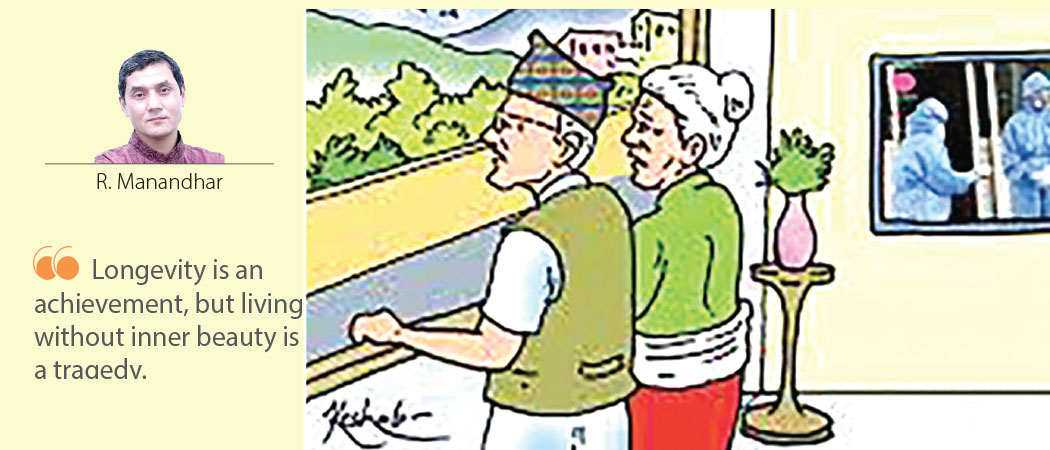

From the moment we are born into this world, we begin preparing ourselves to live in it. From an early age, we receive formal and informal training to succeed in life. Success, as society defines it, means acquiring wealth, recognition, status, and prestige. Indeed, every individual must attain these to some extent for the well-being of family and society; otherwise, it becomes difficult to live with dignity.
Yet, even after achieving partial or significant success in these areas, the later phase of life often becomes deeply challenging—not only for the individual but equally for those around them. The root cause of this challenge lies in the fact that our society makes little or no preparation for old age. In fact, the very need for such preparation is rarely acknowledged. As a result, whether one is a salaried professional, a businessperson, or a political leader, there is little awareness of the changing roles required in later life.
From youth to adulthood, we are engaged in an uphill journey toward the peak of success. Throughout life, we are taught to move forward—to climb higher and higher. Everyone encourages us to go up, but no one teaches us how to come down. At this point, I am reminded of an important statement by Sir Edmund Hillary:
“I personally think that getting down is quite important and that a complete climb is reaching the summit and getting safely to the bottom again.”
This insight is especially significant because many climbers of Mount Everest have lost their lives not while ascending, but while descending. The reason is simple: climbers become so obsessed with reaching the summit that they prepare meticulously for the ascent but inadequately for the descent. Their entire imagination is fixed on standing at the top, pushing the importance of a safe return out of their minds.
The same principle applies to our lives. We learn how to climb, but we do not learn how to descend. This becomes the cause of serious personal and social crises. In mountaineering, such an accident affects only the climber. But in life, failing to descend gracefully into old age affects everyone around us. If the individual is a leader, the consequences affect the nation; if an ordinary citizen, the family suffers.
This does not mean that older people should become inactive. The problem arises when one fails to understand and adapt to age-appropriate roles. Role transition is not something that can be accomplished overnight; it requires long-term preparation and awareness. Even an ordinary salaried employee often feels lost after retirement because there has been no preparation for life beyond work. Once employment ends, people begin to feel as though their very existence has ended Whether one is employed, self-employed, engaged in politics, or a homemaker, just as childhood prepares us for adulthood, adulthood must consciously prepare us—personally, socially, and psychologically—for old age. Only then can old age become graceful and fulfilling.
Challenges of old age
In childhood, youth, and adulthood, social roles are clearly defined: learning during childhood, entering employment during youth, and becoming the economic backbone of the family during adulthood. These roles provide a sense of identity and meaning. However, when old age arrives without preparation, individuals suddenly experience a loss of purpose and identity. Human beings neither wish nor are able to live without a sense of existence.
In such circumstances, many elderly individuals attempt to assert their existence through unusual or disruptive behaviours, which can become negative and harmful. Family members grow frustrated and attempt to resolve the issue through logic and explanation. But this is not a problem that can be solved through reasoning alone. On the contrary, repeated problematic behaviour often leads elderly individuals to be labelled as stubborn. This may sound harsh, but it is an uncomfortable reality in many families.
Additionally, age-related biochemical changes in the brain play a role, and certain parts of the brain gradually shrink. These facts must be understood both by older adults themselves and by their family members. Solutions to these challenges can be found within our own Eastern philosophical traditions, complemented by insights from modern psychology.
Vedic philosophy offers a practical framework for managing the stages of life through the concept of the four ashramas (life stages): Brahmacharya Ashrama (8–25 years), Grihastha Ashrama (26–50 years), Vanaprastha Ashrama (51–75 years) and Sannyasa Ashrama (76–100 years)
The Brahmacharya Ashrama, the phase of learning, begins with the Bratabandha ritual—a traditional initiation into education and discipline—and continues until the age of 25. This stage is not only about acquiring knowledge but also about cultivating discipline and integrity. 'Brahmacharya' does not merely signify sexual restraint; 'Brahman' refers to truth and higher consciousness. This phase lays the foundation for the remaining stages of life.
The next crucial stage is the Grihastha Ashrama, the phase of earning, professional growth, and family responsibility. This stage is vital because individuals in this phase sustain those in the other three stages. The progress of family, society, and the nation largely depends on the energy and enterprise of people in this stage.
Vanaprastha Ashrama does not literally mean abandoning home and going to the forest. The term “Vana”, which means “forest”, is symbolic. This stage represents a gradual transition away from worldly responsibilities, slowly transferring duties to the younger generation. Sudden withdrawal is neither practical nor desirable. It is a period for cultivating non-attachment and shifting from being a doer to becoming a detached witness.
Finally, Sannyasa Ashrama signifies complete renunciation of worldly attachments. It is the stage of dissolving the ego and merging—according to one’s belief—with God, Brahman, or ultimate emptiness.
Core problem
The core issue raised in this article is that, regardless of age, we are unwilling to let go of the Grihastha role. This stage is meant to carry the burden of the world. But even when age renders one less relevant, many refuse to hand over responsibilities to the next generation. In reality, laying down the burden makes one lighter, yet desire and attachment distort this understanding.
Letting go is mistakenly perceived as loss. As a result, people experience emptiness and a loss of identity. This happens because we equate our existence with position and responsibility. We fail to understand that we are not our roles or titles. Our essence is far subtler and deeper.
Just as Brahmacharya prepares one for Grihastha, Grihastha must prepare one for Vanaprastha. Some of my former colleagues shared how difficult it was for them to spend even a few days without work, despite being financially secure. If someone cannot remain at ease without a job even briefly, how difficult retirement must be for them.
I, too, have experienced periods without formal employment, yet I have found them enriching—engaging in self-study, training, creative writing, and spiritual practice. I am now retired from formal employment and have ample time for training, writing, and meditation. Preparing alternative engagements during Grihastha makes retirement far easier.
Key challenges and resolution
Three core insights can help in the mindful management of old age. First, every infant is born innocent and lovely. Yet as we grow older, this charm gradually fades—a bitter reality. Worldliness, without the practice of detachment, erodes the beauty of life. Longevity is an achievement, but living without inner beauty is a tragedy. If age truly brings wisdom, grace should increase, not diminish. Spiritual understanding and the practice of non-attachment restore this beauty. Old age must therefore be understood as a time to deepen non-attachment.
Second, during Grihastha, we tie our identity to our profession, position, or business. Over time, this creates the illusion that these roles define our existence. When retirement arrives, we either cling to these roles or feel utterly meaningless without them. In truth, our real existence is our inner self, which never changes and does not need to be proven. Forgetting this leads to irrational behaviour aimed at asserting one’s existence through negative actions—becoming the root of many problems. Old age is meant to be a preparation for the inward journey. Whether we wish it or not, we must one day leave this world, and that departure should be peaceful. Religion does not view death as the end of life; preparation for what lies beyond is equally important.
Third, time is not only constantly changing, but the speed of change is accelerating. In the past, elders were the primary source of knowledge due to their experience. In the digital age, this has reversed—youth often possess greater technical knowledge. Where society once depended on elders for wisdom, elders now depend on youth even for basic technology. Understanding this shift is essential for older generations.
Despite everything, the essence of life cannot be found in technology alone; it must be lived. Young people must understand this and cultivate humility. They must also recognise that today’s society stands on the struggles and sacrifices of the older generation. The freedom we enjoy today has come through their efforts. Respecting elders and seeking their counsel therefore remains vital.
At the same time, young people must remember that the pace of change will be even faster tomorrow—and that they, too, will become “irrelevant” sooner than they imagine. We are all moving within this unceasing cycle of time.
(The writer is a leadership trainer, psychological counselor and explorer of Eastern philosophy.)