- Thursday, 28 May 2026

The Flying Green-ness


Recently, while concentrating on the verses of poet Raja Puniani’s Tangsing, an anthology of Nepali eco-poetry, some questions appeared and intimidated me.
Can we imagine the world such as Silent Spring (Rachel Carson) when the chirping birds disappear and the flowers forget to bloom?
Can we bear the consequences of wailing trees and perishing green-ness?
Such questions have been consistently haunting me for quite some time.
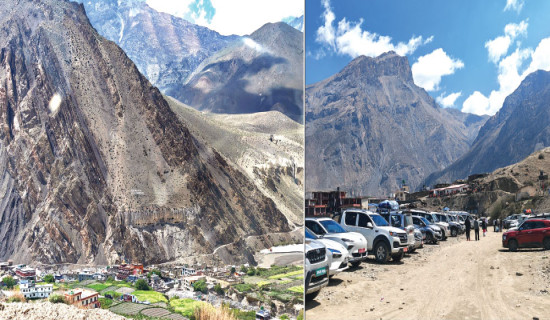
It became more intense when I visited my village, Chhattredeurali (close to Kathmandu) a few months ago. I could hardly recognize my own place since the natural beauty and uniqueness of the indigenous village have been ravished. Primarily, serenity and previous village-ness are nowhere to be seen. The dusty and bumpy road and continuously speeding noisy trucks are the latest visuality of the place.
Anthropologist Mary Deschene takes her position against proliferating wrong development model in Nepal. Her viewpoint becomes more penetrating when I encountered the distorted face of my village. Lots of fertile lands of the villagers are encroached by the latest road extensions. They got tiny or no compensation at all for their massive loss. In fact, nothing could properly compensate the loss of agricultural lands of the villagers. Apart from that even in the small village area, hundreds of trees are cut down while widening the road. The axed trees seem to be pleading as it does in Puniani’s poem.
While falling down
taking a long breath
the young sal tree
told the axe-
…
I wanted to listen the rhythemic sigh of a traveller under my shade…
I wanted to treasure the morning and evening chirping of birds
(Tree Portrait-2)
Apparently, the poet is sensitive enough to capture the outcry of dying trees. Moreover, he highlights the bitter truth in relation to the permeating human exploitation on nature. The poet has foreseen the nearing environmental crisis that he expressed through his creativity. Burgeoning human greed and exploitation of nature will surely smash down the human world. As everything comes with certain price, we have to payback, which is the common rule of the nature. However, we have completely forgotten that everything is connected to everything else that Barry Commoner sheds light on. Human beings have reached each nook and corner of the earth subsiding her message into a trash-bin. Needless to say, we are to suffer: consequences have already started emerging on the surface.
The ongoing road project in my village has not adopted proper precaution to minimise the environmental damage. They have already cut down numerous trees and also destroyed the old padhera (stone spouts), which provided pure drinking water for many generations. It was not a mere tap, but a symbol of local culture. It had quenched thirst of the villagers from time unknown, as it was the only source of water in the area. The stone tap was extremely important for pure drinking water as well as the central space for some rites and rituals. I still remember that from every bratalu (the persons on fast) to the mourner used to bathe and perform necessary rituals in the fountain. Moreover, it was the place for chitchatting of the crowd of women, who used to open their heart and ventilate their emotions with friends while fetching water.
Such activities were the vital part of village life. However, the morning chants, mantras and splashes of water are lost. Rhythm of children’s giggle, laughter of a bunch of women and the Saturday crowd−all are vanished in the black-hole of the past. The real attributes and flavour of small village are swept away. It was not only the road project but also the gigantic chimney of the brick factory, which consistently spew poisonous smoke, erected in a paddy field have snatched away the peace, beauty and fresh air of the locality. The increasing environmental issue has tolled the bell against the human deeds. It looks as if the falling trees and deteriorated condition of nature are pleading for their life. However, how long will the human world survive without proper harmony with the nature? The question is rather serious.
In the past, people were close to the soil, water and trees. They were covered with the greenness of nature and the warmth of the earth. They could inhale fresh air and maintain harmonious relationship with living and non-living neighbors. People carried no baggage and belongings; they lived smooth and natural life. They could unhesitatingly share their pain and open up their heart and feel lighter: even lighter to the flying feather. More importantly, people were close, sensitive and respectful towards the universe.
Nevertheless, rising greed and swollen pride have smeared the purity of human heart. Since then, they have been massively exploiting nature just to extract her riches. These days, we hear the painful resonances of the falling and dying trees. As a result, we are surrounded by our Alzheimered days. There are no green memories left to cherish. The joyous era is erased like someone rubbed a chalked blackboard. The trees are flying away; so is our secure future. Puniani appears with his verse that touches everyone softly,
The tree
sees a natural dream
The tree has got wings
and then
It’s flying
The tree is flying
Far far far
away from the surface of the earth.
(Tree Portrait-3)
(Kumari Lama is an Assistant Professor of English at Tribhuvan Multiple Campus (TU), Palpa. She is an essayist and a critic.)





-original-thumb.jpg)