- Friday, 22 May 2026

Memoirs Of A Fearless Bureaucrat

Subhash Chandra Garg, an administrator of repute and a prolific writer with at least three insightful books to his credit that he has contributed after voluntary resignation from the Indian Administrative Service (IAS) in 2019, has come out with yet another book detailing his life and experience in the prestigious service.
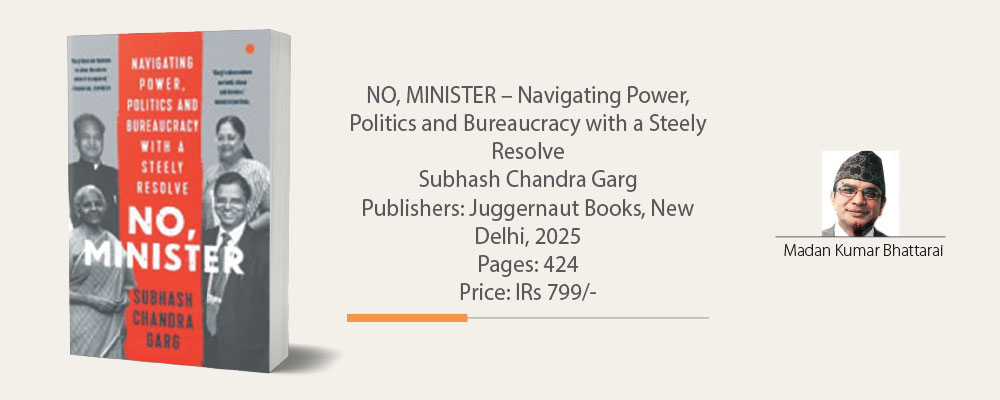
The title of Garg's new book, NO, MINISTER – Navigating Power, Politics And Bureaucracy With A Steely Resolve, is self-explanatory in the sense that it succinctly portrays the contents of the book and his less than cordial relations with ministers he served during his 36 years' innings. It is more than a memoir and something that lies between memoirs and actual states of affairs in the country.
The attractive front cover depicts the author with two chief ministers of Rajasthan, Ashok Gehlot and Vasundhara Raje, and the Union finance minister Nirmala Sitharaman, as he had a rather frosty relation with his political bosses and, at times, had problems with his superiors in service too.
Garg is widely acclaimed as an established expert in the field of fiscal management. Known for his strong approach to fiscal discipline and close scrutiny of central funds, one senior IAS officer even called him a smiling assassin, despite the fact that top bureaucrats who manage finance are generally bound to attract criticisms all over the world.
Garg, belonging to the 1983 batch of the Rajasthan cadre of the IAS, held important assignments after a brief stint at Oil India Limited, including positions of finance secretary and India's executive director in the World Bank. In his capacity as both executive director and secretary, Department of Economic Affairs, he is credited with having played a pivotal role in several negotiations for positively resetting India's ties with the World Bank and International Monetary Fund.
A prolific writer and commentator on public policy issues and an acknowledged expert on budgetary matters, Garg has already earned acclaim for his earlier publications. Out of three books he brought out in the last three years, The $10 Trillion Dream, We Also Make Policy, and The $10 Trillion Dream Dented, the second one focuses on his life and achievements in the IAS and circumstances leading to his voluntary resignation from the service.
The new book is of special interest to all those who wish to know the insightful account of the working of India's top civil service. It is divided into three broader parts apart from an enlightening prologue and epilogue. Part A, dealing with administration in Rajasthan, is subdivided into 14 chapters detailing his experience that he had in the state during his first 15 years in the service before being asked to go to the centre in 2000 on deputation.
The writer gives credit to his initial posting at the centre as Director, Department of Economic Affairs, which was destined to not only transform the future of his life as a top bureaucrat but also manage economic affairs both nationally and internationally later.
Part B, taken as the shortest of three chapters, literally jumps from Part A in the sense that it covers his second innings in the Rajasthan government after coming back from the central deputation in 2006. The writer acknowledges that his six-year stint in the union government, then under the premiership of Dr. Manmohan Singh, was rewarding in the sense that the experience considerably helped him establish credentials as an expert on economic and financial management.
Part C is the longest chapter with a substantive focus on his service at the World Bank and central government with top-level policy and policy-execution assignments under the Narendra Modi government. He was quite fortunate in being Executive Director, World Bank, as the first additional secretary-level officer to assume the position, as his predecessors were either retired or about to retire secretaries and even a cabinet secretary.
It was an irony that while he owed the Modi government for getting crucially lucrative assignments like Executive Director, World Bank, and Finance Secretary to the Government of India, he was forced to seek premature retirement from the service at least a year before his actual time of superannuation, owing to serious differences with the ministers of the same government.
During his probation days, Garg saw and felt the impact of the assassination of Prime Minister Indira Gandhi, massive anti-Sikh protests followed by large-scale violence in Delhi and its reverberations all over the country, and the dreadful Bhopal gas leak just prior to Lok Sabha elections that returned Rajiv Gandhi with an overwhelming mandate.
The author recalls his disputes and difficult moments of exchanges with many top functionaries both within the service and outside. Balaram Jakhar, once a Lok Sabha speaker and Congressman, was one of those who even refused Garg's inclusion in a team destined to go abroad.
He calls P. Chidambaram a tough boss with hard work and a meticulous nature and thorough study of files as his principal attributes. He also gives insight to how then Congress Vice-President Rahul Gandhi publicly humiliated his own scholarly and suave Prime Minister Dr Manmohan Singh, picked by no others than his own mother, Sonia Gandhi.
This pertained to circumstances leading to acute embarrassment for the technocrat prime minister meted out by Rahul Gandhi as the latter publicly tore the ordinance passed by the cabinet earlier.
He also speaks of the asset of Prime Minister Narendra Modi in reposing full confidence in top bureaucrats, as he is reported to have told Garg that the latter represented a combination of both Arun Jetley and Piyush Goel, taken as top-level confidants of Prime Minister Modi.
While repeating some aspects pertaining to his seeking premature voluntary resignation from IAS that he had mentioned in detail in his earlier book, Garg draws what he prefers to call the central conclusion that a bureaucrat needed to be guided solely by the consideration of public interest.
He also exhorts civil servants to ensure that public interest is compromised at no cost even if the political boss is adamant in fulfilling his or her own personal or partisan interest. This is the hallmark of the book that makes scintillating insights into the workings of the Indian administration. I congratulate the author on his wonderful endeavour.
(Dr. Bhattarai is a former foreign secretary, ambassador and author. kutniti@gmail.com)