- Friday, 22 May 2026

House approves Alternative Finance Mobilisation Bill
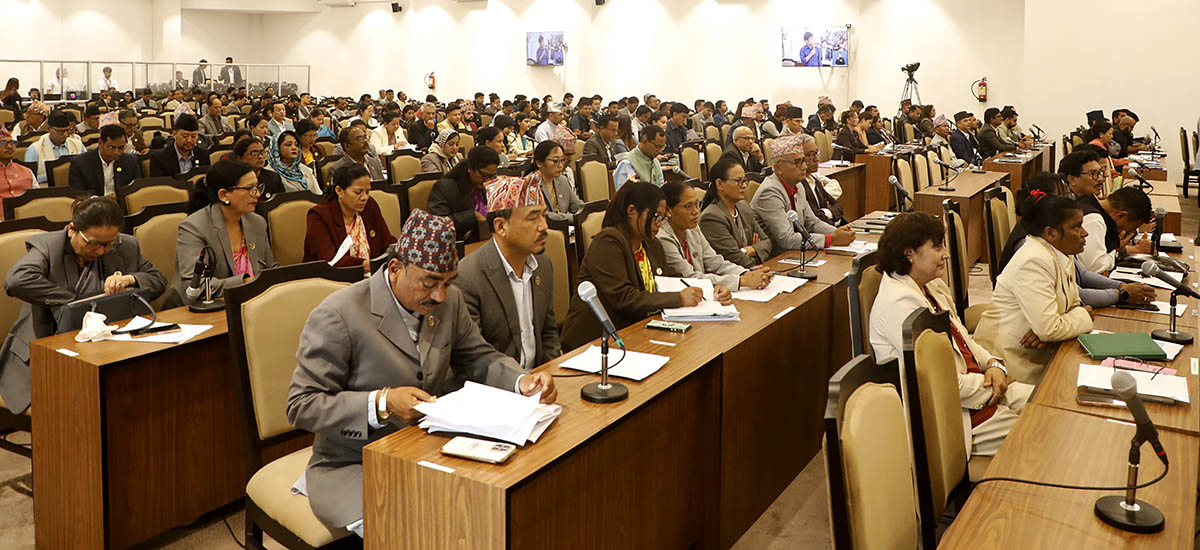

By A Staff Reporter,Kathmandu, May 22: The House of Representatives (HoR) on Thursday passed the Alternative Development Finance Mobilisation Bill, 2082, amid continued objections from opposition parties, demanding that Prime Minister Balendra Shah appear before the House for a question-and-answer session.
The bill was endorsed by a majority vote during Thursday’s meeting of the HoR after Finance Minister Dr. Swarnim Wagle tabled a proposal, seeking its approval.
Speaker Dol Prasad Aryal announced the bill’s passage even as opposition lawmakers continued chanting slogans from the well of the House.
The House also approved proposals to consider three additional legislation by majority vote. These included the Election of Members of the House of Representatives (First Amendment) Bill, 2083, the Voters’ List (First Amendment) Bill, 2083, and the National Forensic Science Laboratory (Establishment and Operation) Bill, 2081.
Minister for Law, Justice and Parliamentary Affairs Sobita Gautam presented the proposals on behalf of Prime Minister Shah. Speaker Aryal invited lawmakers to participate in discussions on the proposals before moving them forward for approval, stating that no names had been registered for deliberations.
The opposition parties, including the Nepali Congress, CPN-UML, Nepali Communist Party, Shram Sanskriti Party, and Rastriya Prajatantra Party, continued to demand the Prime Minister’s presence in parliament, stating that regular interactions between the executive head and lawmakers are important for parliamentary accountability.
The dispute led to repeated disruptions throughout the day. Earlier in the meeting, Speaker Aryal suspended proceedings for 15 minutes and held consultations with Prime Minister Shah in an effort to ease tensions and build consensus among the parties.
Despite the disagreement between the ruling and opposition sides, the House resumed proceedings and continued with the scheduled legislative agenda.
Opposition lawmakers later boycotted the clause-wise discussion and final voting on the Alternative Development Finance Mobilisation Bill, while the ruling coalition argued that parliamentary business should continue alongside political dialogue.
Ruling lawmakers maintained that important legislative work, particularly bills related to economic management and institutional reforms, should not be delayed indefinitely because of procedural disputes. The newly endorsed bill is expected to create a legal framework for mobilising alternative sources of development finance for national projects and infrastructure development.
MPs raise diverse issues during zero hour
While much of the attention remained focused on the parliamentary deadlock, lawmakers also used the zero hour of the meeting to raise a broad range of public concerns affecting people nationwide.
Several MPs urged the government to reduce pressure on ordinary citizens through a more balanced taxation system and accelerate long-delayed infrastructure projects. Lawmakers said roads, bridges and airport projects in remote districts had remained incomplete for years, causing hardship to local communities, particularly with the monsoon season approaching.
One of the major issues raised during the session was the increasing destruction caused by monkeys and wild boars in agricultural areas. MPs from both ruling and opposition parties said farmers in many districts were facing heavy crop losses, discouraging agricultural production and affecting rural livelihoods.
UML lawmaker Rajendra Rai said residents in his constituency in Dhankuta had repeatedly complained about damage caused by monkeys. Referring to concerns raised by locals, he said the issue had become a serious challenge for farming communities and called on the government to present an effective response.
Independent MP Mahabir Pun stressed the need for long-term scientific solutions rather than temporary measures.
He argued that the issue required research and technological innovation, noting that even developed countries had struggled to find effective ways to manage monkey populations. He also proposed allocating funds for research into sustainable control measures.
Similarly, Ashika Tamang called for humane and environmentally sustainable solutions. She suggested planting fruit-bearing trees within forests to reduce the movement of monkeys into farmlands and encouraging farmers to cultivate crops such as ginger and turmeric that are less prone to damage.
Lawmakers also raised concerns over increasing road accidents and called for stronger public safety measures. Rastriya Swatantra Party lawmaker Toshima Karki stressed the importance of improving road safety standards and emergency response systems, saying infrastructure development should be accompanied by adequate protection for the public.
Other issues discussed during the session included shortages of cancer medication, allegations of irregularities in taxi registration systems, unresolved border disputes between Humla and Bajura districts, and delays in rescuing a Yarsagumba collector, who had fallen ill, in Bajhang.
Lawmakers also voiced concern over the proposed dissolution of the National Child Rights Council and urged the government to ensure that institutions working on child welfare and social protection remain effective and functional.
The next meeting of the House is scheduled for may, 26 at 11 AM.