- Friday, 22 May 2026

Water Fairy Of Jagdishpur
 Rajesh Dhungana
Rajesh Dhungana
Rajesh Dhungana
Jagdishpur Lake in Kapilvastu is Nepal’s largest man-made reservoir and one of the country’s most important wetlands. Built in the 1970s to provide irrigation water to farmers, the reservoir has gradually developed into a rich habitat for many resident and migratory birds. Recognising its ecological value, the wetland was listed as a Ramsar site in 2003 under the Ramsar Convention on Wetlands of International Importance. Covering 225 hectares, Jagdishpur is also regarded as Nepal’s second-largest bird sanctuary.
Every winter, the reservoir hosts more than 110 migratory bird species. Birds arrive from distant regions such as Siberia, Russia, Turkmenistan, Kyrgyzstan and other parts of Central Asia. For bird lovers, Jagdishpur has become one of the best places in Nepal to observe wetland birds in their natural setting. Among the many birds that visit the reservoir, the pheasant-tailed jacana (Hydrophasianus chirurgus) stands out for its striking appearance and graceful movement. In Nepali, it is known as Jal Apsara, meaning “water fairy".
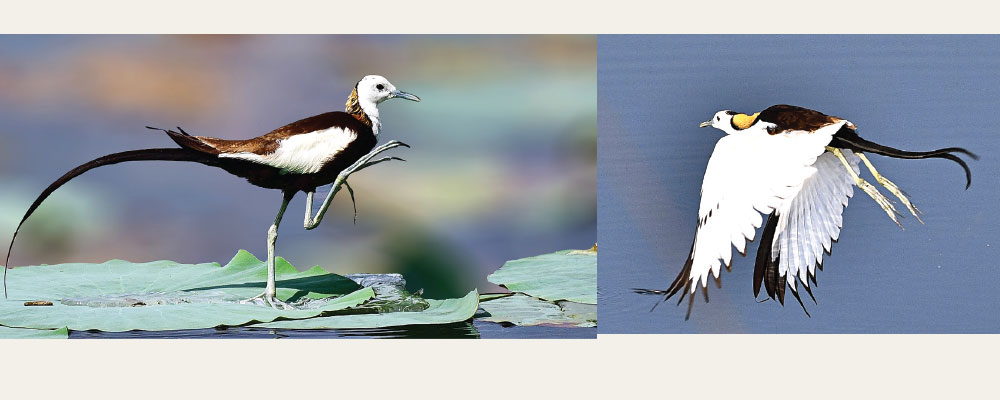
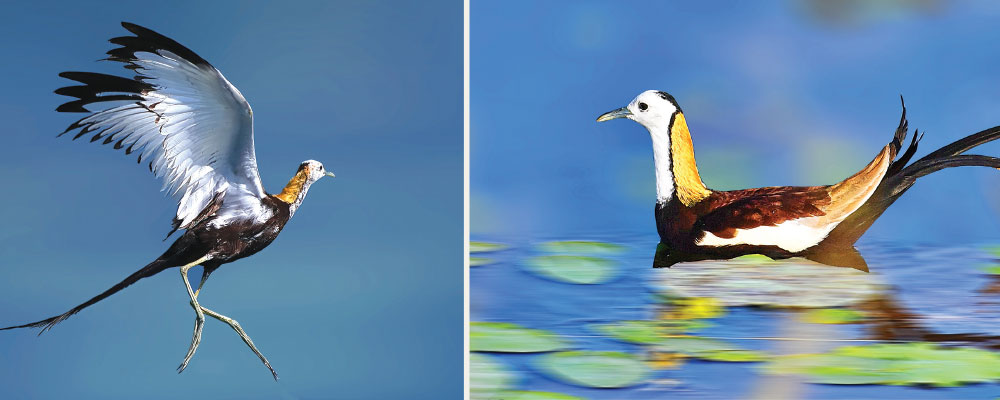
The name suits the bird well. With its long tail, broad wings, slender legs and unusually long toes, the jacana appears elegant both in flight and while walking lightly across floating leaves of lotus and other aquatic plants. The pheasant-tailed jacana is commonly seen in Jagdishpur, especially in the eastern and southern sections of the reservoir. It is also found in other wetlands and ponds across Nepal. Many domestic and foreign birdwatchers visit Jagdishpur specifically to see this beautiful species. The bird is widely distributed across tropical Asia. Its breeding range extends from Nepal, India and Sri Lanka to Southeast Asia, China and the Philippines.
During the breeding season, the bird develops long central tail feathers that give it its English name. Its body turns rich chestnut brown, with a white face, a black crown and a golden-yellow patch on the back of the neck. In flight, its white wings edged with black create a particularly striking sight. Females are larger than males. A female usually weighs between 190 and 200 grams, while a male weighs around 120 to 140 grams.
The pheasant-tailed jacana feeds mainly on aquatic insects, molluscs and other small creatures found in floating vegetation. It also eats seeds, algae and bits of plant material. Breeding takes place during the monsoon, from June to September.
The species has an unusual breeding system: one female may mate with several males and lay up to 10 clutches in a season. Each clutch contains four dark olive-brown eggs marked with glossy black.
Once the eggs are laid, the male takes over incubation, which lasts 26 to 28 days. He also cares for the chicks after they hatch, while the female may seek another mate.
Although the pheasant-tailed jacana is listed as a species of least concern by the IUCN, it faces threats from wetland loss, habitat degradation, human disturbance and excessive pesticide use. The continued protection of Jagdishpur Lake is essential for the survival of this enchanting water bird and the many other species that depend on Nepal’s wetlands.
(The author is a wildlife photographer. Photos used in this article are by the author.)