- Friday, 22 May 2026

Design Thinking To Transcend Problems

There are two versions of most problems. The one everyone agrees is the problem. And the actual problem. I have spent years living in the gap between those two things. Working with brands, building systems, sitting across from clients who are convinced they need a new logo when what they actually need is clarity about who they are talking to. And then walking into a classroom at Shanker Dev Campus, looking at a room full of business students, and realising the gap starts even earlier than I thought.
We are not taught to question. Not really. We are taught to answer. To perform competently. To have the solution ready before we have fully understood what we are solving for. That costs more than we think. Not just in business. In the way we communicate, the way we collaborate, and the way we make decisions that affect other people. I did not always have the language for this. For a long time it was just instinct. Something felt off about jumping to solutions. Something felt important about slowing down and asking one more question. I thought it was just how I was wired.
Then I encountered design thinking formally, through my studies in user experience design, and everything clicked. Not because it taught me something new. Because it named something I had been doing all along and showed me it was not just instinct. It was a discipline. One that belongs to everyone.
Where I come from, questioning isn't always encouraged. Politeness often means going along, staying smooth, and not disrupting the room. For a long time, I carried that too. It was through studying user experience design that something shifted. Not a new skill. Not a technique. A permission. I began to understand, through the work, through the process, why questions aren't just acceptable. They are necessary. Skipping them doesn't save time. It wastes it. You move fast in the wrong direction, burn resources, build things nobody needs, and solve problems that aren't the real ones. All because nobody stopped to ask.
Design thinking gave me the language and the confidence to take that mask of politeness off. To say, do we actually understand the problem? Not as a disruption. As discipline.
It is a problem-solving system. And you do not have to be a designer to use it. At its core, it moves through five stages: empathise, define, ideate, prototype, and test. But forget the labels for a moment. Here is what it actually looks like as a human being: You start by genuinely trying to understand a situation, not through assumption but through curiosity. You talk to people. You observe. You listen more than you speak. Then you define the real problem, which is almost never the one you walked in with. You generate ideas, try the most promising ones in small, low-risk ways, and see what works. Then you refine and go again. That is it. The magic isn't in the steps. It is in the mindset: stay curious before you commit. That is what struck me in those first few days of formally learning it.
I kept thinking, 'I have been doing this all along.' Trying things, noticing what breaks, rebuilding better. Over and over again. I wasn't following a framework. I was just paying attention. Design thinking didn't change how I thought. It validated it. Showed me it wasn't just instinct; it was a discipline. One with a name, a structure, and decades of thinking behind it.
That was the shift. And it made me more confident, not less. Because now I could explain it, teach it, and bring others into the process.
I see that same moment happen in my classroom every semester. A student connects something from the curriculum to a decision they made instinctively in a project, in a team, or in their own life, and something clicks. That recognition is not small. It is the beginning of thinking more deliberately about how you solve problems.
James Clear writes: "Goals are for people who care about winning once. Systems are for people who care about winning repeatedly." Design thinking is a system. And systems belong to everyone.
Think about the last time you had a misunderstanding with someone – a colleague, a partner, a friend. Chances are it wasn't a disagreement about facts. It was a misalignment. Two people are thinking from different perspectives, neither of them wrong, but both of them talking past each other.
That is not a communication failure. That is a design problem. And it has a design solution. Go back to empathy. Understand their perspective before defending yours. Define the actual issue before jumping to fixes.
Different perspectives aren't the problem. They are the raw material. The process is what turns that diversity into alignment. Morning routines. How you plan a difficult conversation. The way you approach a problem at work. Even how you take care of yourself. Nothing is static. Everything is iterative. And that is not exhausting; it is clarifying.
Because you stop expecting things to be perfect on the first try, and you start building something that actually works over time.
That is healthy. Not just productive, genuinely healthy. For your work, your relationships, your thinking. Nepal is producing more graduates, more entrepreneurs, and more professionals than ever before. But the challenge has never been talent. It has been clear. The ability to identify the right problem, align a team around it, and move forward with confidence.
That is exactly what design thinking teaches. Not creativity as a gift that you either have or don't have. But problem-solving is a practice anyone can learn and apply.
If we want business leaders, educators, and young professionals in Nepal who can navigate complexity and build things that actually work for people, this is the kind of thinking we need to be developing. In our organisations and in our classrooms.
Once you start seeing problems as things to understand before solving, you can't go back to guessing. You don't need a design degree for that. You don't need post-its or a whiteboard or a workshop.
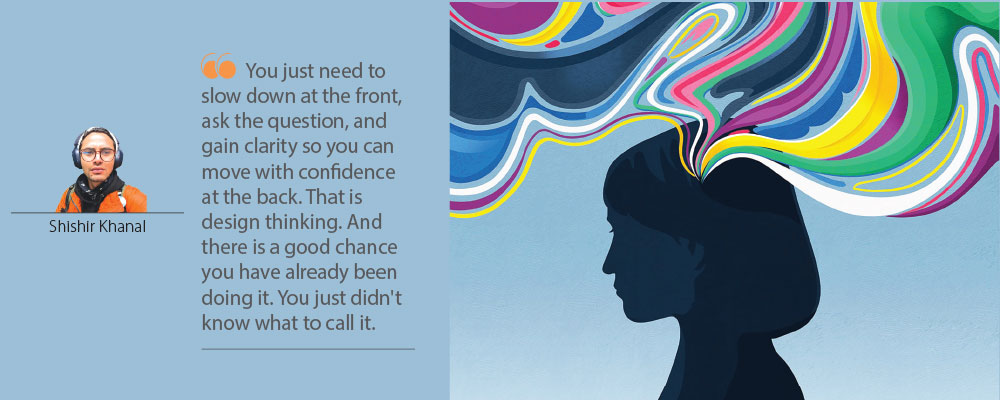
You just need to slow down at the front, ask the question, and gain clarity so you can move with confidence at the back. That is design thinking. And there is a good chance you have already been doing it. You just didn't know what to call it.
(The author is a creative director and teaches IT and application at Sankar Dev Campus.)