- Friday, 29 May 2026

Left Unity Talks: A Desperate Move
Following their humiliating debacle in the March 5 general elections, the top leaders of the CPN-UML and the Nepali Communist Party (NCP) have discreetly begun talks to unite their parties. This is seen as an attempt to thwart the challenge to their leadership that both face within their respective parties. UML chair KP Sharma Oli and NCP chair Pushpa Kamal Dahal Prachanda are now reeling from the worst phase of their political career. They were supposed to pave the way for the second-rung leaders to take on the mantle of the parties on the moral ground after the Rastriya Swatantra Party (RSP) routed them in polls. But they are digging in their heels over the growing calls for quits, only to further destroy their remaining support base.
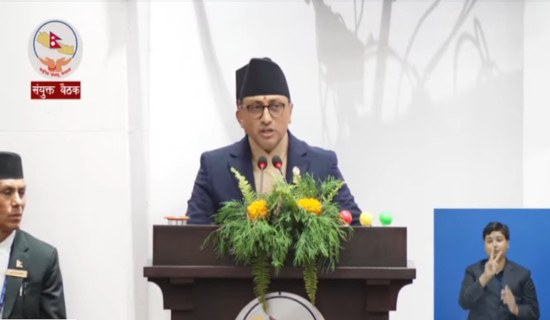
What is more bizarre is that Oli is now relying on former Maoist leaders to revive his shattered political legacy. His own lieutenants have reportedly stood against giving continuity to his leadership. This is perhaps a reason why he picked the senior vice chair and former Maoist guerrilla commander Ram Bahadur Thapa Badal as the UML’s Parliamentary Party leader. Oli’s inner circle fumed over Badal’s pick. His controversial speech, delivered in the first meeting of the new House of Representatives (HoR) on April 2, clearly showed a hangover from his days of violent campaigning. The UML was forced to redact his remarks following the widespread protests inside and outside the party.
Talks for unity
Now, Oli has mobilised another former Maoist leader - Lekhraj Bhatta, also UML deputy general secretary – to hold talks with NCP chair Pushpa Kamal Dahal Prachanda on possible left unity. Prachanda went to meet Oli in hospital in a clear sign of thaw in their relationship marked by mutual brickbats and attrition. It is believed that the loyalists of the two leaders have been engaged in talks for unity. But, cadres of both parties have vehemently opposed the unity talks, terming it an ill-timed bid aimed at overcoming the unprecedented threat to their leaders.
The unity proposal has not gone well with UML leaders and functionaries, who insist that unity without a clear ideological basis is bound to collapse, as seen in the past. In a Facebook post last week, UML leader Surendra Pandey made a scathing comment: “Yesterday, unity was forged to grab a post, today to save their fading existence. The parties’ unification is carried out with unambiguous thought and principle, not to fulfil the interest of a few.” Pandey’s statements indicate the tragic end of unity between the UML and the then CPN-Maoist Centre. In May 2018, the two parties formed a unified Nepal Communist Party (NCP) but an intense factional feud eventually led to its disintegration in 2021. That unity was seen as unity between ambitious leaders - Oli and Prachanda – to suit their parochial interests.
The UML rank and file look askance at the unity talks. A majority of UML’s office-bearers have stood against the immediate unity with the NCP. They see it as a ploy to fudge the factors behind the humiliating election loss and discourse on leadership transfer. Even those leaders close to Oli have dismissed it. They have laid emphasis on internal unity and objective assessment of the poll outcomes. Media reports cite that UML top brass, including vice chair Bishnu Paudel and general secretary Shankar Pokharel, have teamed up to give Oli his marching orders to check the party’s steep decline. Both have reportedly urged Oli to step down from the party’s chair.
The UML stalwarts want Oli’s graceful exit. In case he refuses to resign, he will be ousted by a majority of the secretariat. Some leaders have even started a signature campaign to hold a special convention but it requires the backing of 75 per cent of the party delegates of its previous convention. Meanwhile, former president Bidya Devi Bhandari has also intensified her activity to assert her role in the UML. Earlier, Oli had blocked her entry into the party by nullifying her party membership. This is perhaps the right moment for her to avenge Oli by boosting the campaign to drive him out of the party. She can be a unifying figure to bring the party back from the brink.
On the other hand, Prachanda has become soft towards the unity bid with a hope to be the opposition leader in the Lower House and a member of the Constitutional Council in that capacity. If the UML and NCP unite, they will have 45 seats, surpassing Nepali Congress (38) in the 275-member HoR. Following the party’s continuous decline, Prachanda is under huge pressure to pass the baton. The NCP has three former prime ministers, but it bagged only eight seats in the first-past-the-post system. Pachanda has proposed holding the party’s convention within six months but there has been a strong demand that all old heavyweights – Prachanda, Madhav Kumar Nepal, Jhalanath Khanal and Bamdev Gautam – leave the executive position in the party.
Investigation
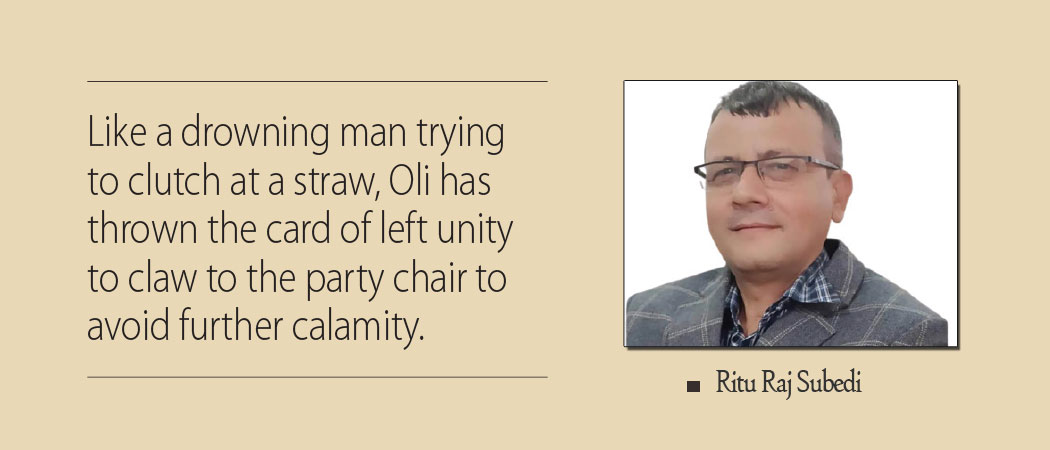
Oli is now under investigation for his alleged role in the killing of youths during the Gen Z revolt last September. The new government has also started investigating three former prime ministers, including Oli, in a money laundering case. In addition, several high-profile corruption scams involving Oli are pending in the Commission for the Investigation of Abuse of Authority (CIAA). Like a drowning man trying to clutch at a straw, Oli has thrown the card of left unity to claw to the party chair to avoid further calamity.
The roots of Oli’s political downfall can be traced to his own disastrous move to dissolve parliament twice, where the left alliance of UML and Maoist Centre secured nearly two-thirds majority. Nepali people handed a huge mandate to communists for their nationalistic stance in the 2017 three-tier elections. The then NCP leadership in the government betrayed the people’s trust and abysmally failed to deliver on their promises. Now the communists have lost much of their lustre among the people, let alone the left unity.
(The author is Managing Editor of this daily.)
(The author is Managing Editor of this daily.)