- Thursday, 28 May 2026

Corruption Control And Growth In Priority
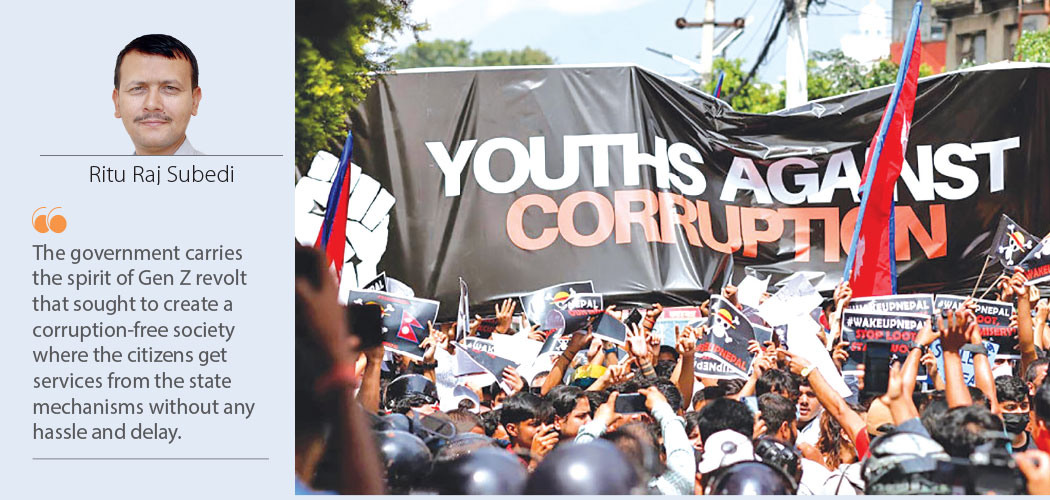
Good governance is the key to stability, growth, equality and prosperity. Many regimes across the world have collapsed when they fail to deliver good governance and development to the people. Good governance promotes efficient resource allocation, the rule of law and transparency. It enhances the people’s participation in the decision-making process and development works. But it can be implemented when corruption is eradicated root and branch. The citizens put trust in the political leadership and government if they realise good governance in every organ of the state. It creates necessary conditions to mitigate conflict, develop consensus and attain sustainable development.
In Nepal, every political party has been talking about good governance for decades, but the people have hardly felt it in their lives. It has become a catchy phrase but has remained elusive. It is not that there is no legal framework to establish good governance in the past. In 2008, the Good Governance (Management and Operation) Act, 2064 (2008), was enacted to make civil service accountable and people-oriented. It stipulates theoretical ground to ensure inclusive development that takes the concerns of the real stakeholders into account and ends red tape and cumbersome procedures for better performance. The Right to Information Act, 2064, the Prevention of Corruption Act, 2002 and the Local Government Operation Act, 2017, are some vital legal instruments that enable to translate Good Governance Act into action. The new constitution, promulgated in 2025, has envisioned a clean government capable of executing the people’s fundamental rights.
Legal framework
However, the legal frameworks alone are not sufficient to achieve good governance until there is political will and honest leadership. In the past, the old political parties of different hues made 'good governance' their slogan to pull the wool over people’s eyes. Instead of building a corruption-free nation, they themselves indulged in one corruption case after another. The country has witnessed numerous corruption scams since the restoration of multiparty democracy in 1990. In every election, the electorates stood against the establishment and voted for the opposition parties so that the new government would bring smiles on their faces. The successive governments betrayed the people’s mandate. This is like the people’s Sisyphean struggles that never come to an end.
More than five weeks into office, the new government under Balendra Shah has taken a series of sweeping measures to put the country on the right track. First and foremost, it is determined to establish good governance, curb corruption and attain sustainable growth amidst the deepening energy crisis. Riding on the huge electoral mandate, it appears not to waste a single minute on the cause of the nation and its people. Prime Minister Balendra Shah convened the first Cabinet meeting on the same day the government was formed on March 27, 2026. The meeting took a bold decision to arrest former prime minister KP Sharma Oli and former home minister Ramesh Lekhak for their alleged involvement in the killing of scores of youths in the Gen Z movement last September.
The government carries the spirit of Gen Z revolt that sought to create a corruption-free society where the citizens get services from the state mechanisms without any hassle and delay. Respecting the voice of the martyrs and their family members, the government swiftly moved to check the impunity that the nation has endured for decades. Giving justice to the martyrs means recognising the demands and aspirations of youths who want their destiny sealed in their soil by overcoming instability, precarious economy, entrenched corruption and high unemployment rate. So the legal action against those involved in the killing of innocent youths marks a decisive step towards ending impunity. It will be difficult to establish order and governance when the culture of impunity is not done away with.
The government has brought eight ordinances that enable it to overcome legal hurdles that come in the way of implementing its sweeping measures to establish good governance and give momentum to the development works. The ordinances seek to solve the problems of cooperative victims, improve procurement laws and appoint fresh faces in different public offices and constitutional bodies. The ordinance related to the Constitutional Council will end the deadlock seen in the appointment of various constitutional wings. The government’s steps are in line with its ‘100-point reform action plan’ that has set an ambitious economic agenda for the next five years.
Pragmatic approach
However, the government should adopt a pragmatic approach when it comes to revamping the entire administration and delivering on its promises. It has to further clarify its vision before the people. It has announced to recruit new ambassadors through an open competition. It appears to be rhetoric. A person with competence and dignity will not apply for an ambassadorial position. The government has to search for such individuals who represent the country abroad. The government has also run the gauntlet for not showing humanitarian feelings for the landless squatters evicted from different places in the Kathmandu Valley. It is imperative for the authorities to conduct sufficient studies and preparations so that the people will not face hardships and mental trauma.
The Gorkhapatra daily is celebrating its 126th anniversary today. This is a rejoicing moment for the nation’s oldest publication house. As the state-owned media, Gorkhapatra has played a critical role in disseminating factual, impartial and objective news and views to the public for more than a century. It is synonymous with professional journalism. In an age marked by fake news, disinformation and slanderous reporting, Gorkhapatra stands as the most credible newspaper among the readers. And picking ‘good governance’ as the theme of the special pullout on this occasion is aptly fitting. In a changing context, Gorkhapatra is committed to promoting good governance, rule of law and development by serving authentic news and opinions to the masses.
(The author is the Managing Editor of this daily.)

(The author is Managing Editor of this daily.)



-original-thumb.jpg)