- Thursday, 28 May 2026

Balen, Gagan Trigger Electoral Tremors
Elections to the House of Representatives (HoR), scheduled for March 5 this year, are expected to be momentous for several reasons. Every election, conducted in the aftermath of political upheavals, has endorsed the agenda of the forces that engineered such popular uprisings. This time, this trend is unlikely to be missed. For the first time, the established political parties have become defensive before going to the polls in decades. The Nepali Congress, CPN-UML and Nepali Communist Party have seemingly lost their steam as the Rastriya Swatantra Party is taking the electoral space by storm. This development is not unusual if one scans the country’s political trajectory spanning over seven decades.
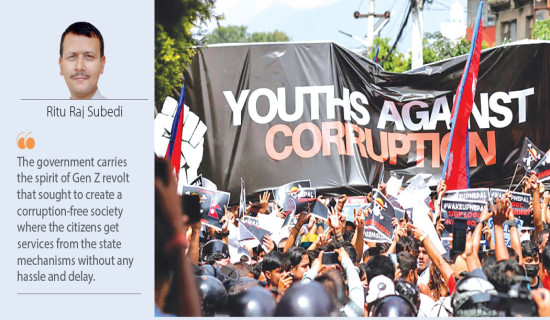
The March election was announced to give a logical outlet to an unprecedented crisis triggered by the Gen Z movement last September. The youths took to the streets against the endemic corruption in the wake of the ban on social media. But the nerve-racking revolt had also made a clarion call for youth intervention in national politics. The major parties tried to make cosmetic reforms to appease the dissenting youths by giving them limited space within their structures. But they were reluctant to pass the baton to the younger generation. This created an explosive situation in the NC. General secretary duo Gagan Thapa and Bishwo Prakash Sharma revolted against the old guard and organized the Special Convention, which will go down as a watershed moment in the party's history.
Psychological boost
In fact, the Gen Z movement gave a much-needed psychological boost to the Gagan-Bishwo camp to call a Special Convention and elect a new leadership. Sher Bahadur Deuba and his loyalists have been effectively sidelined from the leadership rung. Gagan has avenged Deuba in the distribution of tickets in the HoR polls. Of a total of 165 seats under the First-Past-The-Post (FPTP) system, Deuba group got 32 and Shekhar Koirala faction 13. Gagan has kept himself a whopping 120 seats, according to a media report. Deuba had similarly treated the Gagan-Bishwo group while selecting candidates for the National Assembly polls and proportional representation (PR) category.
On Friday, the NC Central Working Committee decided to make Gagan the prime ministerial candidate in the elections in a move to attract the youth voters. Gagan's rise to NC leadership has many positive implications for national politics. It has now ended the pre-electoral unholy alliance that forced party followers to cast votes for candidates against their own choice. Such non-ideological pacts meant to maintain the status quo, with three major parties – NC, UML and erstwhile Maoist Centre – controlling national politics and enjoying the state's resources and key positions. Dismantling the outdated gerontocracy in the oldest democratic force can inspire other youth leaders to follow suit.
The disgraceful exit of Deuba, a five-time prime minister, is a ruthless lesson for politicians who often stick to power by fair means or foul. Gagan's election to the party president through the Special Convention can be compared to that of its first Special Convention in 1957 when BP Koirala was picked as the party head. Two years later, the party clinched a landslide victory in the country's first general elections under his able stewardship. Indeed, Gagan has successfully brought the party back on track but he is leading the party in the polls at a time when the political tide is not blowing in its favour.
The Gen Z movement erupted due largely to scores of corruption scams involving the NC and UML leaders. The NC-UML coalition government brutally crushed the youth uprising, killing at least 76 people, mostly young. The new leadership of NC has supported the Gen Z demands. However, the RSP has owned up to it, putting it on the frontline to fight for the cause of Gen Zers. This is a crucial factor that has made the RSP a popular force among the voters. And Kathmandu Metropolitan City’s former Mayor Balendra Shah, widely known as Balen, has stolen the limelight by challenging the former prime minister KP Sharma Oli in the latter's constituency in Jhapa-5. The epic battle between Balen and Oli has been seen with intense curiosity because its outcome will set a new discourse and decide the fate of the post-poll government.
Audacious move
In the beginning, Balen’s audacious move to throw his hat into the ring in Oli’s stronghold sounded unfeasible, but as he filed his candidacy on January 20 as an RSP candidate, he created waves, with hundreds of followers supporting him. This spectacle was enough to implant fear in Oli and his party members, who consider Jhapa-5 as their own exclusive fort. Oli, who was at the helm of government during the Gen Z movement, is dead-set to vilify the agitation of youths, accentuating the arson and destruction of public and private properties on the second day of the movement. He is framing it as a foreign-sponsored, destructive event that toppled his government but this appears to be a defective narrative that the majority of people are not ready to buy.
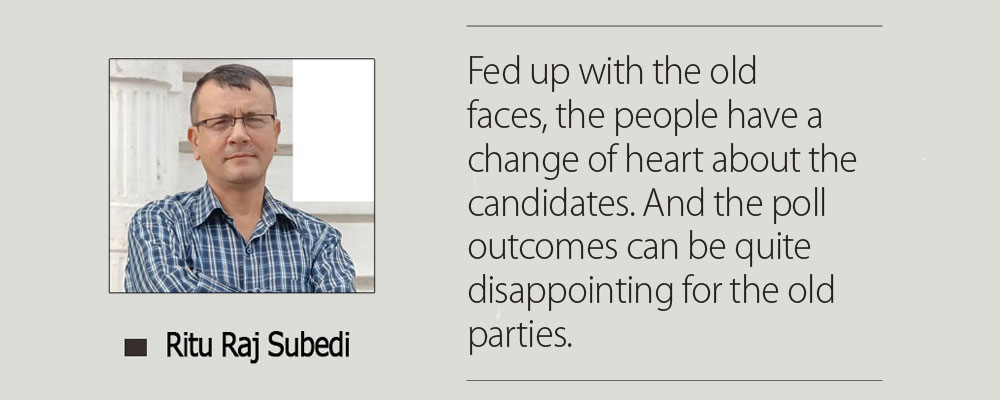
On the other hand, Balen, who is also the senior leader of the RSP, has presented himself as the strong defender of the Gen Z movement and its achievements, particularly demanding strong action against those responsible for the ‘massacre’ of young people. Balen is sure to collect many sympathy votes, which has been common in the country’s elections. Ironically, Oli has refused to take moral responsibility for the deaths of a large number of people. His stubborn refusal can be an Achilles' heel in the election. Moreover, RSP candidates have projected themselves as the agents of change, calling for youth intervention in politics and policy. Fed up with the old faces, the people have a change of heart about the candidates. And the poll outcomes can be quite disappointing for the old parties.
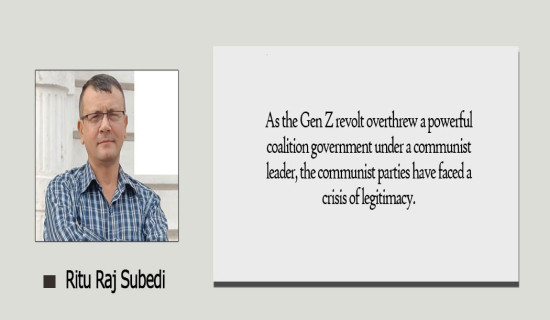
(The author is the Deputy Executive Editor of this daily.)

(The author is Managing Editor of this daily.)


-original-thumb.jpg)