- Saturday, 6 June 2026

SAARC Literature Festival
Culture Bridges Friendship Across Borders
This title evokes two dimensions of cultural studies that are related to time and space. Connectivity is related to time because the temporal dimension of culture should be approached from the point of history, which entails that the cultures, in order to establish connectivity, take time to be influenced by each other. Such connectivity therefore happens not only across time but also, very importantly, across the geo-cultural spaces. We name the spaces under various nomenclatures. South Asia is one. On both scores of time and space, South Asian cultures present tremendous examples of cultural connections and their spread over geographical areas.
Cultural connectivity over the space of South Asia drew the attention not only of the scholars of this region but also those of the West, some of whom have become famous both as historians and analysts of cultures. In this short presentation, instead of using citations and references, I want to evoke the nature of the cultural connectivity across time and space. I have called such meetings a cultural mosaic.
Mosaic of civilisations
South Asia is such a mosaic of ancient civilizations that is principally shaped by dominant religions such as Hinduism, Buddhism, Islam, Jainism and Sikhism. But we should not forget that besides these most touted nomenclatures, this region has also got a strong and long tradition of folk cultures that cut across various genres of art and literature.
Despite having different languages, religions and ethnicities, South Asia exhibits a sense of cultural bond among its people. The South Asian culture evolves through shared interactions, festivals and historical legacy, demographic mobility and a common tradition of art and knowledge system.
Sanskrit shapes the roots of languages and dialects. There are several regional initiatives and networks of journalists, poets, women, and workers, founded on the notion of a regional public and working for common benefits. In fact, diversity in South Asia is an asset, not a liability. This is evident in the growing bonhomie among the people with diverse nationalities and religions.
Culture is a broad concept. It reflects the particular way of life and worldview of the people in a given socio-economic and political milieu. Anthropologist E. B. Tylor defines it as a complex whole, which includes knowledge, belief, art, morals, law, custom and any other capabilities and habits acquired by man as a member of society". Spengler and Toynbee see it as the product of a long tradition of shared habits among people living together over generations. It entails ‘practices, discourses and material expressions, which, over time, express the continuities and discontinuities of social meaning.’ These definitions imply that the meaning and interpretations of culture cannot be defined by a single line of thought.
South Asia is a unique cultural society characterized by tolerance and humanism. All South Asian nations except for Nepal remained under the brute colonial rule for centuries. Colonial rulers used to invoke communal divide to exercise political control over the populace. But distinctive cultural norms and practices enabled the people to fight the vestiges of colonialism and develop a free mindset.
Enlightenment tradition
The Vedas and Buddhism have enlightened people from the laps of the Himalayas to the plains of the Gangetic Valley. Hinduism and Buddhism are the spiritual bridges for the people of Nepal, India, Sri Lanka and Bhutan. Similarly, Islamic values create an identity for the Muslim community living in India, Nepal, Pakistan and Bangladesh, and Afghanistan. Hindu pilgrims from Nepal and India visit each other’s countries in the pursuit of spiritual bliss and salvation. Lumbini, the birthplace of Gautam Buddha, is a sacred site for Buddhists all over the world. Lumbini has not only enriched the culture of South Asia but also of the world. In addition to the ancient religious scripts, other unifying cultural elements include festivals, foods, attire and architectural wonders.
The advent of internet-driven globalization has brought about changes in people's cultural practices. Social media platforms have revolutionized how individuals communicate, react, and maintain relationships with their peers. They have established new online communities, thereby influencing cultural interactions, production, and consumption. Cultural values and norms have diffused internationally, connecting individuals through shared convictions and sentiments. For the younger demographic, the line between tangible and virtual culture has blurred.
This, however, risks the youth neglecting ancient wisdom and knowledge, which are vital components of the region's culture. On a positive note, digital technology has transformed the creation and consumption of cultural content. Social sites have injected new vitality into ancient art, dance, literature, music, and folklore.
Electronic and digital media have been instrumental in enhancing the cultural connectivity in South Asia. The author vividly remembers the excitement of Nepali viewers watching the Mahabharat series on India's Doordarshan in 1988. Back then, there wasn't a TV at my home. We would visit a neighbour's home, where the room was already filled with locals eager to watch the Hindu epic. The sight of Arjun firing arrows at the Kauravas thrilled us, mirroring the emotions of Indian audiences. Such spiritual connections fostered a bonhomie between the two peoples.
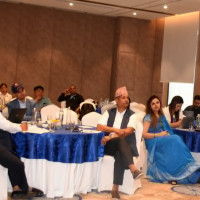
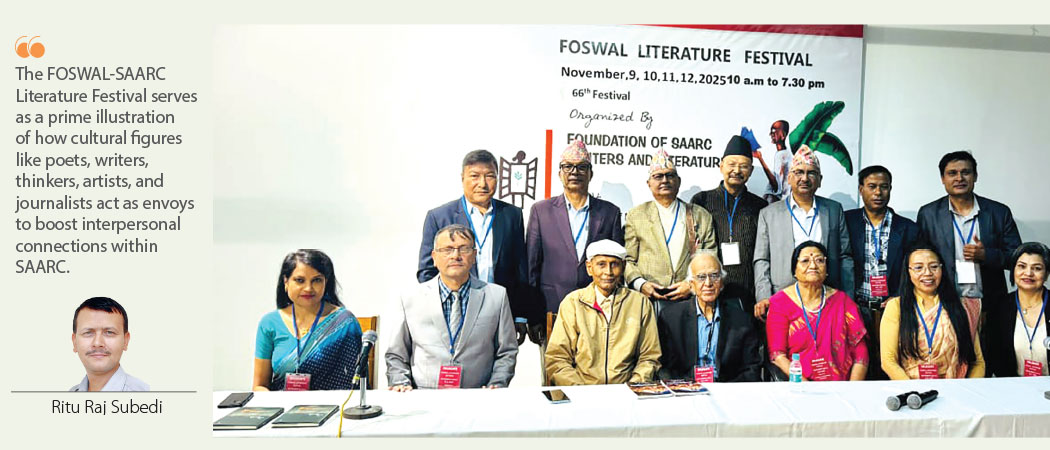
The FOSWAL-SAARC Literature Festival serves as a prime illustration of how cultural figures like poets, writers, thinkers, artists, and journalists act as envoys to boost interpersonal connections within SAARC. Participants from most SAARC member states gather here, strengthening solidarity and goodwill among them. Artistic expressions form the most potent means of conveying cultural values and ethos. Poems, songs, essays, dramas, and stories about individuals from diverse nationalities, religions, and social classes reveal truths and enlighten the populace. These creative endeavours inspire positive transformations, fostering greater understanding, harmony, and closeness among nations.
Spiritual values transcend the geopolitical enmity. We have examples galore wherein the hostilities are defused through cultural communication and wisdom. So the need of this time is to accelerate the cultural interactions to overcome differences and prejudices that have precluded them from realizing their common goals of peace, stability, prosperity and happiness in the region.
Creative efforts
This year, the FOSWAL literary festival has chosen the theme of ‘Cultural Connectivity in South Asia.’ This is a fitting topic to promote peace, fraternity and unity in the region affected by the political turmoil, economic hardships, terrorism and environmental degradation. Writers, poets, and thinkers play a critical role in building rapport and understanding among the people in the region. The Foundation of SAARC Writers and Literature (FOSWAL) deserves appreciation for its creative and ongoing efforts in this regard.
The subject of cultural connectivity and studies reminds us all about the validity of the endeavor, especially by evoking the history and the nature of the crosscurrents of cultures. Such movements have taken time and seen momentous occasions for people's mobility that including the history of the peaceful as well as the bellicose times. For that reason, a study of the connectivity of cultures through space and time has become a very important subject in our age.
Certain features like the literary genres, forms of arts including architecture and border formations and their resolutions stand there bearing the history of the millennia. I am sure this literary meet will act as a catalyst for the promotion of such inter-art and cross-cultural studies. Such meetings and interactions will broaden our visions and inspire us to find ways to use the subject productively and creatively.
(The writer is Deputy Executive Editor of this daily)
(The author is Managing Editor of this daily.)