- Wednesday, 27 May 2026

Sacred Legacy Of Swasthani
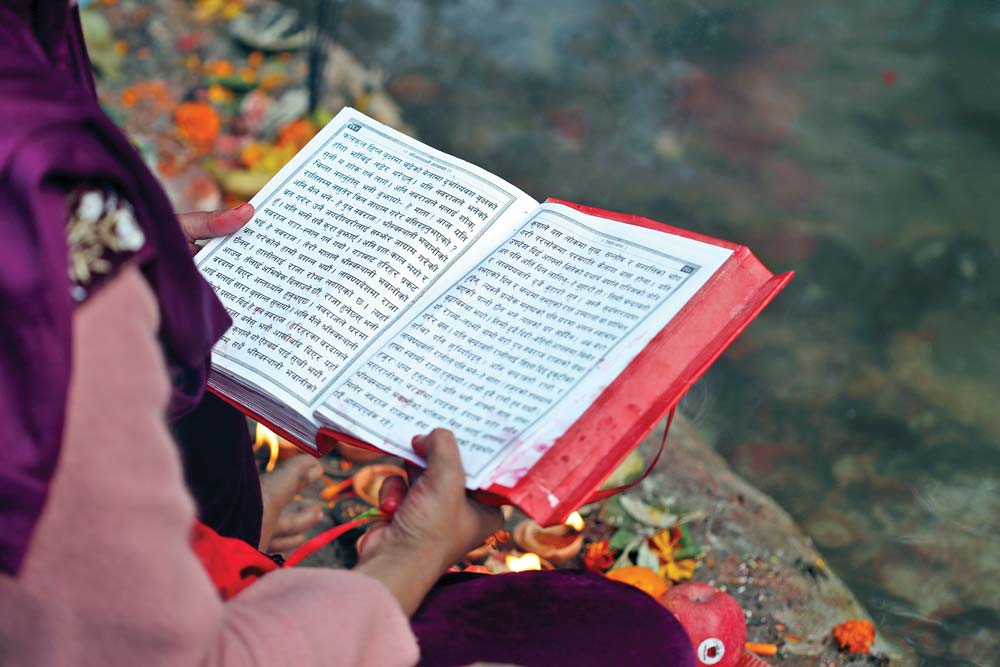

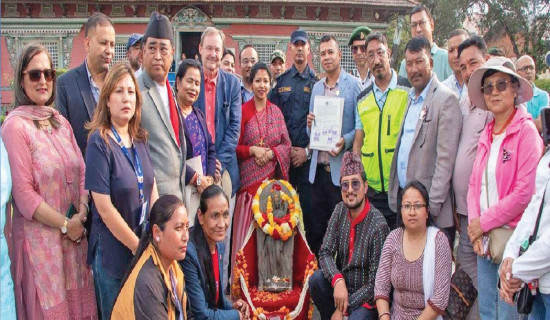
Swasthani Brata Katha (story of goddess Swasthani) is a month-long Hindu ritual which starts from Poush Sukla Purnima and continues till Magh Shukla Purnima. Brata Katha is widely recited and listened to in every household when a month-long ritual of Madhav Narayan Mela is also celebrated on the banks of Salinadi (River) in Sankhu. Every year, hordes of devotees make a pilgrimage to this sacred place. It is referred to as the Swasthani Mela. However, in reality, the fasting is done in the name of Lord Madhav Narayan, where women and men along the Salinadi chant the name of Lord Narayan in reverence during every sacred act.
The Swasthani Brata Katha is an extremely revered text in Hinduism, interwoven with the magic of wonder and wisdom. The term ‘Swa’ stands for self, and ‘Sthana’ stands for a place. Therefore, it is a text that is shaped by one’s inner self. The goddess in this text is one of the eight deities of the Newars. The text of the Swasthani Brata Katha is now available in Nepali, although it is a glorious 450-year-old text. It was written in a small script, a mix of Sanskrit and Newari, and dates back to the Nepal Sambat year 693, or 1629 BS.
This original work, inscribed on eight palm leaves, is now carefully preserved in the National Archives. During those times, the fast lasted merely for two days and a single night. The origin of the narrative dates back to the Skanda Purana of the Mahabharat, specifically located in the Kedar Khanda.
However, it was in the year 1602 (1659 BS) that the celebration of the fast blossomed into a month-long event. The narrative gained popularity in the Newari dialect, which is Nepal Bhasa, thereby spreading the celebration among the Newari people.
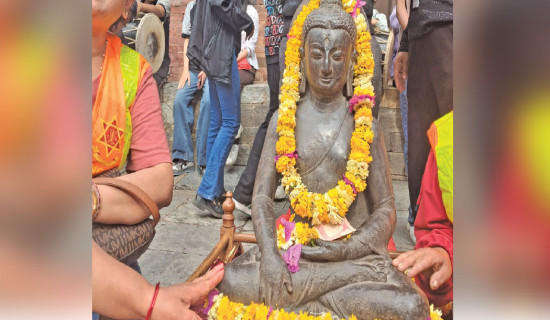
Subsequently, in the year 1673 (1730 BS), on the sacred day of Magh Shukhla Pachami, the idol of Swasthani was first unveiled in Makhan by the then King of Kantipur, Pratap Malla. The Swasthani Brata Katha gained momentum among other Khas and Brahmin groups shortly after the conquest of the Kathmandu Valley by King Prithvi Narayan Shah. The Newari version of the Swasthani Brata Katha was converted to the Nepali version in the year 1806 (1866 BS) during the reign of King Girvan Bir Bikram Shah.
This shows that the Swasthani Brata Katha, which originated in the Malla era, was adopted by other groups about four decades after the conquest of the Valley by Shah. The original work on the palm leaves was converted to a thick book of about 400 pages.
Jessica Vantine Birkenholtz, an American scholar who researched extensively on the history of Swasthani in her PhD, states, "The text and tradition emerged in the 16th century, probably among the Newar community of Sankhu. The earliest texts combine Nepal Bhasa with Sanskrit, influenced by Newari." After Prithvi Narayan Shah’s victory in 1768-69, Hill Brahmins, or Bahuns, adopted Swasthani’s story and nurtured it, passing it on to Brahmins and Chhetris. The story, originally written in Nepal Bhasa mixed with Sanskrit, has now beautifully been translated into English by Jessica Vantine Birkenholtz and Alaka Atreya Chudal.
Their book, named ‘Swasthani Brata Katha: A Secret Vow to the Goddess’, is slated for a February 2026 release through Oxford Academic Open Access.
However, researchers have pointed out an interesting fact: the ancient Swasthani legends do not mention the Salinadi. This important characteristic is added to the narrative only in the legends that appeared 200 years ago. Consequently, the practice of fasting on the banks of the Salinadi is no more than two century old.
(Shrestha is a journalist at The Rising Nepal.)