- Thursday, 11 June 2026

China's Alternative Paradigm To World

Chinese President Xi Jinping probably is the person who played a role in reshaping the global order in the beginning of the 21st century. Within a year of his ascent to the power of the largest country in the world in terms of population then and fourth by land area, he announced the Belt and Road Initiative (BRI) in September 2013. In his speech at Nazarbayev University in Astana, Kazakhstan, he proposed the land-based BRI in September that year, and during his address at the Indonesian Parliament a month later, he proposed the sea-based version of the initiative.
The BRI is a project said to revive the ancient Silk Road to increase trade, connectivity and development in the countries along the route. China adopted the BRI as its national strategy in November 2013, and it was incorporated into the statute of the Communist Party of China (CPC) in 2017 – "following the principle of achieving shared growth through discussion and collaboration, and pursuing the Belt and Road Initiative". This inclusion is accorded high priority as a long-term strategy of China. It ensured that the BRI will be a top agenda of China even after Xi is gone. In the following years, the world witnessed BRI being a central element in Chinese foreign policy that influenced the bilateral as well as multilateral relations across the globe.
China continued innovating its foreign policy instruments and announced the Global Development Initiative (GDI) in September 2021, the Global Security Initiative (GSI) in April 2022, and the Global Civilisation Initiative (GCI) in March 2023. These initiatives were announced in the aftermath of the COVID-19 pandemic when the world was ravaged by the virus and the developing world particularly suffered a great loss both in terms of human lives and economic activities. Many countries are still struggling to recover the loss.
A surprising fact is that China announced the BRI while it was a middle-income country and offered economic cooperation to dozens of countries from Asia and Europe to Africa. While a debate is also ongoing about whether Chinese financial assistance or infrastructure development programmes create a 'debt trap' for the receiving country, China has continued its cooperation under the BRI. An upper-middle-income country now, it is trying to reshape the world order, creating a strong counter with the programmes on security, development and culture to the Western initiatives and Bretton Woods system that have been shaping the global economic order.
While China maintains that these initiatives are its vision for building a global community with a shared future for mankind, the Western countries and India have taken them as a threat to their national as well as regional interests. Although India is sharing the board with China in the Shanghai Cooperation Organisation (SCO) and the BRICS (Brazil, Russia, India, China and South Africa) forum, it has exhibited strong apprehension to the BRI and GSI.
Being a close neighbour and the second-largest trade partner, Nepalis should be updated with what is happening in China, as you are closely following the happenings in India. Due to simple geography, open borders, similar culture and language, Nepal has greater trade, culture and people-to-people exchange with India, which is not the case with China. Many Nepalis still rely on Western media to get updates on China and its policies.
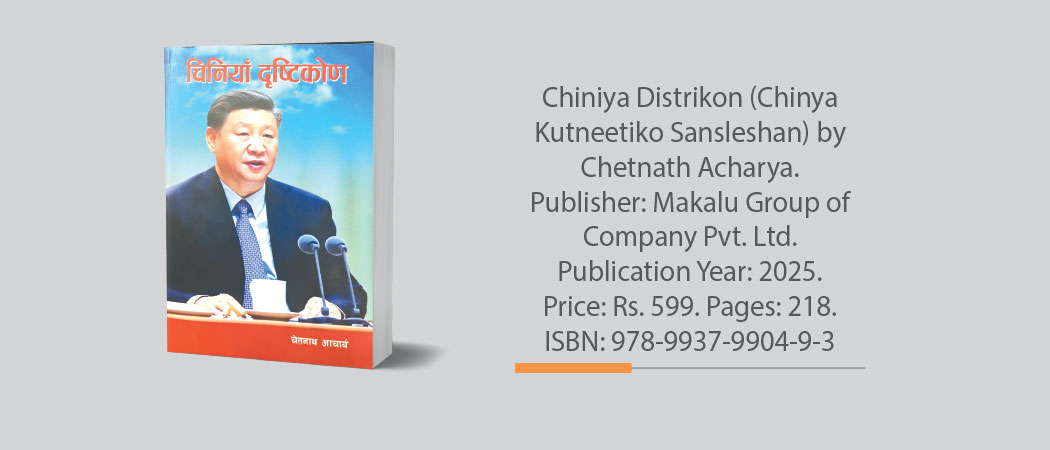
In such a scenario, Chetnath Acharya has come up with a book describing the recent Chinese international initiatives and strategies. This is the first of its kind book in the Nepali language that discusses the BRI, GDI, GSI and GCI in detail while also discussing the form of democracy exercised by China, which it is branding as a consultative democracy. Acharya has spent more than a decade in China working with the China Radio International (CRI) and is based in Beijing. He has extensively explored China's geography and networked with both Nepali and Chinese high officials, journalists and people from other sectors.
According to Acharya, the Chinese perspective is represented by the GDI, GSI, GCI, BRI, and functional democracy. These serve as visionary and comprehensive roadmaps for global governance and development. "This vision reimagines a world founded upon peace, cooperation, harmony, and mutual benefit. This perspective is shaped by China's own experiences and claims to offer solutions to global challenges such as poverty, inequality, and conflict," he said. Its success or failure in the coming decade will depend on its implementation and its acceptance by nations across the world. Nevertheless, it has provided a significant alternative viewpoint to global discourse and has enriched the debate within international relations.
The book has comprehensively presented the philosophies incorporated in those five initiatives. It can be useful to the diplomats, academia, researchers, politicians and those who have an interest in Nepal-China relations as well as international order. Since each Chinese international policy directly or indirectly impacts Nepal, having knowledge of them can be a step towards awareness and education. The book is mostly a translation of original documents related to the strategies or opinions expressed by top leaders, media persons and foreign political leaders. Acharya has edited most of the documents to make them brief and succinct. There are a couple of chapters where he has presented his analysis of the policies.
However, readers might feel there should have been a critical review of the initiatives and strategies. Since most of the documents are prepared originally by President Xi, Chinese state institutions, media and experts, and foreign personalities who are highly friendly with China, there is no critical viewpoint on the policies. While it's important to note that the book is on the 'Chinese perspective', so it has done justice to the title, many international – here Nepali – readers definitely want to know the second opinion from the critics.
(Dhakal is a journalist at this daily. He can be reached at dhakalutsav@gmail.com.)

-original-thumb.jpg)