- Monday, 25 May 2026

Industry revival sounds exciting but entails significant cost and risk

Kathmandu, Apr. 26: The government's move to bring the large public enterprises (PEs), that have long been closed or running in a poor state, into operation has rekindled debate about its outcome.
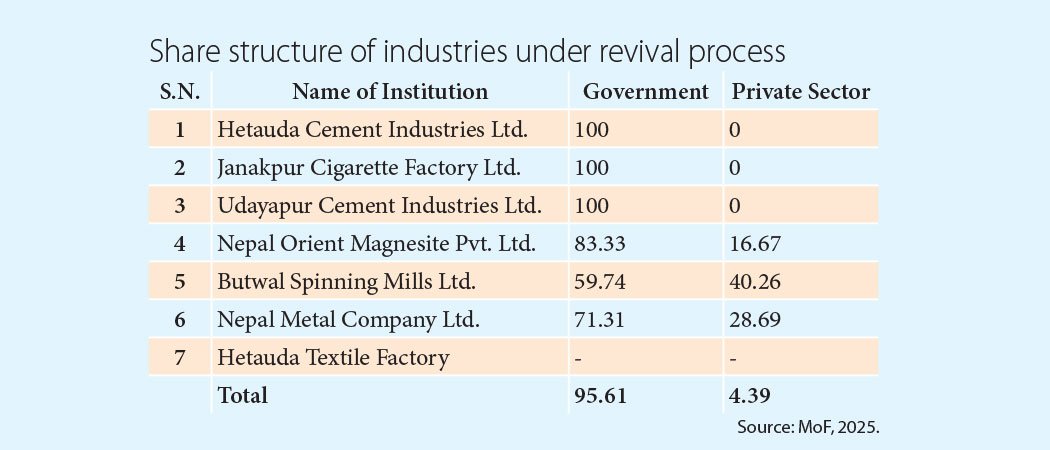
The Ministry of Finance (MoF) has begun work to conduct detailed audit and property assessment of seven large industries – Udayapur Cement Industry, Gorkahkali Rubber Industry, Janakpur Cigarette Factory (JCF), Nepal Metal Company (NMC), Butwal Spinning Mills (BSM), Hetauda Textile Factory (HTF) and Nepal Orind Magnesite (NOM).
As planned earlier, the Public Private Partnership (PPP) is prescribed as the operation modality of these industries.
Netra Prasad Subedi, Spokesperson of the Ministry of Industry, Commerce and Supplies (MoICS), informed that the preliminary estimation of the Department of Mines and Geology (DoMG) has shown that the mine-based industries had greater potential. "It means the government might begin the revival of these industries from the mine-based ones such as Udayapur Cement, Orind Magnesite and Nepal Metal," he said.
The MoF had selected a consulting firm S.&S. Associates to assess the status of the four industrial establishments – JCF, BSM, NMC and NOM. Jin and Associates and S. Subedi and Associates will assist S.&S. in the property valuation process.
The move to revive PEs has drawn mixed reactions from the media, experts and private sector stakeholders.
Although the PEs are expanded across six sectors and 11 ministries, the closed or sick ones are from the industry sector and managed by the MoICS. They are labour-intensive and can provide jobs to a large number of people.
Of the seven industries under the revival process, Udayapur Cement Industry was running intermittently until February this year. It was running at loss for the last several years and staff went without pay for as long as nine months.
Meanwhile, as the government initiated the valuation of the property to privatise it or invite private investors under the PPP model, locals protested alleging that the government was selling the public asset too cheap.
According to the experts and industry officials, the company's old coal-based technology has created obstacles in expanding or upgrading the production plant of the once most sought-after brand in cement in the country. The industry has taken Rs. 240 million loan from the MoICS.
However, the revival plan is not a new phenomenon. Industry Minister Mahesh Basnet in 2015 had initiated a process for conditional privatization of Nepal Orind Magnesite, Nepal Metal, BSM, JCF, Birgunj Sugar Mill, Krishi Auzar Karkhana, Hetauda Textile and Gorakhkali Rubber.
The NOM, BSM and Birgunj Sugar Mill had drawn attention of the private sector investors and a few had submitted proposals to operate these indsutries.
Following suit to Basnet, his successor Nabindra Raj Joshi continued with the process.
He had said that the BSM and Birgunj Sugar Factory would be leased out to the private sector while Gorakhkali Rubber Udhyog was planned to be run under the PPP model.
To attract investors to run the industries then, the government had decided not to charge rental payment to the prospective lessees until the factory came into operation. Joshi wanted to move ahead in the revival drive in collaboration with the private sector.
Several Industry and Finance ministers in the last one and a half decades – including Damodar Bhandari in 2025 – had tried to address the problems in the PEs but they failed in achieving any positive results.
A case study of mismanagement
The Hetauda Textile Factory can be a case study in terms of sustainability of the industrial-sector PEs. The landmark Chinese-supported industry had begun operations in 1978, three years after its establishment. It was a leading manufacturer of cotton, and other textiles and a supplier of uniforms to the Nepali Army.
However, poor management, political appointments leading to overstaffing and failure to upgrade the technology caused the downfall of the industry following the restoration of democracy in 1990. The first democratic government had initiated the privatization drive as well. The factory began to incur losses in 1997, the government decided to close it in 2000 and liquidation process started in 2003, However, it took one more decade to conclude it. Finally, the government finalised the plans to sell the machinery and transfer land and buildings to Industrial Estate Management Limited (IEML).
After ascending to power in 2008, then CPN (Maoist) tried to revive the industry but the project couldn't actually take off.
Then Industry Minister Nabindra Raj Joshi tried to revive the factory
along with Butwal Spinning Mills and strengthen Udayapur and Hetauda cement industries.
Then, all three security agencies - Nepali Army (NA), Nepal Police and Armed Police Force – had shown interest to run the industry, if needed, jointly.
Again in 2024, the NA formally proposed to revive the mill with an estimated investment of Rs. 1.93 billion and annual operating cost of Rs. 780 million. It wanted to reoperationalise the industry to manufacture military uniforms.
Broken linkages
However, reviving the HTF is not an easy task which is reflected by the estimated cost proposed by the Army. This is particularly challenging as the existing channels of backward and forward linkages have been damaged. Earlier, there was a cotton production company which supplied raw materials to the BSM and the latter supplied yarn to the textile factory.
But now all three companies are defunct.
And, current discussions and industry revival plans don't include the cotton and spinning enterprises. While the private sector initiations like Reliance Spinning Mills witnessed consistent growth in production and export, state-run BSM met an early demise. Reliance employs about 4,400 people and exports yarn worth Rs. 6-8 billion a year.
MoICS Spokesperson Subedi indicated that the government would adopt an integrated approach in reviving the industries but details are yet not prepared.
Meanwhile, all the equipment and machines of the HTF and BSM are outdated. So, these companies need an installation of new equipment at all levels. In the last two to three decades, the textile industry has undergone a massive technological advancement, said a private sector textile entrepreneur.
"Since the public institutions care less about being competitive, there is a challenge to make the revival sustainable," he said.
However, the PPP modality could be the best solution in case of manufacturing industries. It would be miraculous if the market within the country is guaranteed like in the case of HTF for which the NA said it will produce uniforms of the security agencies. Initial proposal from the security agencies said that the factory would also produce cloth for school uniform.
Orind sits on Rs. 5 billion loss
The government had handed over the management of Orind Magnesite in Dolakha to Khetan Group in 2014. The Group had planned to inject Rs. 120 million to bring the sick company back to the normal health. But this move couldn't provide the needed impetus to the industry. It remains shut till date.
The industry was established in 1979 to produce dead burnt magnesite and talc powder, and the production plant had a capacity of 50,000 tonnes a year.
Statistics by the MoF show that accumulated loss of this company has reached Rs. 5.16 billion. This is the second highest loss after the Udayapur Cement's Rs. 6.4 billion. The JCF has Rs. 2.90 billion accumulated loss and BSM about Rs. 2 billion. Financial analysts say that managing this loss is one of the biggest challenges in managing the PEs.
Public perceive it positively
People commenting on social media on these developments also said that integrative approach and market assurance could motivate private sector to be the part of management and operation of these sick or defunct industries.
Former CEO of the Investment Board Nepal (IBN) Sushil Bhatta wrote on his social media post that he was eager to see these brown field industrial projects structured in PPP model and transacted. "Good to see the essence, need and importance of PPP modality being realised," he said.
On several occasions, entrepreneurs and private sector leaders welcomed the move stating that it will create employment and utilise domestic raw materials.
Talking to The Rising Nepal, President of the Nepal Textile Association of Nepal, Shailendra Lal Pradhan, said that establishing or reviving the industry is a good move as it helps to meet the domestic demand and substitute exports in the first phase.
But there should be market assurance and facilitation in technology transfer if the government wants private investors onboard of these industries, said Pradhan. According to him, it may attract investors due to the infrastructure of the industry. Currently, industrialists are finding it very hard to get land for the industry so the physical infrastructure and land of the sick industry can be an attractive advantage for the private investors.
However, several individuals were critical of the government reviving or
running the Janakpur Cigarette Factory with a few suggesting the facilities there for other purposes like medical or education.
Such a large industrial establishment can be converted into agro-processing industry, exhibition centre, medical college or international level convention centre. China has successfully converted mammoth manufacturing industries into exhibition venues and sports centres.
PEs in six sectors
The government operates enterprises in industry (10), commerce (4), service (11), social (5), utility service (5) and financial (10) sectors. Of them, 14 are managed by the MoICS, 10 by MoF, five by Physical Infrastructure Ministry, three each by Energy Ministry, Communication Ministry and Tourism Ministry, two each by Agriculture and Forest ministries, and one each by Education, Water Supply and Urban Development ministries.
Government receives a major chunk of profits from Nepal Oil Corporation and Nepal Telecommunication Company Limited. Currently, 28 PEs are in existence, of which 15 are running in loss. Interestingly, the government is earning rental from the land and building of the Janakpur Cigarette Factory.
In its annual report of the PEs for Fiscal Year 2024/25, the MoF has recommended that the State's investment in the closed or sick industries like Janakpur Cigarette Factory, Nepal Engineering Consultancy, National Construction Company, Nepal Metal Company, HTF, Nepal Orind Magnesite should be managed with appropriate alternative, following the assessment of property and liability.
Likewise, investment should be effectively managed in the company that have long been witnessing losses, such as Hetauda Cement, Udayapur Cement and Nepal Drugs Limited.
The Finance Ministry also recommended converting the PEs to public limited companies. Selling or leasing out the properties (except land) to the private sector on the basis of the nature of the PE and market competition is also an option.