- Monday, 25 May 2026

Economy to expand by 3.68 % this FY
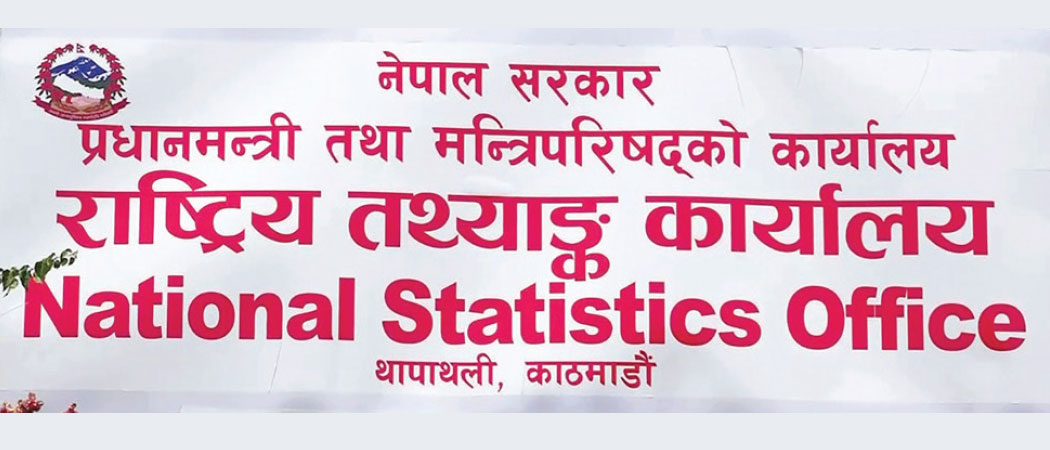

Kathmandu, Apr. 29: The National Statistics Office (NSO) has projected that the growth in the Gross Domestic Product (GDP) for the Fiscal Year 2025/26 will sit at 3.68 per cent at the real price. With this, the size of the national economy will reach Rs. 5,796 billion.
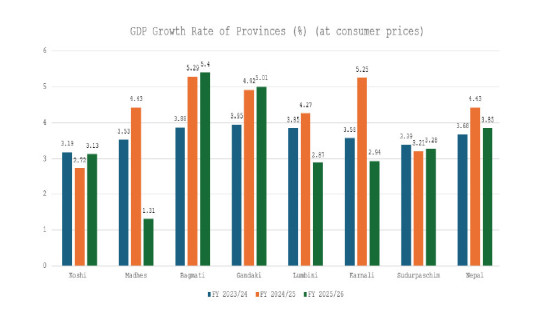
Likewise, at the purchaser’s price, the economy will expand by 3.85 per cent to reach Rs. 6,600 billion.
The government, through its budget for this year, has announced to achieve a growth rate of 6 per cent.
The statistic agency has made the projections on the basis of the statistics of the first eight months of the year while estimations were made for the remaining four years.
Publishing the reports of the national accounts at a programme in Kathmandu on Tuesday, the NSO said that the national economy is unlikely to get any shock impacting the economic activities.
The overall industrial sector is analysed by classifying it into three broad groups: the primary (agriculture), the secondary (manufacturing), and the tertiary (service) sectors.
For this year, the preliminary estimates indicate that the growth rates of the primary, secondary, and service sectors are expected to be 1.63 per cent, 5.77 per cent, and 4.21 per cent, respectively.
Agriculture will contribute 24.5 per cent to the economy, manufacturing 13.7 per cent, and the service sector 61.8 per cent to the GDP.
The overall trend in agricultural production is expected to show moderate growth. However, paddy production is projected to decline by 4.16 per cent, while maize, wheat, millet, pulses, and industrial crops are estimated to record only modest growth.
Similarly, on the livestock side, meat, egg, and fish production are also expected to increase at a moderate rate. In addition, due to only marginal growth in fruit and some winter crops, the overall value added in the agricultural sector is projected to rise only slightly, said the NSO.
The sluggish growth in agriculture, which incorporates about two-thirds of the population, has created a challenge to the overall performance of the economy.
Electricity, gas sector to grow by 21%
The electricity and gas sector will witness the highest growth of 20.93 per cent, followed by financial and insurance services 9.16 per cent, transportation and storage 5.79 per cent, information and communication 5.53 per cent and administrative and support services 4.52 per cent.
The estimates were made at a fixed price with 2010/11 base year.
According to the NSO, the electricity and gas sector’s growth appears to have remained significant due to increased electricity generation from new projects, an expansion in power generation capacity, the extension of transmission infrastructure, and a rise in consumption.
Multilateral donors like the World Bank and Asian Development Bank have projected the economic growth of Nepal for this year at 2.3 per cent and 2.7 per cent, respectively.
They have downgraded the growth numbers on the pretext of the disruptions caused by the Gen-Z movement, poor capital expenditures that sit at just a quarter of the total allocated amount and fuel price hike following the conflict in West Asia. Dinesh Bhattarai, Director of the NSO, said that the multilateral donors use model-based projections while the former makes statistics-based model, so the projections are different.
Meanwhile, with the contractors halting the construction of the development projects due to the escalating prices of fuel, and construction materials, development spending will be further slowed creating further challenge.
Speaking on the occasion, Executive Director of the Nepal Rastra Bank, Dr. Ram Sharan Kharel said that he found that the estimates of the central and the NSO are similar showing similar perspectives on the economy.
“The Gen Z movement and doubts about elections happening badly disturbed the environment for economic activities, including business and investment, resulted in poor GDP growth,” he said while adding that the West Asian crisis deepened, our economy will further suffer bruises hitting the growth.
According to Dr. Kharel, there are hopes for a better economic scenario with the expectations that the government would make significant reforms in governance, development spending and creating a business environment.
PCI remains at $1533
Meanwhile, the per capita income of Nepalis has remained unchanged this year – it remained at US$ 1,533.
According to Chief Statistics Officer Dr. Kamal Prasad Pokharel, the primary reason for the stagnation in per capita income is the significant depreciation of the Nepali rupee against the US dollar. As the rupee weakens, the per capita income calculated in US dollar terms remains unchanged.
Similarly, the revised estimate indicates that the economic growth rate at basic prices is expected to be 3.80 per cent in the last FY 2024/25, while it stood at 3.38 per cent in 2023/24. Last year's economic size is revised from Rs. 6107 billion to Rs. 6199 billion.