- Monday, 8 June 2026

"Affirmative policies promote inclusive representation and support for marginalized women," says Minister Shrestha
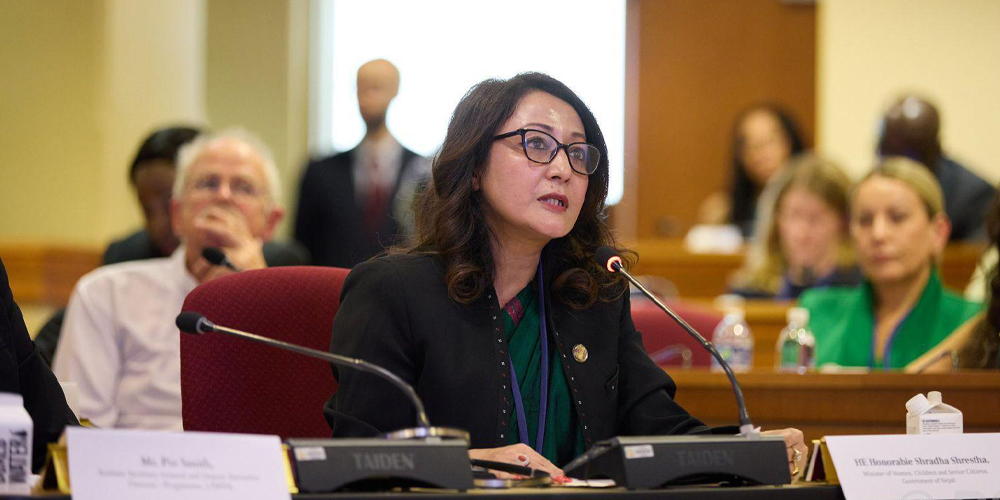

Kathmandu, March 11: Minister for Women, Children and Senior Citizens Shradha Shrestha has emphasized that Nepal’s progress in advancing gender equality reflects strong political commitment and sustained legal reform, even as important challenges persist.
"I am proud to note that Nepal’s remarkable progress in advancing gender equality and empowering women and girls—achieved in a relatively short span of time—stands as compelling evidence of what is possible when political commitment is matched with strong legal foundations," she said while delivering a statement at the General Debate of the 70th Session of the Commission on the Status of Women on Wednesday at United Nations Headquarters, New York, USA.
Minister stated that access to justice for women and girls is a fundamental right and a cornerstone of gender equality and reaffirmed Nepal’s firm commitment to this principle, which is guaranteed by the Constitution and is guided by international obligations, including the Convention on the Elimination of All Forms of Discrimination against Women (CEDAW). She further noted that Nepal has enacted laws criminalizing domestic violence, harmful practices, child marriage, human trafficking, and sexual harassment, while strengthening the justice system through fast-track procedures and gender-friendly courts, according to a statement from the Permanent Mission of Nepal to the United Nations in New York.
Minister Shrestha highlighted that Nepal has strengthened institutional mechanisms to ensure that justice is accessible in practice, including through accessible complaint systems, survivor support services, specialized gender-responsive units, and expanded legal aid through free legal assistance and mediation. She also underscored that services such as crisis response, rehabilitation, and financial support have expanded nationwide, while affirmative policies promote inclusive representation and support for marginalized women.
While mentioning that geographic barriers, poverty, digital divides, social stigma, cyber violence, and entrenched patriarchal norms continue to hinder access to justice, she called on global community to deepen partnerships, mobilize adequate resources, harness the potential of technology, strengthen institutional capacities, and uphold shared responsibility to ensure that every woman and girl, everywhere, can access justice without barriers.
Earlier in the morning, Minister Shrestha addressed the Ministerial Roundtable 1: Ensuring and Strengthening Access to Justice for All Women and Girls, Including Through Inclusive Legal Systems and Removal of Structural Barriers.
Addressing the roundtable, she highlighted Nepal’s significant legal and institutional reforms, including expanded social security, broader legal aid services, gender-responsive budgeting, strengthened protection mechanisms, and integrated crisis response centres to support survivors of violence. Nepal is promoting inclusive and accessible justice through local quasi-judicial committees, e-justice services, and survivor-centred approaches that prioritize safety, confidentiality, and recovery, while reforms such as enabling citizenship through the mother’s name and recognizing women’s unpaid care work further advance equality and dignity.
During her visit to New York, Minister Shrestha also addressed a number of side events organized on the margins of the Session.
Minister Shrestha is in New York leading the Nepali delegation to the 70th Session of the Commission on the Status of Women, being held in New York from 9 to 19 March. The Nepali delegation also includes government officials from the Ministry of Women, Children and Senior Citizens and the Permanent Mission of Nepal to the United Nations.(RSS)