- Thursday, 30 April 2026

Xizang Panorama: Dialogue Across Himalayas

At the 9th Nepal International Film Festival, which opened in Kathmandu on April 2, 2026, our research centre specially organised the Xizang Panorama section. This marks the second time this cross-cultural visual communication project has crossed the Himalayas to reach Nepal. This year, the directors and producers of the six films in the Xizang Panorama programme also traveled to Kathmandu to engage in exchanges and interactions with the audience.
The six films are Snow Leopard, Warrior King, Home Away Home Close, Sunrise Over the Plateau, Learners from the Top of the World, and Discovering Xizang 2026. Among them, Snow Leopard authentically depicts the living conditions of herdsmen in Xizang and illustrates the collision and integration of traditional ecological wisdom and modern ecological governance. Furthermore, this specific story confirms the effective implementation of the ecological compensation policy in Xizang, realising a positive symbiosis between ecological protection and pastoral area development, and ultimately conveying the profound philosophy of harmonious coexistence between humans and nature.
Authentic perspective
Learners from the Top of the World is the latest masterpiece by French director Jacques Malaterre. This documentary series focuses on education on the Qinghai-Xizang (Tibet) Plateau, and it delves into schools in Nyingchi, Shigatse, and Lhasa, documenting the learning lives and growth trajectories of students on the plateau through an objective and authentic international perspective. Using school buses on the plateau as a narrative thread, the film allows viewers to understand how students living in Xizang enjoy the right to educational equity, how they learn ethnic cultural traditions such as Xizang calligraphy, Tibetan opera, and traditional dance, and bears witness to the importance the families in Xizang place on education.
The short documentary Discovering Xizang 2026 was recently completed in January of this year. Adopting an international youth perspective, the film invites nine Gen Z youths from six countries across four continents —Nepal, the United States, Russia, Italy, Morocco, and Cambodia — to explore Xizang, China. Through their on-site visits, firsthand experiences, and genuine reflections, the film presents the true face of Xizang in the new era, covering social stability, economic development, ecological conservation, technological progress, cultural heritage, and international exchange.
Warrior King is a 110-minute animated feature film adapted from the Chinese epic The Legend of King Gesar. The film follows the coming-of-age journey of the young Jue Ru, who, after being framed and forced into exile, perseveres in the face of adversity, endures countless hardships and trials, ultimately mastering extraordinary skills. He remains steadfast in his commitment to justice and compassion for all living beings, continuously refining himself through adversity until he matures into the beloved King Gesar.
The film features a distinctive artistic style, incorporating the magnificent colors and solemn compositions of Tibetan thangka aesthetics into its visuals. It presents a panoramic view of the majestic landscapes and unique cultural traditions of the Qinghai-Tibet Plateau, achieving an organic fusion of traditional ethnic art and modern animation technology. Through an international and youthful audiovisual language, the work vividly preserves the essence of China’s outstanding traditional culture and intangible cultural heritage. It profoundly interprets the core of the national spirit—bravery, resilience, responsibility, dedication, and the protection of one’s homeland.
Home Away Home Close is a documentary centered on the human stories and public-welfare practice of Xizang. Following a young man from Hong Kong as he travels deep into Xizang to run a “mobile photo studio,” the film records his encounters in streets, villages and ordinary households, where he takes portraits, delivers printed photos and builds heartfelt connections with residents through everyday interaction. The documentary places public service alongside personal growth. As the protagonist helps others preserve meaningful memories and share warmth through images, he also rethinks his own sense of purpose and belonging. The photographs capture the daily lives and smiles of people on the plateau.
Intuitive mediums
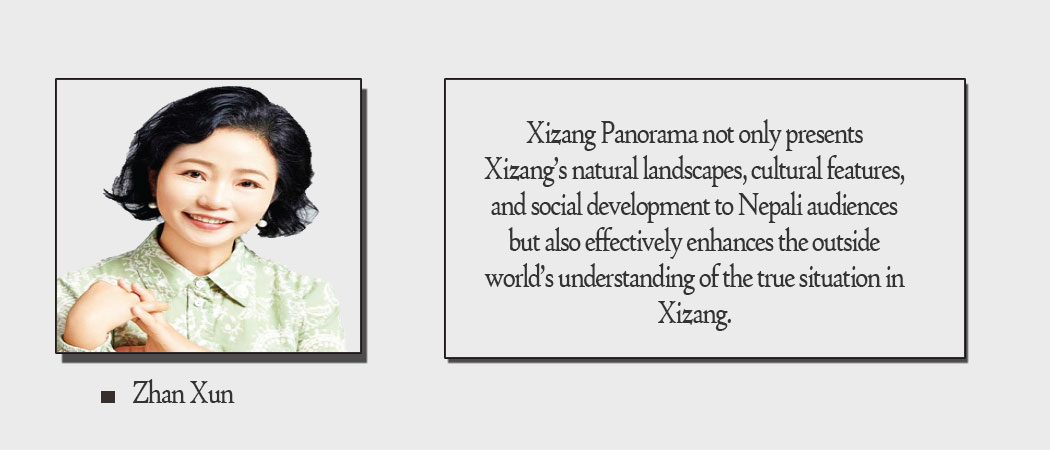
Film is one of the most intuitive mediums of visual communication. Xizang Panorama not only presents Xizang’s natural landscapes, cultural features, and social development to Nepali audiences but also effectively enhances the outside world’s understanding of the true situation in Xizang. Nepal and China have long enjoyed friendly relations, and the two countries share deep exchanges and common ground in multiple areas of mutual interest, including the preservation of mountain cultures, ecological conservation, new energy development, and the application of new technologies.
As a scholar with extensive experience in cross-cultural communication, I sincerely hope that Nepal and China will perceive each other’s authentic, multidimensional, and comprehensive images within a cross-cultural context, thereby deepening cultural exchange and mutual trust between the two nations.
(The author is a professor at the School of Public Administration, University of Electronic Science and Technology of China and Deputy Director of the Pan-Himalayan Information and Communication Research Centre)
-original-thumb.jpg)