- Monday, 8 June 2026

Transport Bill to protect accident rescuers

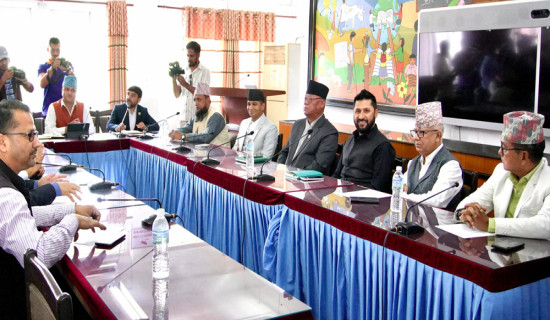
Kathmandu, Apr. 29: The government has proposed a new and progressive legal framework aimed at addressing country’s frequent road accidents and the tragic loss of lives due to delays in timely medical treatment.
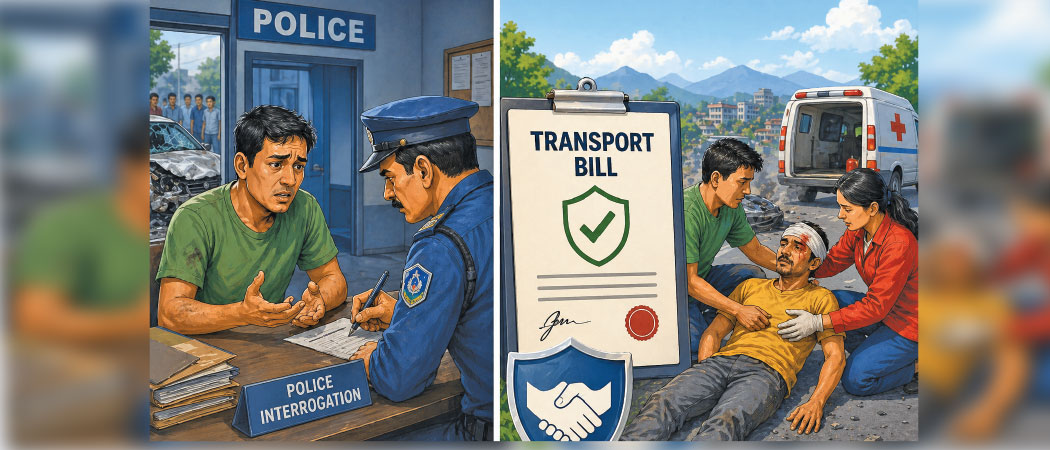
The draft of the “Bill to Amend and Consolidate Laws Relating to Vehicles and Transport, 2025,” prepared by the Ministry of Physical Infrastructure and Transport (MoPIT), includes a historic provision granting full legal protection to ‘good Samaritans’ who assist in rescuing road accident victims.
The bill seeks to repeal the three-decade-old Vehicle and Transport Management Act, 1993, and prioritises road safety, humanitarian values, and modern transport management, according to Ministry Spokesperson and Joint Secretary Engineer Ramhari Pokharel.
He said it has not yet been decided whether the bill will be tabled in the current budget session or the next regular parliamentary session.
The bill aims to eliminate the widespread fear among the public that helping accident victims could lead to police interrogation or legal complications. It also seeks to make road transport services safer, more reliable, and technology-friendly, introducing several far-reaching reforms affecting daily life and road safety, he said.
Legal protection for ‘good rescuers'
The draft law addresses the disturbing trend in which bystanders often film road accidents instead of assisting victims, largely due to fear of legal trouble or financial responsibility.
Under Section 50 of the proposed bill, individuals who provide emergency medical or non-medical assistance, or transport victims to hospital in good faith, will be granted full legal protection. Even if the victim dies during rescue or transport, the rescuer will not be held liable for any civil or criminal charges.
The bill defines a “good Samaritan” as a person who voluntarily provides reasonable assistance or first aid at the scene of an accident without expecting any reward or benefit.
The provision is expected to ensure quicker rescue of victims and save lives during the critical “golden hour” after an accident.
The bill also imposes strict obligations on hospitals and health institutions. If a road accident victim is brought in without family members present or without the ability to pay for treatment, hospitals must still provide immediate emergency care.
This provision aims to eliminate delays caused by demands for police reports, deposits, or the presence of relatives.
Licence validity extended to 10 years
One of the most notable reforms is the extension of driving licence validity from five years to ten years. The government expects this will reduce congestion and inconvenience at transport offices.
The bill also revises age requirements for driving licences. The bill mentions that, persons willing to get two or three-wheeler driving licence, should be 18 years of age, 21 years for small and medium four-wheelers, and 23 years of age for heavy vehicles.
In addition, drivers aged above 65 will not be permitted to operate large or medium public transport vehicles. Individuals with epilepsy, mental health conditions, or colour blindness will be ineligible for getting licences.
Life sentence for intentional killing
The bill introduces stringent penalties for serious road crimes. If a driver intentionally causes death by using a vehicle as a weapon, it will be treated as murder, punishable by life imprisonment.
If death occurs due to reckless or negligent driving, the offender may face three to twelve years of imprisonment and a fine ranging from Rs 30,000 to Rs 100,000. Driving without a licence resulting in death will attract additional penalties.
For the first time, ride-sharing platforms such as Pathao and inDrive have been formally legalised under the bill. These services are defined as “aggregators” connecting passengers and service providers via digital platforms. All vehicles operating through such platforms must be registered, and passenger insurance will be mandatory. Off-platform (“offline”) passenger transport using ride-sharing vehicles will be fined up to Rs. 2,000.
The bill introduces stricter penalties for traffic violations, with fines ranging from Rs 1,000 to Rs 25,000 depending on the offence.
Key safety provisions include, mandatory child seats for children under 10 years or below 135 cm in height, children prohibited from sitting in the front seat, fines for mobile phone use while driving, wrong-way driving, or riding on pavements, and penalties for obstructing roads with goods, materials, or stray animals.
To reduce accidents caused by driver fatigue, the bill mandates, two drivers for journeys exceeding 250 km, and mandatory rest breaks of at least 30 minutes after every 4 hours of travel at designated rest centres.
Carrying passengers on vehicle roofs will be strictly prohibited, and seatbelt use for drivers and front-seat passengers will be compulsory. The government believes that once enacted, the bill will modernise Nepal’s transport system, making it safer, more efficient, and more accountable.