- Monday, 8 June 2026

Distribution of 1.2 M smart driving licences begins
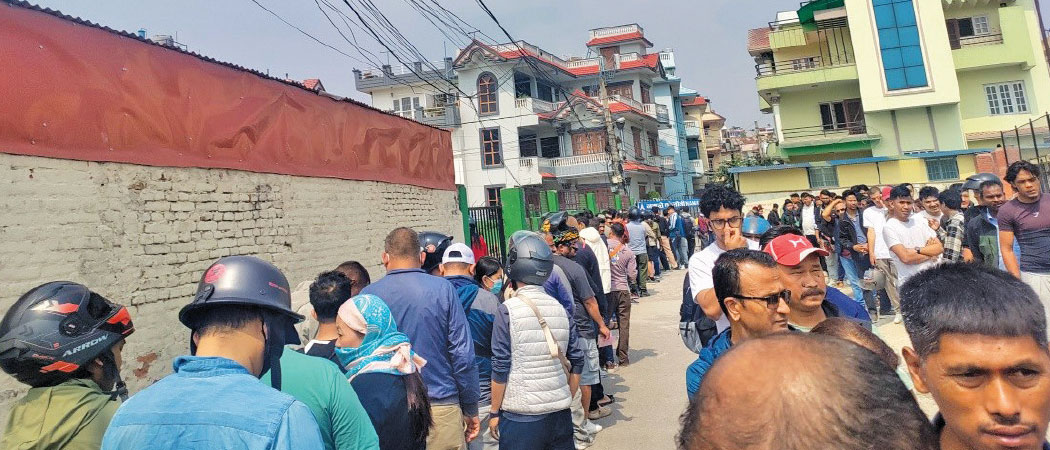

Kathmandu, Apr. 28: The government has begun distributing approximately 1.2 million smart driving licences that had remained unprinted for several years, from April 27, Monday.
The printing of these licences was completed under the first-phase agreement between the Security Printing Centre and the Department of Transport Management. Distribution has formally commenced nationwide from licence distribution centres and transport management offices, where the cards are now being handed over to their respective holders.
Executive director Dev Raj Dhungana said that the printing of 1.2 million cards under the initial agreement has been completed, allowing distribution to begin today. “We are handing over 1.2 million cards this Monday. On average, we printed around 40,000 cards daily across two shifts, and at times production reached as high as 60,000 per day,” he said.
In the second phase, the Centre is set to print an additional 1.7 million licences, following an agreement signed on April 17, 2026. Dhungana said that the Centre currently has sufficient printing materials for one month and confirmed that procurement for the remaining materials has already been completed.
“There is no likelihood of disruption or delay in the printing process,” he added.
With the first 1.2 million licences printed and a further 1.7 million scheduled for completion by mid-July, the total backlog of 2.9 million licences is expected to be cleared. Dhungana said that once the second phase concludes by mid-July, 2026, no pending licences will remain. “From July 18 onwards, people will no longer need to carry receipts in place of licences, as the process will return to normal,” he explained.
Officials said that the long-standing issue of delayed licence printing will be resolved for good from July 17, 2026. Previously, applicants were often required to wait two to three years due to limited printing capacity. While earlier production stood at around 4,000 licences per day, it has now increased to nearly 40,000 daily, significantly easing the backlog.
According to Dr. Bikram Timilsina, Minister for Communication and Information Technology, his ministry directed the Centre to accelerate printing licences as part of a broader reform agenda aimed at improving result-oriented governance. The smart licence system, introduced in 2015, was mired in persistent delays from its inception, with initial daily demand of around 5,000 cards compared to a production capacity of only 2,500.