- Tuesday, 14 April 2026

Laser Therapy Boon For Back Pain Treatment

Back pain is the most prevalent medical problem experienced by people worldwide. It can be dull, constant, sharp or sudden. It can occur suddenly — as a result of a fall or lifting heavy objects — or it may be a continuous problem due to old age or an old injury. It is a symptom of some other medical conditions. It develops due to one or more of the following conditions.
Injuries like sprains, tearing of the ligaments of the spine, fractures of the lumbar vertebrae, displacement of vertebrae and spinal injury cause back pain. There are many medical problems involving the spine and the surrounding muscles, ligaments, and tissues that cause back pain. Some of the pains are caused due to prolonged diseases, while others are due to a recent medical problem. They are as follows:
One common cause is the degeneration of the intervertebral disc. Due to age, the discs between the vertebrae break down and lose the cushioning effect, thereby causing friction between the vertebrae. But nowadays, many young people, including students and job holders, are also suffering from this health complication.
Ruptured disc
A herniated or ruptured disc is another source of back pain. When the intervertebral discs become too weak, their outer ring tears and bulges out. The bulge causes pressure on the nearby spinal nerves. The main cause of severe back pain in the maximum number of patients is associated with one-sided or both-sided radiculopathy (pain and tingling sensation) and myopathy (weakness of thigh and calf-foot drop).
Osteomyelitis, arthritis, scoliosis, osteoporosis, tumours and cancer are other major factors leading to the severe back pain. Osteomyelitis is an infection of the vertebrae due to tuberculosis, fractures, surgery, implants, and so on. All types of arthritis, including osteoarthritis, rheumatoid arthritis, and ankylosing spondylitis, narrow the spinal canal (spinal canal stenosis). Scoliosis is an abnormal curvature of the spine, while osteoporosis makes the bones porous and weak, causing vertebrae to fracture.
A spinal tumour puts pressure on the nerves of the back. The benign tumour is treated through surgery followed by laser therapy. Spinal cord cancer occurs due to metastasis from cancer at other sites. Laser therapy is applied against the contraindication.
Other medical issues include pregnancy, fibromyalgia (muscle pain and fatigue); endometriosis, which is a condition in which the uterine tissue is found elsewhere in the body; fibroid uterus; and ovarian cyst/cancer. Emotional stress can affect the physical condition of the body. It can make the back muscles tight, stiff and painful. It can also affect the severity and duration of the pain. Similarly, wrong posture can give rise to severe back pain.
Diagnosis
The initial diagnosis involves a complete history and physical examination, the nature of the pain, and the severity and present posture of patients. Other additional tests are X-rays, MRIs, CT scans, blood tests and bone scans to support an accurate diagnosis. Most acute back pains get better with complete rest, regular activities and avoiding heavy exercises, while some may require medications. However, more serious back pains can be treated in two ways – surgery or other nonsurgical methods.
Surgical treatment includes laminectomy and micro-discectomy, while common nonsurgical treatments involve rest, exercise, medication, traction, hot/cold packs, braces (lumbar belt), steroid injections, TENS, acupressure, acupuncture, and medical massage.
Low-level laser therapy (LLLT) treatment has evolved into one of the best nonsurgical treatments (non-invasive) for back pain. It is a form of alternative treatment that applies a low-level laser to the surface or orifices of the body. It relieves pain or stimulates and enhances cell function, which is called 'bio-stimulation'. LLLT is a very effective treatment method which is pain-free, non-invasive, affordable, has no side effects and has no thermal effect.
It helps overcome acute and chronic pain in any part of the body, joints, muscular pain and neurological pain. It is useful in treating inflammatory joints (arthritis, rheumatoid arthritis, spondylosis, radiculopathy, sciatica, etc.), especially low back pain that causes degenerative changes and nerve compression due to prolapsed intervertebral disc (PIVD). Several studies have shown that LLLT is 90 per cent effective and heals these medical conditions 200 times faster.
Mechanism
Laser therapy is the use of monochromatic light emission from a low-intensity laser diode (250 milliwatts - 2000 milliwatts total optical power). The light source is placed in contact with the skin, allowing the photon energy to penetrate tissue, where it interacts with various intracellular biomolecules, resulting in the normalisation of cellular components. This also enhances the body's natural healing processes.
This dynamic emerging technology utilises super luminous and laser diodes to irradiate abnormal tissue with photons. These are particles of energy that are absorbed by a variety of micro-molecules within the cell, a process which initiates a number of positive physiological responses. In essence, light energy is converted into biochemical energy. The result: Normal cell morphology and function are restored. The process is curative, and as logic dictates, symptoms disappear. So it is called photobiomodulation. The monochromatic, coherent and polarised characteristics of the therapeutic light beam permit penetration of deep tissues without affecting normal cells. It increases oxygenation of tissues and allows injured or damaged cells to absorb photons of light, which speeds healing. Laser therapy treatment helps reduce pain and inflammation and enhances tissue healing – both in hard and soft tissues, including muscles, ligaments, nerve cells and even bones.
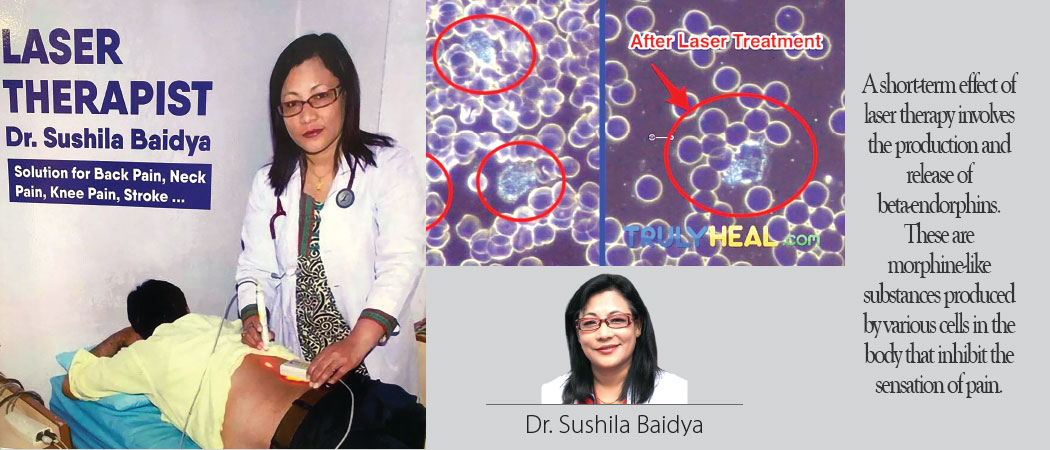
A short-term effect of laser therapy involves the production and release of beta-endorphins. These are morphine-like substances produced by various cells in the body that inhibit the sensation of pain. Cortisol production is increased. Cortisol is the precursor of cortisone. This enables the body to combat the stress associated with trauma or the disease process.
Under its long-term effects, ATP production is increased, resulting in improved cellular metabolism. It substantially increases DNA (deoxyribonucleic acid), the protein building block of tissue. Neurotransmission is facilitated due to elevated levels of serotonin and acetylcholine.
Cell replication
Similarly, mitochondrial activity is stimulated, resulting in cell replication, etc. It includes replacement, regeneration and repair of abnormal cells. There are modulation of macrophages, fibroblasts and other cells; angiogenesis (formation of new blood vessels); regulation of cell membrane potential; essential electrolyte balance in cells; and release of cytokines and other chemicals enhancing cellular communications.
Other positive impacts are stimulation of the immune response, improvement of lymphatic drainage, alteration of the histamine response, increase in the production of growth hormone and enhancement of the body's natural healing processes. The results of the application of laser therapy in PIVD have shown that prior to the existence of imaging studies, little was known about the healing mechanism of disc herniation. Imaging studies have confirmed what has been long suspected: Disc herniation can decrease in size and even disappear spontaneously, leading to the absence of pressure on the nerve root. This means a permanent cure for low back pain without surgery.
(Dr. Baidya, who holds an M.D. and an L.M., is the first laser therapist in Nepal.)


-square-thumb.jpg)