- Tuesday, 14 April 2026

Shaping Health And Illness Narratives
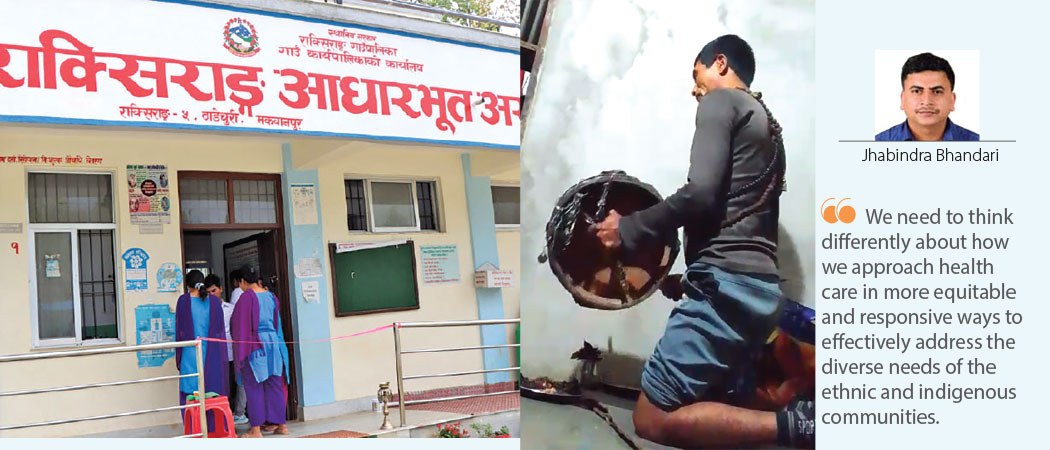

Within and across societies, health beliefs influence how people think about their illness and health problems, when and from whom they seek healthcare, how they respond to community-based interventions, and how well they adhere to treatment. During my ethnographic fieldwork in July 2024, I aimed to uncover the health and illness narratives of Chepangs in Chainpur of Raksirang Rural Municipality by exploring how they perceive illness and health, what treatment they believe in and whom these groups turn to when they are ill.
Chepangs are one of the indigenous groups living across Makawanpur, Dhading, Chitwan, Gorkha, Lamjung and Tanahu districts. Reports reveal that they possess vast indigenous knowledge about herbal medicines. The forest is the most important resource for them in terms of food, fibre, medicine, housing materials, fodder and various other needs. Apart from small farming, they rely on hunting, fishing and other natural resources. They have different experiences of coping strategies during the COVID-19 pandemic and other natural disasters such as earthquakes, flooding and landslides.
Additionally, I also observed Chepang’s housing conditions, food habits and social mobility in their everyday lives. More significantly, I sensed their health beliefs and deep-rooted perceptions of illness, which are socio-culturally constructed at large. I listened to different stories of local people in Raksirang that are rich in context and challenging at times but so often amusing, powerful, and memorable.
After a brief conversation with Hari Bahadur Praja, Ward Chair of Chainpur in Raksirang, who donated his land for the hospital, I walked towards a newly built basic hospital in Thadechuri, which is situated on a small yet beautiful hill surrounded by a small forest and a few households owned by Chepangs.
"In the past, Chepangs faced several barriers in seeking health care services. Because of poor health infrastructure, limited human resources, and a lack of medicines, they mostly depended on traditional healers, rituals, and indigenous knowledge and practices. Furthermore, due to deepening socio-cultural marginalisation, poverty, lack of roads, and poor transport systems, many people were unable to reach hospitals in Hetauda or elsewhere," said Hari, who is committed to achieving notable progress in the health and social well-being of marginalised Chepangs.
Added he further: “We have enrolled Chepangs in the social health insurance, organised several mobile health camps and outreach clinics and implemented provisions for other emergency support to ensure their rights to health are protected and promoted across the communities.”
Then, I followed a few women with their children on the way. Looking at them, I gently asked, 'Where are you going?' They answered with a smile: "A hospital for treatment and some follow-up for our children who were sick earlier." One of them whom I interviewed was Sanu Maya Praja, in her early 30s, who came from a remote community for treatment in the hospital. “It was never easy for us seeking health care and treatment in the past. Now we have easy access to hospitals and are able to utilise basic health care services. However, we go to Hetauda or Bharatpur hospitals for major health complications.”
As I reached the hospital, Dr. Yog Nehar Shrestha was busy checking up on mothers and children. The hospital environment was clean and appealing in many ways. Health care workers were friendly and helping people get what they needed. Female health workers were counselling mothers and checking up on their children, too. A few people were waiting outside. “I am happy to provide treatment and health care in the hospital. Mostly mothers and their children who need the most come for treatment. During the rainy season, people face some difficulties coming here, as the road is not so good. However, local government is supporting us in every effort we are trying to achieve in health care delivery," said Dr. Yog with a smile.
“The health situation of Chepangs is gradually improving as they now come here for treatment and counselling. In the past, they used to hesitate to visit health facilities for maternal and child health, nutrition, vaccination, and other services. Moreover, health facilities were not easily accessible. Still, community-based health promotion interventions need to be expanded for their healthy life," said Surya Bahadur Praja, a local teacher who understands the cultural context of Chepangs and their everyday life.
The interactions between health care providers and local people in the health facilities or outreach clinics are important to enhance the public trust and shared understanding towards the health care system. “There is no problem for communications here. As I belong to the Chepang, people feel more comfortable asking questions or raising their health concerns with me. If some people face difficulties in terms of language or other forms of communication, I help them as needed," said Arati Praja, a healthcare provider in the hospital. Added she further: “Now people are more aware about their illness and health; they rely less on traditional healers and religious leaders." Even if they do, they come to the hospital for treatment.”
Traditional healing is an immersive culture within and across societies. Abith Praja in Raksirang is a young traditional healer. “Some people come to my home for healing from illness and social suffering. Sometimes I go to their homes in case they cannot come here. Traditional healing (dhami jhankri), spiritual rituals, praying or meditation and other religious practices are still common in some families. After that, they go to hospitals if not cured," said Abith, who heavily believes in traditional medicine, healing practices and indigenous health ecosystems. In an informal interaction with a female community health volunteer, she said, "In the past, I used to go to households around to share information about health services such as family planning, safe motherhood, nutrition, sanitation and a few more. Mothers did not care much about what I used to talk about. Because they heavily trusted traditional healers. But the situation has changed over the years. Now they are more aware of increasing access to health care in the hospital and listen to our voices as we encourage and refer them to the hospital for health care services."
The narratives of health and illness are diverse, complex and evolving with modernisation, urbanisation, and evolving federal health systems. From an anthropological perspective, illness is generally viewed as a culturally interpreted subjective experience of being unwell. With deep-rooted socio-cultural beliefs, values and norms, illness is influenced by a range of socio-demographic factors such as gender, age, literacy, income, occupation, access to health care, local healing traditions and practices. More importantly, an interesting area of exploration is to examine how people respond to illness and health in different socio-cultural contexts.
Beyond biology and biomedicine, it is vital to explore how social, economic, and political structures influence the ways people usually access health care and the resulting health outcomes in broader socio-cultural contexts. For a more nuanced understanding, this gives deep insights into how cultural beliefs influence perceptions of illness and health-seeking behaviour or how social inequalities and marginalisation contribute to disparities in health outcomes.
The stories about illness as embodied experiences are not just personal accounts; rather, they reflect historical facts, social norms, cultural values and beliefs about health, social suffering and healing.
Understanding illness as a complex social phenomenon, anthropology has opened up new avenues for inclusive and participatory action research that essentially considers the perspectives of people in their everyday lives.
In the past, the majority of Chepangs in Raksirang faced deepening poverty, limited access to nutritious food, illiteracy, safe housing, early marriage, and limited access to health care in remote areas. As a result, malnutrition among children, maternal morbidity and mortality were huge concerns from the viewpoint of public health. Though the health situation of Chepangs has improved to a large extent, the most marginalised families still continue to suffer from illness, diseases, weak family support systems, lack of food and stable income.
On the other side, women are particularly more vulnerable, as they still face barriers to accessing health care, leading to poorer health outcomes. People’s ability to access health care relies on several factors such as geographical location, socio-economic status, insurance provision, language, transportation systems, family support and a few others.
This is an area where local governments need to explore and invest more resources to improve people’s access to health care, education and income-earning opportunities for sustainable livelihoods.
In addition, understanding the role of local governments and health care providers is instrumental in ensuring inclusive health policies in order to address the health care needs of ethnic and indigenous people who have been socio-politically marginalised for decades. “We are concerned with the unmet health care needs of Chepang and their families. Our health policies aim to empower the indigenous groups through awareness raising and provision of financial incentives as needed to partly cover their treatment costs and other emergency support," said Yam Gautam, chief of the hospital.
Armed with these curiosities, my insights from in-depth interviews with a range of stakeholders in Raksirang reveal that an interdisciplinary approach is crucial to address the widening health inequities within and across social groups. Effective implementation of inclusive health policies, incentives such as health insurance and culturally competent health care interventions are crucial to engaging communities not only in accessing health care but also in empowering them to reduce social inequalities which are culturally embedded in the societies across time and scale.
Given the social realities, there is a clear need for people-centred approaches on how health workers provide more effective socio-medical care to the poor and marginalised families. Towards this end, it is interesting to explore and build on the traditional shamanic practices, indigenous knowledge ecosystems and religious beliefs as a means of health-seeking behaviour among different social groups. Because a vast majority of Chepangs in Raksirang used to rely on traditional healers and religious leaders in the past rather than healthcare workers for seeking help for treatment.
The need for culturally sensitive health care has been growing in recent years. While there is an increasing trend to seek health care in the hospital or other health care facilities, the way people and health care providers communicate is largely influenced by culture. People’s willingness to seek health care in the health facilities will improve if there is a clear communication system, trust, good health infrastructure and social support promoting a culturally contextual approach in health-care settings.
It is equally relevant to explore how the culture of health care has been socio-politically embedded and transformed in recent years, thereby resulting in a shared identity in the communities. The insightful analysis and cultural meanings of the health and illness narratives should not be just a visual experience but also a symbolic meaning related to representation, social justice, empowerment, gender, and identity. There needs to be a paradigm shift in understanding local health systems and enlarging people’s choices for health care services in the context of ethnomedicine and emerging medical pluralism.
Traditionally, biomedicine has often imposed on indigenous cultures, having both positive and negative consequences in terms of accessing health care in communities. However, there are limited efforts to explore and better understand how illness experienced at a personal level is shaped by social institutions and structures in the communities. Given the changing socio-political context, the time has come to challenge the traditional ways of thinking about illness, health, healing, social suffering and coping strategies in local health systems at large.
Therefore, shaping our understanding of health and illness narratives is an emerging priority to ensure a more inclusive and holistic approach in the healthcare system. The interplay of social, biological, cultural, political, environmental and historical factors will continue to have profound impacts on human health and social well-being at large.
Unfortunately, local health systems have not adequately considered the prevailing social hierarchies, cultural values, political structures, and economic systems at large in terms of ensuring easy access to health care for people who are still left behind. Without addressing social determinants of health, the overarching goal of universal health coverage is impossible.
As we move forward, we need to think differently about how we approach health care in more equitable and responsive ways to effectively address the diverse needs of the ethnic and indigenous communities.
(Bhandari is a health policy analyst interested in anthropology. )