- Tuesday, 2 June 2026

Environmental Safeguards In Development Projects

A safeguard is a measure taken to protect someone or something or to prevent something undesirable. Environmental and social safeguards are applied by identifying potential impacts before a project is constructed, ensuring that risks are anticipated early. Measures are then designed to avoid, minimise, or mitigate these impacts, and to compensate for those that cannot be fully addressed. Proper management of occupational and community health and safety risks is also an integral part of project implementation.
These safeguards promote sustainable infrastructure development through active participation, cooperation, and ownership of local stakeholders. Development partners and implementing agencies must strictly follow their safeguard policies and regulations when financing projects, ensuring full compliance during planning, construction, and operation. These policies also include environmental and social impact assessments during the construction of infrastructure projects. The Environmental Protection Act 2076 and Regulations 2077 have regulated them.
Impacts
There is a wide range of environmental and social impacts in development projects. These impacts are generally described as beneficial and adverse. Beneficial are those that justify the project activities and can further increase the benefits from implementation. On the other hand, adverse impacts are unfavourable conditions that may occur due to the project on the overall environment (physical, biological, and Socio-economic) and interrelationships. These can negatively affect the environment. Ecosystems may be disrupted, as well as their interrelationships.
Measures should be adopted to mitigate these and other impacts during the implementation phase. The mechanism used to assess impacts and adopt mitigation measures to avoid or minimise adverse impacts is called a safeguard. There are various dimensions of social safeguards: from land acquisition that may occur during project development to the impacts that affect indigenous peoples, religious and social conditions, among others. If all the impacts that may occur during the project construction and operation phases are assessed properly and steps are taken to address them beforehand, the damage they may cause can be managed properly. Safeguards are an important dimension of development. Environmental management is important for sustainable development and poverty reduction. Committed efforts are essential to protect the environment, which include a nation’s land, forests, water systems, wetlands, ecosystems, and other natural resources, as well as and the natural resources on which the poor depend for their livelihoods.
Environmental and social safeguards aim to ensure environmental soundness and sustainability through the integration of environmental decision-making processes. Safeguard policies guide governments in identifying and assessing project impacts. Screening alternatives to projects, as well as preparing, implementing, and monitoring environmental management plans, are essential elements. Safeguard regulation requires development partners and governments to consult with people who may be affected by the project.
The safeguard process maximises social and environmental opportunities and benefits while ensuring that adverse social and environmental risks and impacts are minimised, mitigated, and managed. There is no regulatory legal provision or body in Nepal that can look at all the safety processes from a single window. Based on the contributions of donor agencies, it is seen that the environmental and social safety policies of development partners, such as the World Bank, Asian Development Bank, the United States Agency for International Development, the Asian Infrastructure Investment Bank, and the UN, are being used in Nepal. This can enhance the consistency, transparency and accountability of their decisions and actions, improving performance and strengthening the achievement of sustainable development outcomes.
Safeguard policies, rules and procedures strengthen the quality of the programme, maximise social and environmental opportunities and benefits, avoid adverse impacts on people and the environment, and minimise, mitigate and manage adverse impacts. They can also strengthen the capacities of partner agencies to manage social and environmental risks, ensuring full and effective stakeholder engagement through mechanisms for responding to the grievances.
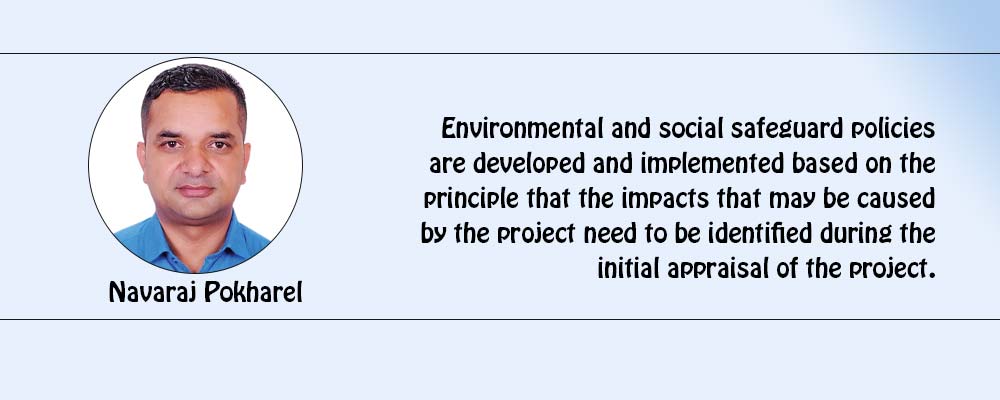
The safeguard concept emerged to address the adverse impacts of projects throughout the project cycle. Environmental and social safeguard policies are developed and implemented based on the principle that the impacts that may be caused by the project need to be identified during the initial appraisal of the project. Affected persons under social impacts must be informed appropriately throughout the time from project preparation to implementation. Internal procedural requirements for all stages and all components of the project should include similar implementation procedures, which are as follows:
Key issues begin once potential projects for financing are identified and continue throughout the project cycle. Once impacts are assessed, mitigation measures, monitoring programmes, institutional arrangements and mechanisms should be developed. Safeguards should be integrated into project design and implementation. Affected people are consulted and information is disclosed during project preparation and implementation in a manner and language that is understood.
Project cycle
Safeguards should be disclosed at various stages throughout the project cycle and updated regularly to clarify common elements and principles, ambiguities, overlaps, and inconsistencies. The coverage of social elements in environmental assessment needs to be clarified. The involuntary resettlement policy should also include some elements of the policy on indigenous peoples. All policies require disclosure and consultation. The extent to which the policies cover different lending instruments and the procedural responses they prescribe differ.
Social and environmental aspects are not a core function. A subject that systematically describes all the impacts that a proposed project may have on social and environmental aspects, clearly stating the budget, responsibilities, and monitoring bodies, and prepares it along with a management plan, is called a safeguard report. It is necessary to have a system for implementing the environmental management plan step by step during the implementation phase.
(Pokharel is an environmentalist. navarajp@gmail.com)



-square-thumb.jpg)