- Monday, 8 June 2026

Excellent Three Movies
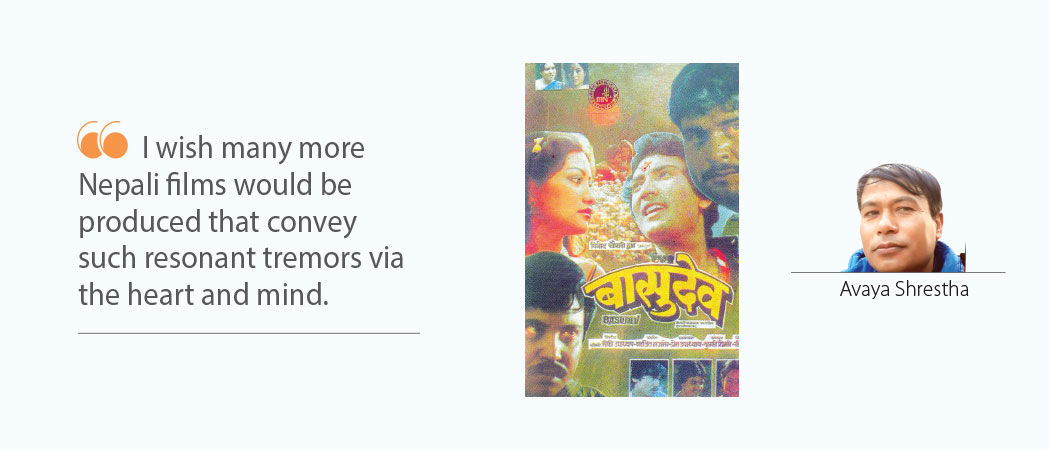

A film journalist asked me recently to name three Nepali films that are dearest to me. I believe there is a difference between the 'excellent' and 'favourite'. He agreed and requested to name the ones I love most. Without hesitation, I said, 'Basudev', 'Numafung', and 'Karma'. As I named them, scenes from those movies began to whirl through the reel of my memory.
Basudev
Among Nepali films, the one that can be regarded as excellent from every perspective is 'Numafung'. Yet even today, 'Basudev' (1984) remains my dearest. The film is based on the novel 'Kattel Sirko Chotpatak' by novelist Dhruba Chandra Gautam, a novel I consider my all-time favourite in Nepali literature. There are significant differences between the novel and the film’s plot. However, the script written by Gautam himself in collaboration with director Neer Shah does considerable justice to the novel's original spirit.
In both the novel and the film, sycophants of the Panchayat system unjustly dismiss Prof. Basudev Kattel from his job. His younger son dies, and grief turns him into a chronic patient. The novel ends with his lingering hope that his missing elder son, Prem, will return. In the film, however, Prem returns midway and assumes the role of the hero. At the time, the dialogue spoken by Krishna Malla in the role of Prem, "Mero namai prem, kamai prem" (My name is Prem (love), and my duty is to love), became immensely popular among the youth. The film was not entirely free from the formulaic demands of including comic elements and romantic spice. Yet the depth with which it portrays the mentality, imagery, characters, and the tragic erosion of human sensitivity in the late Panchayat era is unparalleled in Nepali cinema. It is a film saturated with such emotional intensity that the cruelty of the system compels even a simple, honest, and righteous man like Basudev to become a killer.
Even today, every self-respecting, truth-loving yet defeated individual reminds me of Basudev, while every corrupt but swiftly rising opportunist reminds me of Kumar. These roles were played vividly by Harihar Sharma as Basudev and Neer Shah as Kumar.
Whenever I recall the final two scenes of the film, I almost feel breathless. In an act of revenge, Kumar attempts to rape Basudev’s daughter, Ranju. When Basudev's wife, Sabitri, and his visually impaired father try to resist, Kumar beats them and leaves after issuing another threat. In response, Sabitri – portrayed by veteran actress Shakuntala Gurung – utters, in a trembling voice that conveys the most harrowing despair of her life, "What a suffocatingly helpless life, dying every day and yet forced to live every day!" To me, this is perhaps the finest dialogue delivery ever done in Nepali cinema.
The other unforgettable moment is the film's final scene. After killing Kumar, Basudev returns only to suffer a fatal heart attack. In the background plays the famous song 'Kun Mandirma Janchhau Yatri', sung by Rabin Sharma and written by the Great Poet Laxmi Prasad Devkota. Basudev staggers forward and collapses at the resting platform in front of Durbar High School. The Trichandra College-based Ghantaghar (Clock Tower) strikes eleven, signalling 11 p.m. Moments later, he dies of the heart attack. Rarely do we watch a film filled with such profound sensible depth.
Numafung and Karma
The second film closest to my heart is 'Numafung' (2001). Based on the story 'Karobar Ki Gharbar' by Kajiman Kandangwa and directed by Nabin Subba, 'Numafung' depicts a father who marries off his daughter Numa after receiving money and gold from the groom's family as 'Rupauli Sunauli'. When Numa becomes pregnant, her loving husband dies. As she had a miscarriage, her father again accepts money and gold and forces her into a second marriage against her will. Unable to endure the quarrelsome and insensitive second husband, Giri Hang, she elopes with a Rikute (recruit). As the proverb goes, excess inevitably leads to ruin; Numa’s act is a rebellion against such excess. Yet the penalty for this rebellion is heavy: her maternal family must repay the bride-price in gold and silver, leaving them destitute.
This was the first Nepali film shot in the actual Limbu settlements of Panchthar, the region to which the story belongs. In many respects, it stands as an outstanding creation of neo-realism.
After 'Numafung', the next film I love most is 'Karma' (2006).
What might be the inner world of a nun who has spent her life within a monastery when confronted with the outside world? The film 'Karma', directed by Tsering Rhitar Sherpa, offers a beautiful answer. It transcends religious boundaries and presents the portrait of an open, humane heart.
From a monastery in Mustang, two young nuns, Karma and Sonam, set out in search of a mysterious trader named Tashi, who has borrowed a large amount of money from the monastery, urgently needed for religious purposes. Sherpa's camera follows them, capturing along the way the ups and downs of everyday life, geographical hardships, social discrimination, and flashes of human behaviour.
They reach Pokhara, where Sonam falls ill. Learning that Tashi has gone to Kathmandu, Karma leaves Sonam behind and travels onwards. From Kathmandu she hears he has left for Bhairahawa, and she follows him there. By coincidence, Karma and Tashi are in the same bus. Tashi had a dark past; he was once notorious for trafficking young women into India. But that past has changed. After falling in love, he has dedicated himself to noble humanitarian work. He now runs a Christian organisation that shelters displaced women, the vulnerable, and abandoned children born of them.
Tashi repays the monastery's loan to Karma. As she journeys back with the money, a storm of thoughts rises within her: Spiritual advancement or service to humanity? Which is greater? She chooses the latter. What might it look like for a Buddhist nun to return a large amount of money in trust to a Christian institution? Surely it is a testament to magnanimity. Karma performs this noble act and returns to the monastery empty-handed. She realises that there are many paths to serving humanity.
Such a profound story told with such simplicity is rare in our cinema. After earning acclaim for 'Mukundo,' Tsering Rhitar Sherpa crafted 'Karma' into a truly unique humanistic film. The roadside harassment faced by the nuns, their conversations with hotel owners in Kathmandu and Pokhara, and the curiosity awakened in Karma by a model on a billboard advertisement—all these subtly sketch the psychology of the nuns and add layers of intrigue.
I wish many more Nepali films would be produced that convey such resonant tremors via the heart and mind.
(Litterateur Shrestha is a cinephile.)