- Monday, 8 June 2026

Journey Beyond Festival Halls
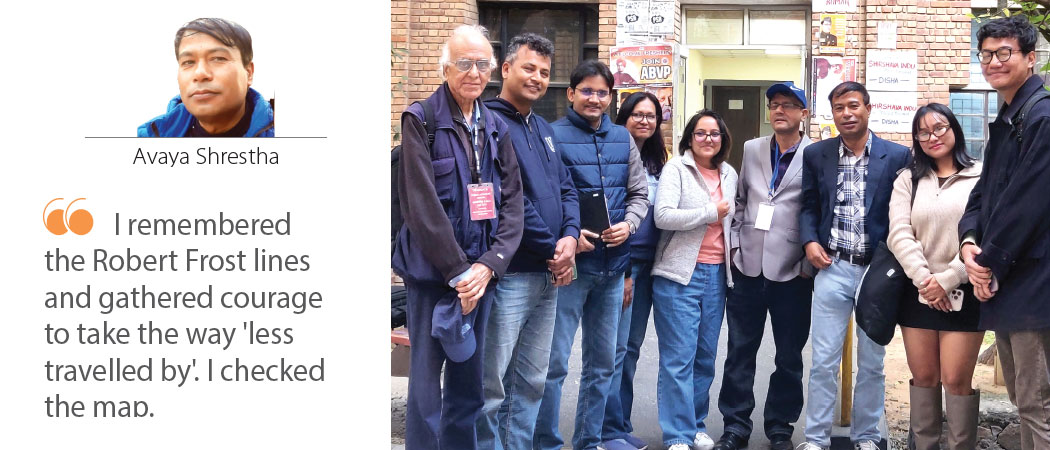
I participated in the SAARC Literary Festival–2025, held at the Academy of Fine Arts and Literature in Siri Fort, New Delhi, from November 9 to 12, 2025, for the second time. On the first day of the festival, we met Kamal Lamsal from Surkhet, a PhD student in South Asian Studies at Jawaharlal Nehru University (JNU), New Delhi. He passionately attended all the sessions that day and invited us to visit JNU at our convenience.
JNU is one of India’s most renowned universities, known for producing politically conscious and intellectually sharp students. I was eager to visit the university and interact with them. I shared the idea with veteran litterateur Abhi Subedi and journalist Rituraj Subedi, and both readily agreed.
By the first half of the festival’s third day, my sessions on poetry and short stories had concluded. I sent a message to Lamsal via Messenger informing him that we were on our way to the university. He was delighted and informed his colleagues. We hired an auto-rickshaw, which took about half an hour to reach JNU.
Nepali students Lamsal and Indu Dhungana and Bangladeshi student Ferhana Afroj warmly welcomed us. They led us to a wall where a rebellious slogan was written in Hindi, meaning, "Dead people do not run missions, and the living ones do not let them stop." The slogan truly reflected the spirit of JNU students.
Soon after, Nepali students Saroon Bhattarai, Irfan, and others joined us. While waiting for tea, we discussed contemporary world politics. I asked Ferhana about the latest situation in Bangladesh after the formation of the government led by Nobel Peace Prize winner Mohammad Yunus. She shared her views, and we, in turn, discussed Nepal’s political scenario in the aftermath of the Gen-Z movement.
Abhi Sir, a highly respected professor at Tribhuvan University, quickly won the love of the JNU students as well. He spoke about his theatre tours, his association with the SAARC Literature Festival, and his friendships with veteran Bangladeshi writers. He also narrated an incident from a Foundation of SAARC Writers and Literature (FOSWAL) event honouring the national poet of Bangladesh, Samsur Rahaman, where the chairperson Ajeet Cour remarked, "Dear poet, tell me which good poet in the world does not have a weak heart?" Afroj listened with great interest and joy.
We also met the head of the South Asian Studies department, who was familiar with Abhi Sir and enquired about political scientist Lokraj Baral. On our way back, we encountered Saugat Phuyal, a master’s student and the chairperson of the International Students’ Association. Eventually, he turned out to be the nephew of my journalist friend Ajay Phuyal.
Green park to Karol Bagh
After returning to our residence at Hotel Saidham in August, Kranti Marg, Indian authors Bhupinder Kaurpreet, Gayatri Majumdar, and Seema Jain were preparing to go shopping at Connaught Place. They offered us to follow them in another Uber taxi and soon left.
The four of us—Bidhan Acharya, Dhir Kumar Shrestha, Din Bandhu Sharma, and I—did not have Indian SIM cards, so booking an Uber was not possible. Instead, we decided to visit Karol Bagh around 8 pm, one of Delhi’s most affordable markets.
We walked to Green Park, bought metro tickets, and boarded the Yellow Line. At Rajiv Chowk, we switched to the Blue Line and reached Karol Bagh, just after RK Ashram Marg. Bidhan led us towards the market area. We had heard a beautiful eco-story by Gurpreet Kaur at the festival the day before, depicting the tragic consequences of the environmental pollution. As told in the story, Delhi was suffering from severe air pollution, and Karol Bagh felt suffocating, enveloped in thick smoke. Most of the shops were nearly closed. People appeared hurried and anxious. I overheard a young lady speaking on her phone about a bomb blast in Delhi. There was no shopping at all. We had a light dinner at a restaurant and returned via the same metro route.
When we reached our residence, television channels were broadcasting breaking news about a bomb blast at Lal Killa (Red Fort), which had reportedly claimed twelve lives.
Alone in Delhi
Two roads diverged in a wood, and I—
I took the one less travelled by.
And that has made all the difference.
-Robert Frost (from 'The Road Not Taken')
The four-day festival had just concluded, and on the very same night, Abhi Sir and four others left without even resting. Among the remaining five, four decided to stay for medical treatment because their return tickets were flexible. I was the only one left alone. I had a Nepal Airlines ticket for November 13. I only needed to find my way from the hotel to Indira Gandhi Airport, but even that felt difficult.
Some suggested I take an Uber bike, others told me to hire a taxi, and some recommended the metro. I was scared to ride a bike in the chaotic, traffic-choked Delhi streets, and the air pollution was terrible. I had to carry a sling bag and a rucksack filled with books. Bangladeshi writer Nurquamrun Naher offered me to join her Uber taxi, but she was leaving a bit later. I actually enjoy travelling by metro in Delhi. I’ve ridden it several times. When you are with experienced friends, there is no tension at all. But now I was alone. We are born alone, and in some matters, we must struggle alone. Even while roaming through Sarojini Nagar, I was mostly on my own.
I remembered the Robert Frost lines and gathered courage to take the way 'less travelled by'. I checked the map. My friends had already guided me, and I had screenshots of the route. I took an auto-rickshaw to Green Park. From there I bought a ticket to New Delhi for IC 32. I boarded the Yellow Line and passed AIIMS, Patel Chowk, Lok Kalyan Marg, Udyog Bhawan, Delhi Haat, and Rajiv Chowk, finally getting off at New Delhi Station.
From there, I followed the signs for the Airport Express Orange Line, walking through the underground passage for five to seven minutes. I stood in a queue to buy a ticket, but it turned out to be the line for issuing metro cards. I asked again whether cash payments were accepted and queued in the proper line.
Following the Orange Line route once more, I reached the platform area. There were two platforms: number 1 and number 2. People were waiting at platform 2; platform 1 was empty. When I’m with friends, I’m very talkative, but when alone, I turn extremely introverted! But being an extrovert was not an option for me. I asked someone, and they asked another person, and finally came the answer, "Yes, this is the right one." Still unsure, I went up and asked two other people to confirm. Platform 2 was confirmed. This was the fastest metro service in India. Passing Shivaji Stadium, Dhaula Kuan, and Delhi Aerocity, the train reached Terminal 3.
I followed the directions to international departures. The screen showed that Nepal Airlines check-in was running at counter J. First, it was a struggle just to locate the check-in area, and then another struggle to find counter J. The police kept saying, "It's that way," but I could never figure out exactly where that way was. I couldn't find any Nepali faces either. Eventually, I checked in at whatever counter I found, and only after that did I locate counter J.
After completing immigration and security, I reached Gate 18. There, the waiting lounge was filled with Nepalis, most returning after treatment at Rajiv Gandhi Hospital or after living with relatives in rented apartments in Shyam Bazaar.
(Litterateur Shrestha writes on various issues.)