- Monday, 8 June 2026

Distress Of Finding Money
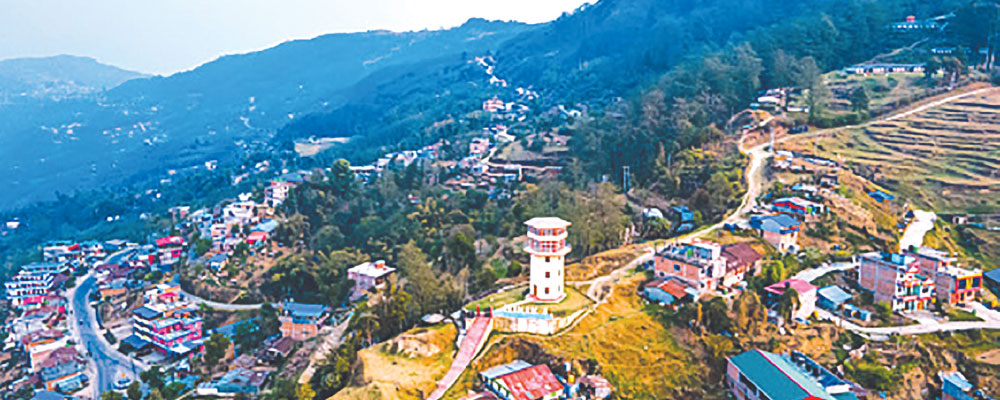
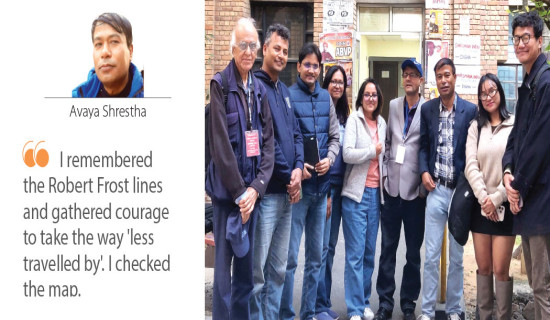
We were on a literary tour in the first week of Baisakh 2073 (April, 2016). In the course of the three-day tour organised by the Nepali Kala Sahitya Dot Com Foundation, we reached Dhankuta Bazaar in the evening of Baisakh 3. It had begun drizzling, and in that murky evening we circled Dhankuta Bazaar with poet Suman Pokhrel, a native of Dhankuta now living in Biratnagar. The next afternoon, a crowded poetry symposium was organised in Dhankuta. I had read a poem on my mother's legacy.
The following morning, passing through the highland Hile of Dhankuta, we reached Basantapur of Tehrathum. Even in the heat of Baisakh, Hile remained cold. When we reached fog-covered Basantapur, a wind cheater was hardly enough; the cold made one shiver. From there, we had planned to travel 26 km east to Myanglung, the headquarters of Tehrathum. However, for some reason, the plan was cancelled. After enjoying the pleasant morning at Basantapur, we had lunch there and then hiked to Tute Deurali of Sankhuwasabha, and from there walked to the captivating RR Park.
I cannot recall the names of everyone who travelled with us. But I remember that Usha Sherchan, who had difficulty walking due to her weight, stayed inside the microbus at Tute Deurali. Poet Tulsi Diwas too did not seem eager to walk. Naturopathist Dr. Hari Prasad Pokharel 'Manasagni'- who always emphasised good health, yoga, and walking- along with Momila, Rajeshwor Karki and the others, reached the park on foot. We entered the park from the northern entrance, walking downwards. Three or four groups had already entered before us.
TV journalist-cum-poet Thakur Belbase was walking beside me at the time. A little ahead, several notes of one-thousand and five-hundred rupees lay scattered. I pointed them out to Belbase. He jumped back like a startled rabbit and said, "I won't touch the money. I might get beaten up for no reason. I don't want to get beaten up in this age."
I thought that someone might misuse the money, so I picked up all the notes with the intention of returning them to the rightful owner or handing them over to the police. But there was no bag, no identity card, nothing at all around the spot. Stuffing the notes into the side pocket of my pants made it uncomfortable to walk.
Within moments, the news of the money spread like wildfire among our companions. Now I truly began to fear. With the news going viral among the group, I feared becoming the target. Someone might falsely claim the money, snatch it, or I might even be beaten. At the same time, imagining the distress of the person or group who had lost it, especially if they were poor, filled me with sadness. I silently wished that the matter would not spread further, that the real owner would come searching for it inside the park, and that I would be able to return it.
Meanwhile, friends were busy taking photographs with the statues of tigers, bears, deer, and sitting with real yaks. I too took part, but inside me there was a great storm. My heart throbbed so strongly that it felt as if it might burst out of my chest. The nearly two-hour walk inside the park felt like an entire era. No one appeared to claim the money.
I expressed my wish to hand it to the police. Hearing this, our driver ran to the microbus and conveyed this to our seniors, Usha Sherchan and Tulsi Diwas. "He is such a learned man, yet his brain doesn’t work even as much as mine; he wants to hand it to the police! What foolishness is that?" he complained. Usha called me immediately and advised me not to hand over the money to the police.
I then asked other friends whether I should inform the local FM station. That, too, did not seem likely to help identify the real owner. Later, a plan materialised between me and journalist Belbase, who was then a hit presenter at Image TV and Image FM. Once back in Kathmandu, he would interview me about the incident on Image FM and then we would hand the money to a financially poor girl he knew, for her schooling and books. I agreed.
While returning to Hile, Anupam Roshi and I counted the money on the microbus. It totalled Rs. 30,500. Usha worried, saying that if the money belonged to the group of orphans who had walked ahead of us, it would be a great tragedy. In the end, both Tulsi Diwas and Usha suggested that the amount be donated to the organiser, Nepali Kala Sahitya Dot Com Foundation, as it had been ‘tirelessly serving literature.' Everyone clapped. Embarrassed, I looked at Belbase; he silently surrendered to the idea. Finally, I said, "Let's not make this public. If the rightful owner comes by tomorrow, I will return it. If not, I will hand it to the Foundation. Until then, I will keep it with me."
We spent that night at Hile. I could not sleep even for a moment. I kept thinking no one was going to show up to claim it. Right then, RM Dangol told me that the Foundation was facing financial difficulty. The next day, the group once again reminded me to hand the money to the Foundation, and I did it to chairperson Momila Joshi. Clearly, I felt guilty about this. As a simple man, I have many weaknesses. In some matters, I may not be a good person either. I still feel guilt and regret about those things. Yet in some matters, I have an instinct that feels a bit different.
Once at Pashupati Plaza in Kathmandu, a young man talking on his phone dropped a hundred-rupee note from his pocket. I returned it; he did not even thank me, yet I felt happy. Another time, at New Road Gate, I bought a packet of lemons worth twenty rupees. When I gave a five-hundred-rupee note, the vendor mistakenly returned Rs. 980 to me, thinking I had given a thousand-rupee note. Returning the extra money and seeing gratitude flare in her eyes still gives me joy.
Similarly, whether it is the meat-seller at Harsha Chowk in Dadhikot, the momo vendor, or the bus conductor, many times they have given me extra change by mistake, and I have always returned it honestly. It is a different matter that many times I have mistakenly given extra money to vendors and others, and they did not return it to me.
The joy of returning someone's money is something only the one who returns it can feel. I believe one can deceive the whole world, but not oneself. So at the very least, I do not lie to myself, which is why I return such money. The amount I found at RR Park was no small amount at that time for an average Nepali. I think it was equivalent to Rs. 70000 today. In a hilly district like Sankhuwasabha, it was extraordinary. Imagining the mental anguish of the person who lost it still fills me with a deep melancholy.
(Litterateur Shrestha writes on various issues.)