- Wednesday, 27 May 2026

Bagh Durbar retrofitting underway following long delays
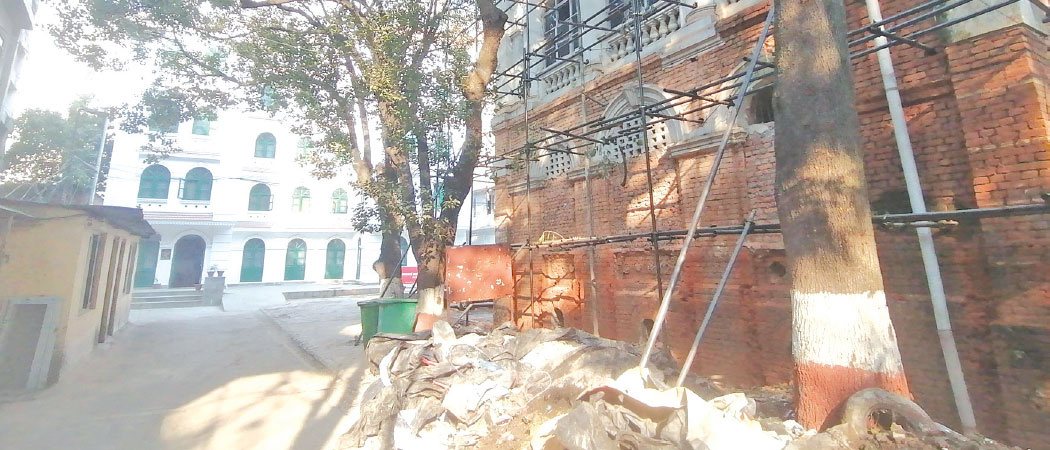

Kathmandu, Feb. 9:The retrofitting work on the historic and neoclassical Bagh Durbar building in Sundhara has gained momentum after a lengthy legal battle and years of conservation efforts.
The palace suffered severe damage during the 2015 earthquake, leaving parts of the structure cracked and dilapidated. For a long time, debates continued over whether the building should be demolished and rebuilt or preserved through retrofitting. After a final decision was made in favour of retrofitting, construction work is now progressing at a rapid pace.
Bagh Durbar previously housed the Kathmandu Metropolitan City (KMC) office, which has since been relocated to Kamaladi.
Acting Mayor of Kathmandu Metropolitan City, Sunita Dangol, recently inspected the retrofitting site and directed concerned authorities to ensure that both structural strength and architectural originality are maintained throughout the construction process while implementing the retrofit plan.
Dangol, who is also the coordinator and acting head of the Plan Monitoring Committee, instructed officials of the Public Works Department to closely supervise every phase of the construction work.
The retrofitting contract for Bagh Durbar was awarded through a public procurement process at a cost of Rs. 369 million. The work order was issued to the contractor on December 1, 2025. The project is scheduled to be completed by 2017 (Mangsir 15, 2084) and around 5 per cent physical progress has been achieved so far.
During the tenure of former KMC mayor Bidhya Sundar Shakya, there was a proposal to demolish Bagh Durbar and construct a new building. The metropolis had even issued tenders for demolition.
Recalling that period, heritage activist Ganapati Lal Shrestha said that conservation activists had warned of moving the Supreme Court if the decision to demolish Bag Durbar was not withdrawn. On July 20, 2018, more than 40 conservation activists staged a protest demanding KMC reverse its decision.
Heritage activist Shrestha further said that it was a great achievement that finally Bagh Durbar in now being retrofitted and it had been now lobbying to develop it into a seminar hall to organsie national and international meeting, exhibition and conference programme.
Subsequently, senior advocate Prakash Mani Sharma, along with advocate Sanjay Adhikari, filed a public interest writ petition. The Supreme Court overturned all decisions of the Kathmandu Metropolitan City related to demolition and issued a directive to preserve the building.
According to the Supreme Court verdict delivered on March 19, 2019 (Chaitra 5, 2075), Bagh Durbar could not be demolished as it holds archaeological significance.
Despite the ruling, conservation efforts did not immediately gain momentum. The Department of Archaeology later called for tenders and awarded a conservation contract. In 2019 (2076 BS), the contractor reported that KMC had obstructed the preservation work after the contract was awarded.
Earlier, in 2017 (2074 BS), KMC had planned to demolish Hari Bhawan and construct three facades for office use one inspired by Bagh Durbar, another reflecting Lichchhavi-era architecture and a third modern structure. However, following the Supreme Court’s decision, the demolition plan was scrapped, leading to prolonged uncertainty and neglect.
In its policy and programme for the fiscal year 2022/23, Kathmandu Metropolitan City stated that necessary arrangements would be made to strengthen Hari Bhawan (Bagh Durbar).
KMC had been operating its office from Bagh Durbar since 2003 before relocating to Kamaladi. The palace area falls under the jurisdiction of the Ministry of Finance.
Bagh Durbar, an important landmark in Nepal’s history, was built by Amar Singh Thapa (Sanu) and later used by Bhimsen Thapa in 1805. The palace was later owned by members of the Shah royal family, including Upendra Bir Bikram Shah, Juddha Shumsher JBR, and his son Hari Shumsher.
Over the years, Bagh Durbar has undergone several renovations, notably by Bir Shumsher in 1885 and later by Juddha and Hari Shumsher following the devastating earthquake of 1934.