- Wednesday, 27 May 2026

Nepal’s first apsidal Buddhist temple unearthed at Tilaurakot
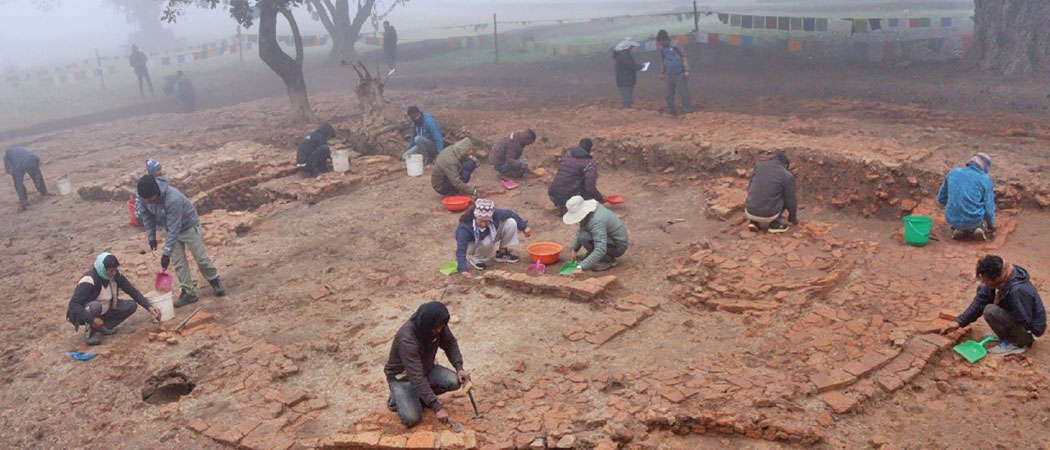

Kathmandu, Feb. 13: The recent discovery of Nepal’s first apsidal Buddhist temple within the ancient city of Tilaurakot-Kapilvastu, one of the best-preserved early historic cities and hinterlands in South Asia, has added new evidence supporting the proposal to nominate Tilaurakot to the UNESCO World Heritage List.
The efforts to include Tilaurakot in the list had failed at the 47th session of UNESCO, held in Paris, France, in July 2025.
A collaborative team of national and international experts from the Department of Archaeology, Government of Nepal; the Lumbini Development Trust; and Durham University’s UNESCO Chair uncovered Nepal’s first example of an apsidal Buddhist temple in Tilaurakot of Kapilavastu district.
At a press meet organised on Wednesday at the Department of Archaeology (DoA), officials informed that the monument revealed at Tilaurakot-Kapilavastu, the first of its kind discovered in Nepal, follows this exact layout but looks unusual in its location. It is a rare example of an apsidal temple constructed within a city rather than in a separate religious complex.
Saubhagya Pradhananga, Director General at the DoA, said that among the 12 protected areas in Nepal, Tilaurakot and Kapilvastu are among the listed sites. Therefore, there are plans to acquire 100 bighas of land in Tilaurakot to preserve the historic area. Of the planned 100 bighas, 50 bighas have already been acquired.
After completing all necessary tasks, the proposal will be submitted for inclusion at the 49th session next year. The World Heritage Committee at its 47th session also recommended fully excavating the apsidal temple area. Following further excavation, additional remains of the apsidal Buddhist temple were discovered.
Kosh Prasad Acharya, former Director General of the Department of Archaeology and co-director of the excavations, said that the remains were first identified and recorded by Indian archaeologist P.C. Mukherjee as a “Deva Temple” when he surveyed the site and excavated locations across Tilaurakot-Kapilavastu in the late nineteenth century.
He further stated that the Greater Lumbini Area of Nepal is rich in both tangible and intangible cultural heritages. The discovery of this unique apsidal temple in the city of Tilaurakot-Kapilavastu further demonstrates the richness of the Buddhist heritage of this area and its significance within the ancient Buddhist pilgrimage routes of South Asia.
Professor Robin Coningham, UNESCO Chair on Archaeological Ethics and Practice in Cultural Heritage at Durham University and co-director of the excavations, said that the discovery of the apsidal temple at Tilaurakot-Kapilavastu is vital for understanding the history and heritage of Buddhism in South Asia.
The newly discovered apsidal structure was built near the centre of the city of Tilaurakot-Kapilavastu over the remains of the city’s earlier palatial complex. This central walled complex defined an area of 100 by 100 metres, enclosed by a massive brick wall measuring 1.5 metres wide.
After its abandonment, the complex became a focus of veneration, with Buddhist monasteries built over its ruined monumental walls. It was within the courtyard of one of these monasteries that the apsidal temple was constructed, enshrining and honouring an earlier Buddhist stupa within the monastery.
The abundant finds of oil lamps suggest that the site had a long-standing and concentrated focus of ritual activity by pilgrims and devotees who visited the ancient city. The importance of this site for religious activities continued into the later history of Tilaurakot-Kapilavastu, with the apsidal temple and monastery deliberately sealed beneath a mounded platform defined by brick paving.