- Wednesday, 27 May 2026

Tokha’s Chaku factories scramble to meet Maghe Sankranti demands

Kathmandu, Jan. 14: As Maghe, or Makar Sankranti, approaches, the air across Nepal is filled with festive cheer and the sweet aroma of Chaku, the beloved Newari delicacy.
Maghe or Makar Sankranti is being observed across the country on Thursday.
On the day, people celebrate Maghe Sankranti by performing cultural rituals and eating traditional delicacies such as ghee, yam, Chaku (molasses), and sweets made from sesame and molasses.
The mouth-watering delicacy Chaku is a favourite among children, adults and people of all age groups.
With Maghe Sankranti often referred to as the unofficial “Chaku Day” just one day away, factories in Tokha, Kathmandu are running at full capacity to supply the chocolate-coloured stuff to markets in the Kathmandu Valley, other districts and even abroad.
Tokha, located on the northern edge of the Valley and famed for chaku, is considered the chaku (hardened molasses) capital of the national capital. Many families in this ancient Newa settlement have been involved in Chaku-making for generations.
Using methods and technology that have remained largely unchanged for centuries, Tokha has been producing Chaku, a delicacy cherished across the country and increasingly among Nepalis living abroad.
This winter alone from mid-November to the first week of January Tokha produced approximately 700,000 kilograms of the Chaku, worth more than Rs. 98 million, informed Krishna Shrestha, President of the Tokha Traditional Chaku Conservation Society, the community organisation responsible for branding all Chaku produced in the area.
Shrestha said the produce had been supplied to stores across districts of the Kathmandu Valley and other parts of the country where the Newar community resides. He added that Chaku is also in high demand in countries such as China, Australia, Japan and Canada, with Japan recording particularly high demand this year.
At present, the town has 18 large and small traditional Chaku factories. During the peak season, each factory produces around 7,000 kilograms of molasses daily, offering varieties ranging from plain, masala and liquid Chaku to Dallo Chaku (one-kilogram blocks).
“Simple Chaku is sold at Rs. 140 per packet, while masala Chaku is priced at Rs. 150 per packet,” he informed.
Shrestha said the current demand for Chaku cannot be fully met. One of the major challenges in production is a shortage of workers during the peak season, as many people have left for foreign employment.
His factory also produces additional varieties, including cut Chaku (Chaku in pieces), special nutritious Chaku and gundpak, a sweet made from thickened milk and various ingredients for new mothers.
Traditionally, Dallo Chaku holds special significance in Newari family life. As Shrestha explained, it was sent to the homes of daughters-in-law’s parents to inform them that their daughter had given birth.
Chaku is a traditional Newari food item made from concentrated sugarcane juice, ghee and nuts.
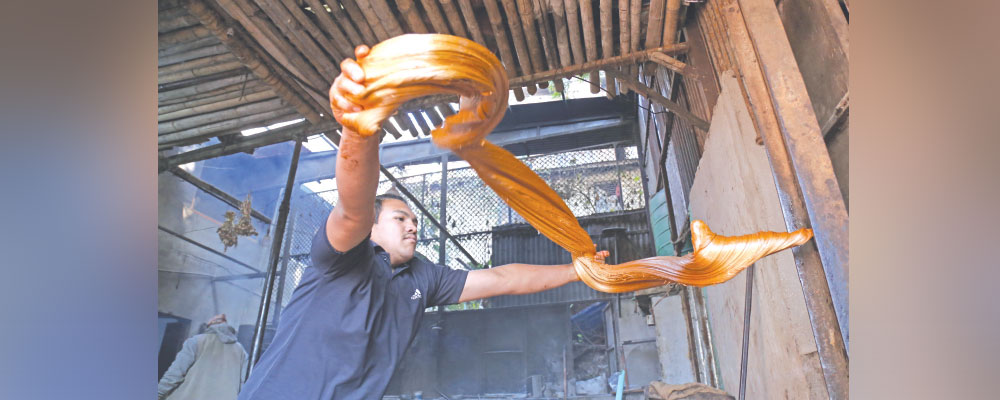
The preparation process begins by boiling sugarcane and jiggery-mixed syrup in a large cauldron before allowing it to cool. Once set, the mixture is whipped, slapped and stretched repeatedly until it turns dark brown. Peanuts and cardamom are added for extra flavour before packaging.
Despite the large-scale production, Shrestha noted that Chaku remains a seasonal business. Factories increase output during the Maghe Sankranti peak season the first day of the Nepali month of Magh and reduce production for the rest of the year.
Many people consume Chaku during the cold months as it is believed to keep the body warm.