- Wednesday, 27 May 2026

Swasthani was initially a ‘short Newari narrative’

Kathmandu, Jan. 12: “Lord Kumar dictates: Oh, sage Agastya …” The sacred chant has once again echoed through homes across the Kathmandu Valley and beyond with the commencement of the Swasthani Katha.
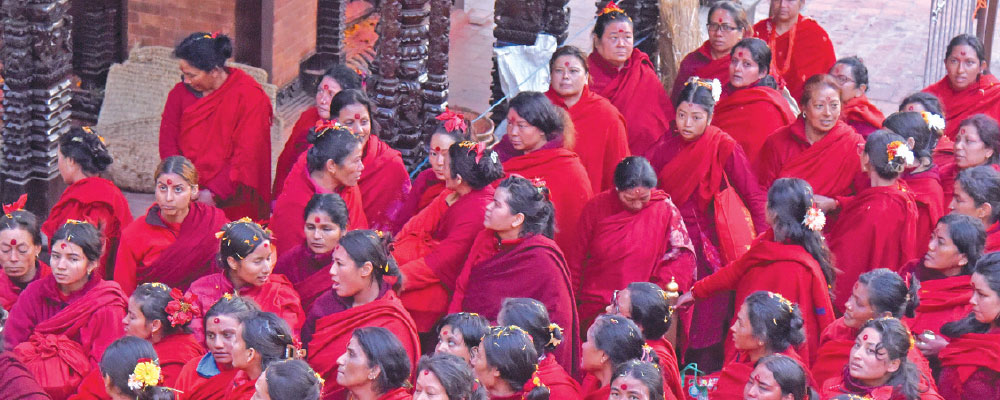
The month-long religious observance began on the full moon day of Poush 19 (January 3), marked by fasting and the recitation of the holy Swasthani story. This year, over a 100 devotees have gathered on the banks of the sacred Sali River in Sankhu, a conch-shaped town located 20 kilometres northeast of Kathmandu.
Revered in the Swasthani scripture, the Sali River is believed to be divinely associated and endowed with healing powers, making it a central site for the observance.
That is why hundreds of devotees arrive here from all over the country during the fasting month to take ritual baths.
Among the 18 Hindu Puranas, the Swasthani story is linked to the Skanda Purana and revolves around the female characters Goma and Chandrawati, both of whom attain wealth and prosperity after worshipping the goddess Swasthani and observing the fast. A large rock in the middle of the Sali River, believed to represent Chandrawati, can still be seen. Visitors to Sankhu can also see the hut where Goma is believed to have lived, as described in the Swasthani story.
The word ‘Swa’ means ‘self’ and Sthana means ‘place.’ Therefore, the Swasthani story is interpreted as a narrative about one’s own place. The goddess described in the text is believed to be a form of the eight goddesses worshipped by the Newar community, while the city mentioned is Lawanya Desh (present-day Sankhu).
The Swasthani story is also the story of a woman named Goma (Gomayaju), who lived in Sankhu and experienced the joys and sorrows of life—tears, wealth and poverty.
The oldest known Swasthani manuscript dates back to about 450 years. It was in handwritten Sanskrit mixed with the Newari language in Nepal Sambat 693 (1629 BS) and is preserved at the National Archives. At that time, the fast appears to have lasted only two days and one night, said Sunil Ulak, President of the Jagannath Ulak Memorial Trust and a researcher.
However, in a Swasthani text written about 30 years later, the fast is described as lasting 30 days. This suggests that the month-long observance began around 1602 (1659 BS), he said.
Ulak informed that the Swasthani was originally written only in the Newari language.
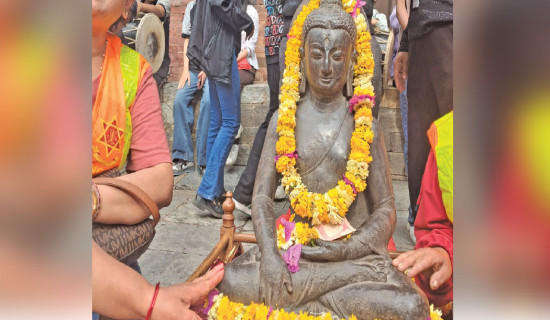
As a result, the tradition of reading the Swasthani was initially limited to the Newar community of the Kathmandu Valley. On Magh Shukla Panchami in 1630 King Pratap Malla of Kantipur installed the idol of Swasthani for the first time at Makhan Tanabha. This is considered the oldest idol of the goddess.
Research has found that the original Swasthani text was written on eight palm leaves, which are now preserved at the National Archives. Over time, the original story written on eight palm leaves, which focused on only three characters Gomayaju, Nawaraj, and his wife Chandrawati continued to evolve. The original narrative of Swasthani is found in the Skanda Purana of the Mahabharata, particularly within the Kedar Khanda, he explained.
Later, it was expanded into a thick book of about 400 pages. For the first 200 years, the text was written exclusively in the Newari language, he added.
The central character of the Swasthani story is Gomayaju, now commonly referred to as Goma in various Swasthani texts. In Nepali translations, Goma is described as a Brahmin woman. The other main characters are her son Nawaraj and his wife Chandrawati. The story is predominantly women-centered.
Because the Swasthani story mentions the Sali River, large crowds gather there to observe the fast and take ritual baths. However, earlier versions of the text did not mention the name of any river. The Sali River has been referenced only for about the past 200 years, he said.
Therefore, the custom of fasting at the Sali River is estimated to be no more than 200 years old. He further explained that when the recitation of the Swasthani begins, it is widely publicised as the start of Swasthani fasting. In reality, the fast is observed in the name of Madhav Narayan, while Swasthani refers to the book and its story.
Prabin Man Singh, an advocate of the Shree Madhav Narayan Swasthani Fasting and Sali River Management Committee, said that devotees at the Sali River observe the Madhav Narayan fast for a month and worship the idol of Madhav Narayan, not Swasthani.
This year, a total of 176 devotees have undertaken the Madhav Narayan fast, including 15 men and 161 women, according to the committee.
Those observing the fast must follow strict rules. They are allowed to eat only one meal a day without salt, must walk barefoot, and are prohibited from using cosmetic items, said Prakash Man Shrestha, a cultural expert from Sankhu. They must also take a ritual dip in the Sali River every morning and visit various shrines for worship, he added.
Devotees are also required to visit important religious and historical sites such as Bajrayogini, Pashupatinath, Pharping, Panauti, and Changu Narayan on foot.
“They are required to survive on a diet consisting only of rice, carrot, beans, ginger, ghee, chaku (hardened molasses), sugar, beaten rice, and milk. On the day of Ekadashi, they are allowed to eat bananas, yams, sugarcane, and oranges,” Shrestha said.