- Tuesday, 2 June 2026

Finance Ministry report on Gen Z Movement calls for governance, economic reforms
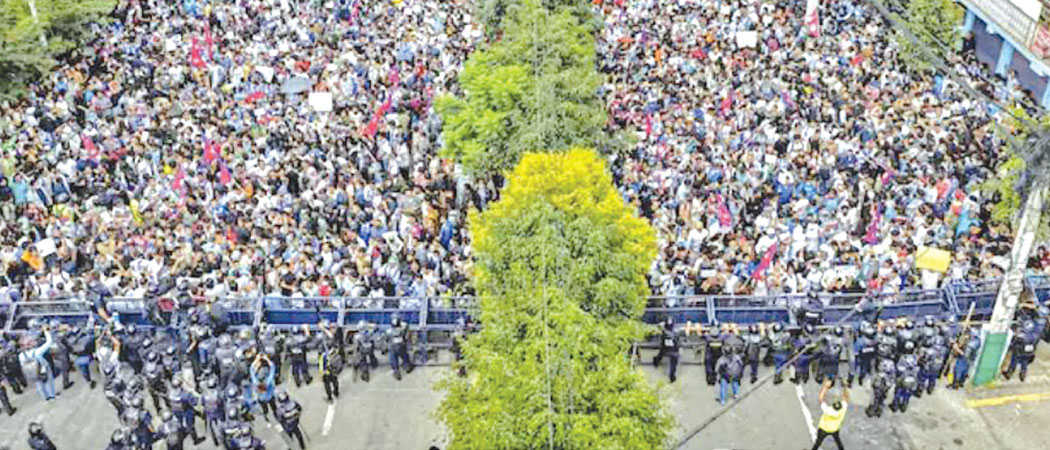

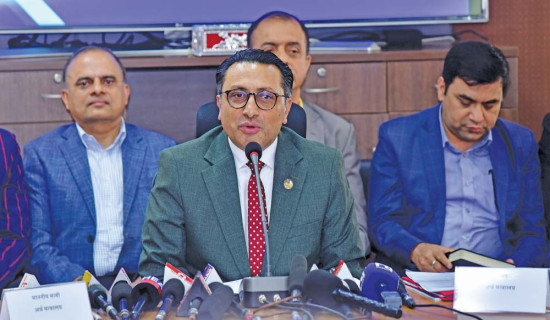
Kathmandu, Mar. 16: The Ministry of Finance has released a new study titled “Understanding the Gen Z Movement: Causes, Realities, and a Roadmap for a Capable Nepal.”
The report analyses the youth-led protests that took place on September 8 and 9, 2025 and examines their social, economic, and governance implications.
The study was prepared by a research team from the Tribhuvan University’s Central Department of Economics led by Professor Dr. Ram Prasad Ganwaly, along with researchers Dr. Pramshu Nepal and Dr. Dipak Bahadur Adhikari.
The report aimed to identify the major causes of the Gen Z movement, analyse youth perceptions about corruption, accountability, digital freedom, and employment, and evaluate the movement’s impact on governance and the economy.
It also proposes policy recommendations to strengthen good governance and youth participation in state mechanisms.
Researchers used a mixed-method approach combining quantitative and qualitative techniques.
Data were collected through structured surveys with 420 respondents representing all seven provinces, key informant interviews, focus group discussions, and secondary sources, according to the report.
The findings were analysed using thematic analysis, computer-assisted tools, and triangulation methods to enhance reliability.
Although the Generation Z—raised on digital technology—is educated and aware, with expectations of transparency, justice, opportunity, and accountability in democratic governance, dissatisfaction has been expressed in the form of the Gen Z movement when those expectations have not been met in a timely manner, the report noted.
The study notes that youth-led movements were not unique to Nepal but are part of a broader global phenomenon.
Among the movements in the US, Asia, Africa, and Latin America, examples from Bangladesh and Indonesia showed that the Gen Z movement is often leaderless, decentralised, based on digital platforms, and operates with an inclusive agenda.
These movements frequently use hashtags, memes, and online mobilisation strategies to connect youth, women, workers, and marginalised groups.
According to the report, Gen Z protests should be understood not only as social unrest but also as demands for transparency, accountability, and a new political culture.
The study highlights several factors behind the movement. Most participants were aged 16 to 25, and about 98 per cent had at least secondary education. Students, unemployed youth, and self-employed individuals made up a large share of participants.
Key social causes included declining trust in political leadership, restrictions on digital freedom, visible inequality in lifestyles between political elites and ordinary citizens, nepotism in political appointments, and limited access to opportunities. Youth also expressed frustration over an education system that does not prepare them for employment.
Economic issues were another major trigger.
"Rising unemployment, low wages, the need to migrate abroad for jobs, economic instability, limited entrepreneurship opportunities, and widening income inequality were cited as critical concerns," said the report.
The report identifies governance failure as a central driver of the protests.
Respondents pointed to bureaucratic delays, complex administrative procedures, lack of one-stop service systems, weak transparency in public institutions, and slow judicial processes.
According to the report, many young people believe corruption in Nepal is widespread and systemic rather than merely an individual ethical failure.
They also expressed concern that political appointments in institutions responsible for anti-corruption efforts weaken their effectiveness.
Youth also view digital freedom as a fundamental right and a key indicator of democratic governance.
However, dissatisfaction persists due to limited job opportunities, political influence in promotions within government jobs, and gaps between education and labour market needs.
The report states that the protests had mixed consequences.
According to the on-site survey, the movement negatively affected economic stability and the private sector investment climate, weakening investor confidence and entrepreneurial mindset. The economy suffered a loss of Rs. 84.5 billion due to the movement.
Some positive outcomes were also observed, such as a reduction in the arrogant mentality of traditional political leadership, a significant transformation in the political consciousness of the young generation, strengthened responsibility among political leaders and bureaucrats, and the creation of institutional pressure against corruption, said the report.
The report outlines several policy recommendations such as politics should be viewed as a form of national service rather than a profession, encouraging greater public-service values among political parties.
According to the recommendation of the report, the political appointments should be based on open competition and merit instead of family or personal connections, education should become skill-based and employment-oriented to reduce youth frustration and unemployment. Marginalized communities must be integrated into development processes to reduce social and economic inequality, it said.
The report identified that the economic policies should remain stable for at least five years to improve investor confidence, public service offices—including tax, land revenue, licensing, and local government institutions—should be transparent, efficient, and citizen-friendly.
A one-stop service system should be introduced for business-related procedures such as registration, taxation, and permits.
Key oversight institutions should appoint officials through merit-based competition rather than political nomination, potentially requiring constitutional reforms. Digital regulations should prioritise citizens’ rights, ensuring freedom of expression, access to information, and public participation.
Secondary education should include mandatory vocational subjects so students can pursue entrepreneurship if formal jobs are unavailable. Investors should remain independent from political parties and focus on projects that generate employment and broader economic linkages.
The report recommend that addressing youth concerns through governance reforms, economic opportunities, and inclusive development is essential for building a stronger and more stable Nepal.