- Monday, 1 June 2026

Budget not ambitious, smaller relative to GDP: Finance Minister
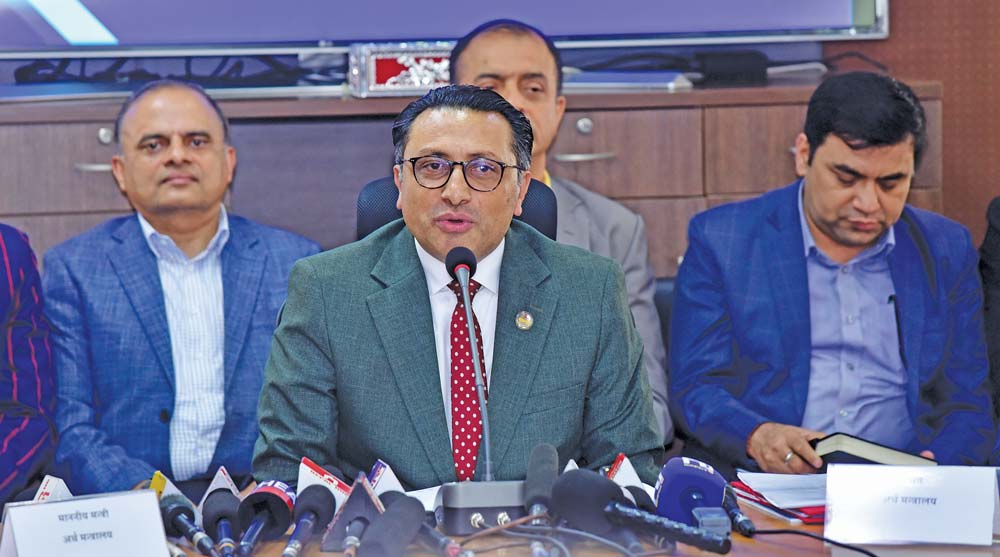

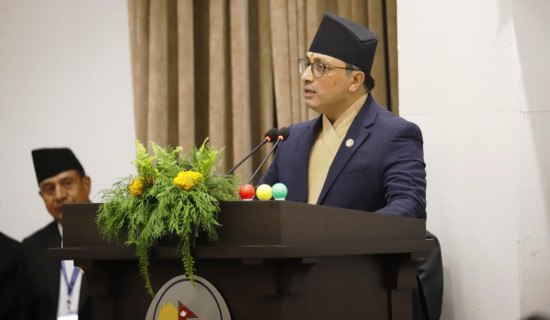
Kathmandu, June 1 : Finance Minister Dr. Swarnim Wagle has defended the budget for the upcoming fiscal year, arguing that it is neither overly ambitious nor excessively large when measured against the country’s economic size.
Speaking at a post-budget press conference organised by the Ministry of Finance on Sunday, Dr. Wagle dismissed criticism that the budget was too large, saying it was significantly smaller than market speculation and was within the state’s implementation capacity.
“There was widespread speculation that the budget would reach around Rs. 2,500 billion, but in the end it came to Rs. 2,124 billion,” he said. “Many have called it large and ambitious, but in terms of size, it is not.”
The Finance Minister stressed that the budget should be evaluated in relation to the country’s Gross Domestic Product (GDP) rather than absolute figures alone.
He said the budget for the fiscal year amounts to around 28.5 per cent of the projected GDP of Rs. 7,458 billion, lower than in previous years when budgets had reached up to 37 per cent of GDP.
Until a decade ago, the size of the budget was around 22–25 per cent of GDP. It started increasing following the acceleration of reconstruction work after the earthquake.
Rejecting claims that the budget would increase the country’s debt burden, Dr. Wagle said Nepal’s debt level had not grown in the same way it did during the earthquake recovery and the COVID-19 pandemic period.
According to the minister, the country's public debt stock currently stands at Rs. 2,975 billion, equivalent to around 43 per cent of GDP.
He said the government plans to mobilise Rs. 657 billion debt this fiscal year while repaying Rs. 318 billion loans, including Rs. 246 billion in domestic debt and Rs. 72 billion in foreign debt.
He said a large portion of the borrowing would be spent on repaying existing debt obligations.
Dr. Wagle also addressed public confusion surrounding civil servants’ salary increases, insisting that the rise amounts to 21 per cent in total.
“The salary increase is indeed 21 per cent. There should be no doubt about it,” he said, explaining that a 10 per cent increase had been added to the base salary, followed by another 10 per cent linked to future performance-based reforms.
7% growth feasible
Finance Minister Dr. Wagle said that the projected economic growth in the budget is achievable, as the government has advanced various programmes to accelerate growth by building private sector confidence.
The Finance Minister argued that the government’s budget alone should not be viewed as the sole driver of economic growth, pointing out that Nepal’s overall economy is worth nearly Rs. 7,000 billion.
“The government budget is designed to facilitate the economy, not control it entirely,” he said. “The real focus is on expanding the broader economy.”
According to Dr. Wagle, government investment in infrastructure such as roads, electricity, law and order, and the justice system would help build confidence among private investors and stimulate economic activity.
He further clarified that the government is prioritising the concept of a strong and effective regulatory state rather than directly investing and operating across all sectors.
“We will work as a ‘big bang’ for the economy and a ‘big push’ for infrastructure,” Dr. Wagle said. “The private sector is currently excited, wondering where such a budget has come from.”
Stating that the government views the private sector as a key partner in economic growth, he said the budget prioritises investment, production, employment, and infrastructure development.
Vice-Chairperson of the National Planning Commission, Gunakar Bhatta, said the budget has set a target of 7 per cent economic growth, expecting the agriculture sector to grow by 3.5 per cent, the industrial sector by 10 per cent, and the service sector by 7 per cent.
He also said inflation is expected to remain limited to 6 per cent, as prices of goods and services are likely to decline following a decrease in international fuel prices.
Special preparations for budget implementation
FM Wagle claimed that the government has made extraordinary preparations to ensure effective implementation of the budget for the upcoming fiscal year.
He said the government had strengthened ministries by granting them unprecedented authority to improve spending capacity soon after he assumed office.
He acknowledged that capital expenditure in physical infrastructure had often remained limited to around 24–25 per cent by mid-March.
To address delays in spending, he said special provisions had been included in the Appropriation Bill to allow budget reallocations from underutilised sectors to areas requiring funds.
He also said the Finance Ministry has empowered ministries to implement the budget on time by granting authority for budget execution from the second day after the budget announcement.
According to him, this would significantly improve budget execution.
The minister also urged people not to doubt the implementation of the budget for the next fiscal year, insisting that mid-term budget cuts would not be necessary this time.
“Our government employees are also capable of implementing the budget, as the government has been able to achieve targeted goals within specific timeframes with the same employees,” he said.
Tax burden shifted from income to consumption
On taxation, Dr. Wagle said measures introduced in education, health, and electricity are aimed at promoting social equality, improving public services, and supporting long-term infrastructure development.
He defended the reintroduction of the “equity tax”, saying it is not a new concept and had existed in the past before being withdrawn.
The minister noted that the government has doubled child nutrition allowances this year, creating an additional annual liability of around Rs. 8 billion.
Revenue raised through health-related taxes, he said, will be used to improve nutrition and strengthen public services, particularly community schools.
“This is not a policy aimed at burdening the general public,” he said. “Its objective is to improve education in community schools.”
Addressing concerns over the newly imposed five per cent VAT on electricity consumption, the minister said the policy reflects the government’s effort to shift the tax burden away from income and towards consumption.
According to him, households consuming up to 50 units of electricity per month will not face any additional tax burden, while those using up to 150 units will pay around Rs. 24 extra per month. For most households, he said, the additional cost will range between Rs. 25 and Rs. 100 per month.
He argued that middle-income households have already received substantial income tax relief, including a one per cent tax exemption on annual earnings of up to Rs. 1 million.
The Finance Minister also clarified that the capital gains tax imposed on the share market will continue to remain a final tax, stating that the slight increase in the tax rate was made based on investors’ suggestions.







-original-thumb.jpg)