- Monday, 1 June 2026

Ghimire: Biratnagar’s silent sentinel against snakes

By Shashidhar Parajuli
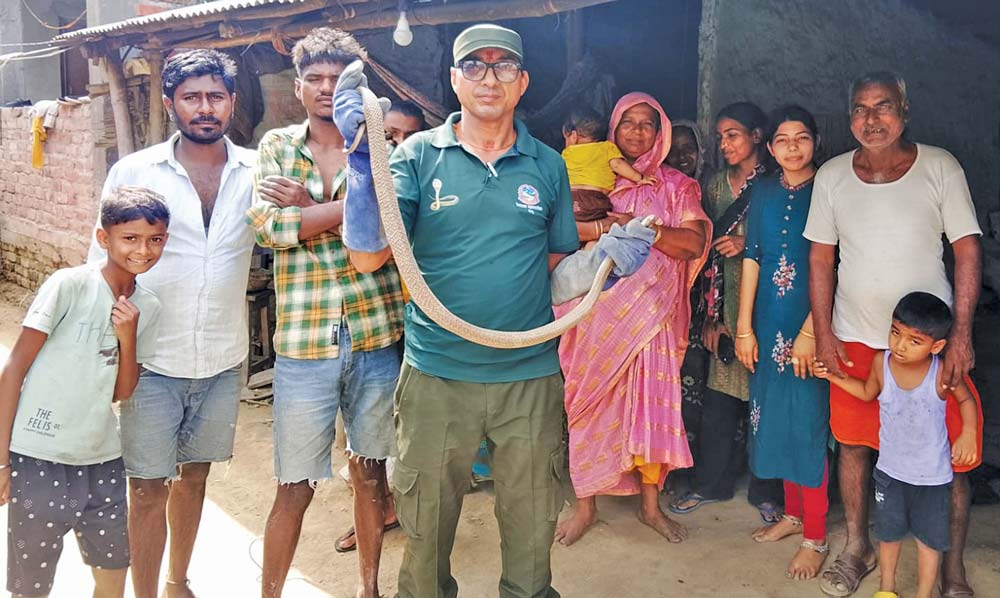
Biratnagar, June 1 : When the city of Biratnagar falls asleep at night, Shambhu Ghimire rarely does. While most residents rest safely in their beds, the municipal police assistant inspector remains on alert, ready for a call that could come at any hour, often from a terrified voice reporting, “Sir, please help, there is a snake in my bed!”
For the past three years, Ghimire has become the unofficial lifeline between dangerous reptiles and frightened citizens. Working under Biratnagar Metropolitan City, he has dedicated himself to snake rescue operations that now define both his professional duty and personal sacrifice.
“I cannot sleep after the phone rings,” he says. “I think there might be children, elderly people, or entire families in danger. I just rush out.”
In a city where snake sightings inside homes were once treated with panic or killed out of fear, awareness has gradually shifted toward safe rescue. As that awareness has grown, so too has Ghimire’s responsibility.
According to municipal records, he has rescued around 890 snakes in the past two years alone, and a total of nearly 890 to date since starting his intensified rescue work in 2023. From densely populated urban wards to nearby rural settlements in areas of Morang District, his work has expanded beyond Biratnagar itself, reaching communities such as Katahari, Budhiganga, Barju, Gramthan, Jahada, and Duhabi.
Ward No. 4 of Biratnagar alone accounts for more than 110 rescues, making it one of the most frequent hotspots for snake intrusions. In many cases, snakes are found hiding in unexpected places, such as kitchens, beds, wardrobes, washing machines, air conditioners, or even toilets.
For Ghimire, no place is unusual anymore. “We have pulled snakes out of rice containers, prayer rooms, and even toilet bowls,” he explains.
His encounters include highly venomous species such as cobras, kraits, and pythons. One of the most dangerous moments of his career came when he faced a monocled spitting cobra inside a private residence linked to a public figure. During the rescue attempt, the snake spat venom directly at him, causing injury that required 28 hours of hospital monitoring.
Despite such incidents, he continues his work without hesitation.
Over time, his efforts have had a measurable impact. Earlier, Biratnagar reported 20–30 deaths annually due to snakebites. In recent years, that number has dropped significantly, with no reported fatalities in the current year.
Authorities attribute part of this decline to faster response times, increased awareness, and safe relocation of snakes instead of killing them.
Yet, despite the life-saving nature of his job, Ghimire receives no special hazard allowance or additional benefits beyond his regular salary. His tools remain basic—some protective gear provided by the city and a snake container from the Division Forest Office.
All rescued snakes are later released into forested areas of northern Morang, including the dense Charkose Jhadi. While some raise concerns about ecological balance, Ghimire notes that natural predators help regulate populations.
Beyond rescue work, Ghimire also focuses heavily on awareness. He repeatedly urges residents not to rely on traditional healers after snakebites. “Do not waste time with superstition. Go directly to the hospital,” he says, emphasising simple precautions like cleanliness around homes, sleeping under mosquito nets, and checking shoes before wearing them.
In a city that sleeps while danger quietly moves through its walls, Shambhu Ghimire remains awake, guarding lives not with weapons, but with courage, patience, and an extraordinary commitment to saving even the most feared creatures.